
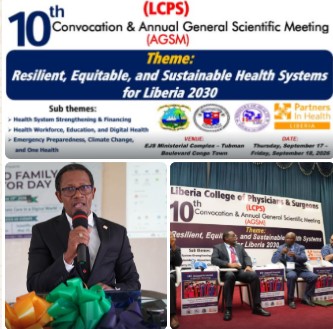
At 10th Annual General Scientific Meeting Of Liberia College of Physicians And Surgeons
By: Alfred Kollie
MONROVIA, Liberia— The President of the Regional Council for Health Professionals Education at the West African Health Organization (WAHO), Professor Angnon A. Koffi Balogou has called for stronger national efforts to transform Liberia’s health sector from recovery to resilience and sustainability by 2030.
Prof. Balogou made the call in his keynote speech at the 10th Annual General Scientific Meeting of the Liberia College of Physicians and Surgeons, held in Monrovia under the theme, “From Recovery to Resilience: Advancing Equitable, Sustainable, and Innovative Health Systems for Liberia 2030.”
He said Liberia’s history of civil conflict, the Ebola outbreak, COVID-19 and other public health emergencies demonstrates the urgent need for a health system capable of preparing for and responding effectively to future crises while maintaining essential healthcare services.
According to Prof. Balogou, health resilience should go beyond rebuilding after emergencies. He called for stronger health institutions, reliable referral systems, emergency-ready facilities, trained multidisciplinary health teams, community-based healthcare systems and improved national preparedness.
Need for greater equality
The WAHO official also emphasized the importance of equity in healthcare delivery, urging greater attention to women and girls, children, persons with disabilities and other vulnerable populations.
He said barriers associated with poverty, geographical distance, gender and social vulnerability should not determine whether an individual has access to safe and quality healthcare.
Prof. Balogou stressed that building a resilient health system requires ensuring that healthcare services reach communities that are often underserved, particularly those in rural and hard-to-reach areas.
Sustainable healthcare financing
On sustainability, Prof. Balogou called for predictable health financing, transparent procurement systems, proper maintenance of health infrastructure and the retention of qualified health professionals.
He also encouraged the responsible use of technology and other health resources while drawing attention to environmental considerations, including energy, water, waste management and laboratory safety.
He outlined five key commitments that could help advance Liberia’s health sector: strengthening district health systems; improving the licensing, deployment and retention of health professionals; linking accreditation with clinical audits and patient safety; using reliable data to strengthen accountability; and promoting sustainable management of financing, infrastructure, medical supplies and partnerships.
Prof. Mulbah highliting College’s 10th Scientific Meeting
Providing an overview of the program, Prof. John Mulbah emphasized the importance of Liberia’s transition from recovery to resilience and ultimately sustainability in building a stronger health system by 2030.
Prof. Mulbah said the College’s 10th Annual General Scientific Meeting provides an important platform for doctors, researchers and other health professionals to exchange knowledge, examine emerging health challenges and identify practical approaches to improving healthcare delivery.
He recalled that the College’s first scientific meeting was held at Monrovia City Hall, with then-Vice President Joseph Nyuma Boakai serving as keynote speaker.
According to Prof. Mulbah, this year’s gathering places particular emphasis on equity and sustainability, with the broader objective of advancing comprehensive healthcare for Liberians by 2030.
Dr. Maxo Luma stresses resilience and national ownership
Meanwhile, the Executive Director of Partners In Health, Dr. Maxo Luma, said Liberia has repeatedly demonstrated its ability to recover from major crises, including civil war, Ebola and COVID-19.
However, Dr. Luma cautioned that recovery alone is insufficient, arguing that the country must focus on building systems capable of withstanding future shocks.
He noted that disasters can become more severe when sudden emergencies encounter longstanding weaknesses in health infrastructure, staffing, financing and institutions.
Reflecting on the 2014 Ebola outbreak, Dr. Luma said the crisis demonstrated how weaknesses within a health system can magnify the impact of an emergency.
He nevertheless pointed to progress made since Ebola, including improvements in disease surveillance, community health programs, workforce development, public health institutions, innovation and technology.
Dr. Luma described resilience as the ability of a health system to absorb shocks, adapt, learn from crises and continue providing essential services.
He identified Community Health Assistants as an important component of Liberia’s health resilience because of their role in bringing healthcare services and disease surveillance closer to communities.
Sustainability as international funding declines
Dr. Luma also stressed the importance of national ownership and sustainable financing, particularly as international health funding faces increasing pressure.
He acknowledged the continuing importance of external assistance but said Liberia must increase domestic investment in healthcare, train and retain qualified health professionals, strengthen primary healthcare and build institutions capable of sustaining essential services beyond individual donor-funded projects.
Using the Partners In Health 5-S framework—Staff, Stuff, Space, Systems and Social Support, Dr. Luma argued that building resilience requires investment across the entire health system rather than focusing on individual components.
He further placed equity at the center of Liberia’s health agenda, calling for improved healthcare access in rural communities, fair distribution of health workers, reliable availability of medicines, stronger referral systems and reduced financial barriers for underserved populations.
A vision for Liberia’s health sector by 2030
The discussions at the 10th Annual General Scientific Meeting advanced a vision of a Liberian health system that is resilient, equitable, sustainable, innovative, digitally enabled, climate-aware, community-centered and locally led by 2030.
Prof. Balogou urged government, healthcare professionals, educators, researchers, development partners and communities to work together to achieve this vision.
He said the ultimate measure of progress should be Liberia’s ability to withstand future emergencies without losing hard-won gains while continuing to provide safe, quality and equitable healthcare to all Liberians.
The Liberia College of Physicians and Surgeons’ 10th Convocation and Annual General Scientific Meeting brought together medical professionals, researchers and other health-sector stakeholders in Monrovia to deliberate on strategies for strengthening Liberia’s healthcare system and advancing quality, equitable and sustainable healthcare delivery.