
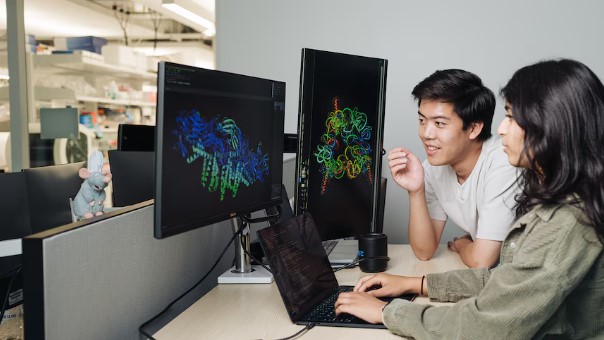
Researchers Brian Hie and Aditi Merchant examine a protein structure generated by their Evo 2 AI model. (Stanford University: Andrew Brodhead)
World’s first AI-designed viruses a step towards AI-generated life
Scientists used artificial intelligence to write coherent viral genomes, using them to synthesize bacteriophages capable of killing resistant strains of bacteria.
SOURCE: World’s first AI-designed viruses a step towards AI-generated life | Nature
The banner headline in the journal, Nature has captured the attention of this news outlet, thus prompting the lifting of this groundbreaking story widely published by international news agencies. One of several published below:
Source: ABC NEWS
Stanford researchers create viruses not found in nature using genomes designed by artificial intelligence
-
By Andrew Thorpe
-
Topic:Medical Ethics
In short:
Researchers from Stanford University have synthesised brand-new, self-replicating viruses using genomes designed by artificial intelligence for the first time.
The viruses, designed by AI models trained on genetic code from other viruses as well as more complex organisms, were able to replicate inside E. coli bacteria, demonstrating their viability.
What’s next?
The breakthrough could potentially lead to significant medical advances but has also raised concerns the technology could be misused to create powerful bioweapons.
US researchers have for the first time successfully synthesised brand-new viruses not found in nature, based on designs generated by artificial intelligence.
The researchers’ paper, published in the journal Science on Thursday, details how scientists from Stanford University and the Arc Institute, a California-based non-profit dedicated to “high-risk, high-reward” research, were able to create the viruses using DNA sequences generated by two “genome language models” named Evo 1 and Evo 2.
Genome language models operate in a broadly similar way to large language models (LLMs) except that they predict genetic code instead of written text, having been trained on the genomes of other viruses and bacteria, as well as more complex organisms such as plants and animals.
The two models in question were told to generate complete genomes for a viable bacteriophage — a type of virus able to infect and replicate itself inside bacteria, destroying them from the inside.
Using an existing bacteriophage as an example — ΦX174 (pronounced “fie-ex-1-7-4”), known for its ability to infect and destroy E. coli bacteria — the models generated about 700,000 potential designs, of which the researchers picked 285 that looked most promising.
The researchers then synthesised new DNA molecules using those designs and inserted them into E. coli bacteria, before waiting to see if viable bacteriophages would emerge.
Shortly afterwards, 16 of the Petri dishes in which the bacteria were growing began to show clear spots, as the viruses began to attack and replicate themselves inside the E. coli, demonstrating their viability.
Some of those viable viruses proved more effective at attacking E. coli than the original ΦX174 bacteriophage.
AI learns to write genetic code
The paper’s eight authors, led by PhD candidate Samuel H King, emphasised in their conclusion that the significance of their research lay not in the characteristics of the viruses they created, but in the demonstration of their AI models’ ability to design viable, entirely new biological entities with predetermined characteristics.
The difficulty lies in being able to speak the language of genetic code with a high degree of specificity; a small amount of missing or jumbled code — even a single nucleotide base pair in the wrong place — can destroy the viability of an entire organism.
“In this case, we wanted the model to generate the entire genome end-to-end in a single left-to-right pass. We didn’t add anything,” said Dr Brian Hie, an assistant professor and one of the study’s authors.
While the ΦX174 bacteriophage genome is relatively simple, containing about 5,400 nucleotide base pairs (compared to the 3.1–3.2 billion in the human genome), the Stanford researchers’ technique could theoretically lead to the design of far more complex organisms, including living beings, as the models become better at predicting the code for desired traits.
In the nearer term, the technology could still lead to significant medical breakthroughs.
Targeted “phage therapy” has long been posited as a potential solution to antibiotic-resistant bacteria, while the ability to design custom enzymes for replacement therapy would be a game changer in treating certain genetic disorders.
However, the revelation that AI models are now able to design entirely new biological entities from scratch has led to understandable concern among some in the scientific community, who raise the possibility that the technology could be misused to create powerful bioweapons.
“Although this is promising for life sciences applications, it also raises urgent biosafety and biosecurity questions,”
Professor Thomas Inglesby and Dr Moritz Hanke said.
The pair, who work at Johns Hopkins University’s Center for Health Security in Baltimore, were not involved in the Stanford research, but provided an accompanying commentary in Science.
“The ability to compose viral genomes using generative AI now exists; the governance to safely steer it does not,” they said.
‘Disconnect’ between safeguards and science
The Stanford researchers took a number of safety precautions while carrying out their experiment, such as excluding viruses that could infect humans and animals from their models’ training data, carrying out their experiment in a secure lab, and selecting the ΦX174 bacteriophage for their models to emulate because it can only attack E. coli.
But while Dr Hanke praised the team for taking those precautions, he also pointed out there was no requirement for them to do so and no guarantee future users of the technology would be as careful.
There is currently a “huge disconnect” between the pace of science and the pace of accompanying regulations, he told The New York Times.
The Stanford researchers have also made Evo 2 freely available to the public, suggesting the risk to the public is offset by the benefit of “having tools like Evo 2 to address existing natural pathogens”.
News of the breakthrough comes just days after multiple AI firms reported their own “agentic” AI models had hacked into systems belonging to external companies during safety testing, including one instance in which an OpenAI model exploited a zero-day vulnerability in its testing environment to gain access to the internet.
Another model used a series of fake identities in an attempt to trick a human into injecting malicious code into an open-source project.
The reports have prompted calls from tech industry observers — as well as more than 1,000 employees of top AI companies — to slow the pace of the technology’s development until safeguards are able to catch up.