
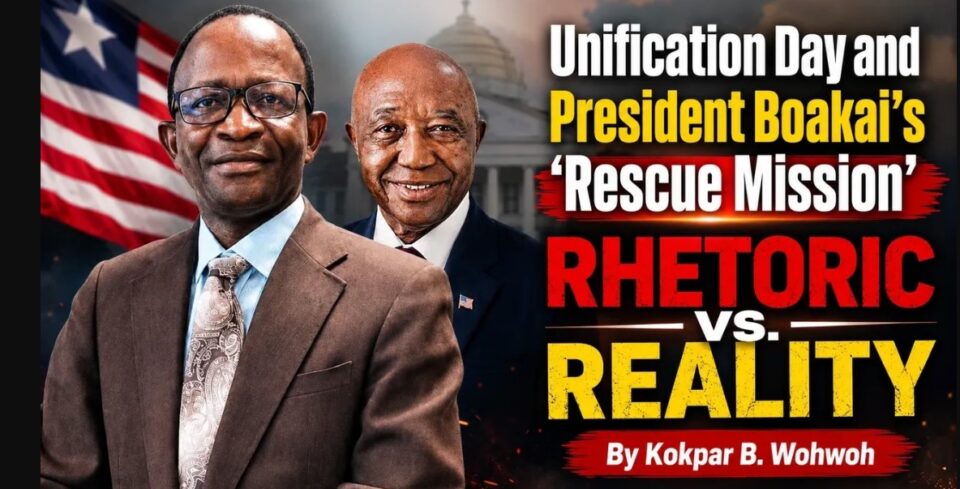
By Kokpa B. Wohwoh
Is unification at the heart of Boakai’s Rescue Mission?
Yes, rhetorically. The Boakai administration frames “unification” as central to its ARREST Agenda and Rescue Mission. In his 2024 and 2025 Unification Day proclamations, Boakai tied the holiday to “national healing” and said Liberia must embrace the ideals of the Unification Act to promote unity after years of civil strife. During the 2025 House leadership crisis, he used May 14 to encourage newly elected Speaker Richard Nagbe Koon to reach across the aisle, and he described the House’s peaceful resolution as exemplifying “the very spirit of National Unification Day.” He also made goodwill calls to Sirleaf, Weah, and opposition leaders as “our own way of forging the spirit of unification and inclusion.” His government created July 5, 2025 as “National Healing, Reconciliation and Unity Day” to rebury Tolbert and Doe and honor war, Ebola, and COVID victims. So on paper, unification is positioned as the moral engine of the Rescue Mission.
How is it being translated when major institutions are tested?
This is where the gap between proclamation and practice emerges, and critics point to four stress tests:
STRESS TEST 1: SUPREMACY BATTLES AND THE SUPREME COURT
The 2025 House leadership crisis became a constitutional test. Both the “Majority Bloc” and Speaker Koffa’s camp claimed legitimacy, and the Supreme Court’s rulings were publicly debated and, at times, sidestepped by political actors. Boakai’s recognition of the House’s peaceful resolution on Unification Day was seen by supporters as de-escalation, but by critics as avoiding meaningful enforcement of court decisions. When the highest court’s authority is questioned during political standoffs, the “rule of law” part of unification gets strained.
STRESS TEST 2: NEPOTISM AND THE “POWER THAT BE”
A recurring critique of Liberian governments, including Boakai’s, is the appointment of family, allies, and partisans to key posts. Opposition voices and civil society groups argue that when jobs and contracts flow through personal networks, it undercuts the Unification Act’s promise of “equal opportunities for all, regardless of tribe or clan.” To many Liberians, unification without equitable access looks like consolidation, not integration.
STRESS TEST 3: TRIBALISM AS A POLITICAL TOOL
Despite Tubman’s policy and Boakai’s rhetoric, county-of-origin and ethnic identity still shape voting, appointments, and resource allocation. When tribal loyalty is rewarded over merit, it turns what should be a beacon for diversity into what critics call an “enemy of progress.” The 2026 Unification Day Dialogue was designed partly to confront this, with organizers stressing that lasting reconciliation needs collective ownership, not sectional wins.
STRESS TEST 4: POLITICS OVERTAKING RECONCILIATION
True reconciliation requires accountability. The War and Economic Crimes Court debate is now linked to Unification Day events. Supporters say Boakai’s backing shows commitment. Critics argue that when political survival drives which cases move forward and which are shelved, “reconciliation” becomes a slogan. The July 5 reburials of Tolbert and Doe were praised as healing by some, dismissed as “political theater” by others.
“Unification is not a static event; it is an active, persistent dialogue.” — NUD 2026 Co-Presider
Bottom Line: Translation is incomplete
Boakai has put unification language at the heart of the Rescue Mission and attached it to concrete actions: reburials, court dialogues, crisis mediation. That is more than document-only commemoration.
But when constitutional rulings are contested, when appointments look nepotistic, when tribalism influences policy, and when politics shapes reconciliation, the public sees contradiction. As one Unification Day co-presider said: “Unification is not a static event; it is an active, persistent dialogue.”
So is unification driving the Rescue Mission? In speeches and some initiatives, yes. In daily governance, Liberians are still testing whether the spirit of May 14 survives May 15. The day does not unify by itself. Rule of law, merit, and inclusive economics do.