
By J. Yekeh F Kwaytah
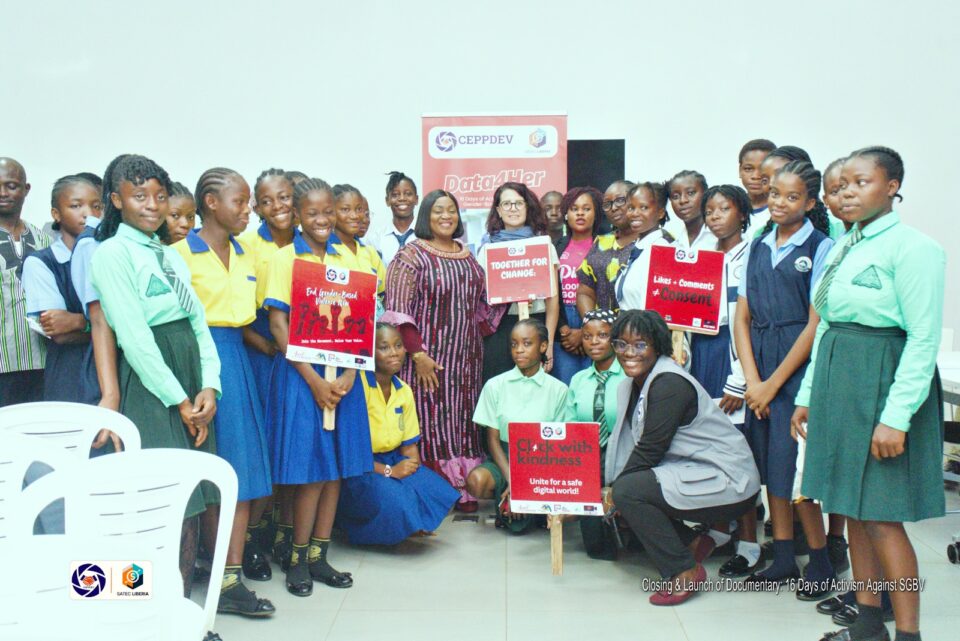
PAYNESVILLE, Liberia– In a resounding display of unity and national resolve, CEPPDEV Liberia, SATEC Liberia, women’s rights groups, community leaders, government representatives, and hundreds of citizens have met here to climax this year’s 16 Days of Activism Against Gender-Based Violence
Joined by former Liberian Vice President, Jewel Howard-Taylor, they set the stage for one of the country’s most powerful calls yet to end violence against women and girls.
Former Vice President Howard-Taylor, one of Liberia’s most enduring champions for women’s empowerment, delivered a commanding message that framed the national mood: Liberia cannot develop while half of its population lives in fear.
Her reflections, drawn from a comprehensive interview during the ceremony, echoed across the gathering as a call to conscience and collective action.
Responding to what the 16 Days of Activism means to her, Madam Taylor stated:
“For me, these 16 days are not symbolic they are a national mirror. They remind us of the lives lost, the futures stolen, and the dreams shattered by violence. At this moment in Liberia’s history, we must decide whether we continue tolerating abuse or we rise to protect our daughters.”
She shared that her lifelong commitment to women’s rights stems from witnessing the systemic inequalities that leave women economically vulnerable, socially silenced, and politically sidelined.
Madam Taylor described Liberia’s situation as “a struggle between progress and persistent threats.”
While awareness is increasing, she noted that violence remains widespread, driven by weak enforcement, stigma, and harmful traditional norms.
“The biggest barriers are silence, impunity, and economic powerlessness. Until we confront these directly, women and girls will continue to suffer.”
Reflecting on her years in national leadership, she highlighted efforts such as strengthening the SGBV Taskforce, expanding support services, and championing legal reforms but emphasized that more must be done.
“Our justice system must stop re-victimizing survivors. Police must respond with urgency, not excuses. Courts must prioritize SGBV cases. And the government must allocate real resources not symbolic allocations to protect women.”
Madam Taylor noted that deep-rooted norms continue to threaten progress.
“Communities must speak out. Traditional and religious leaders must reject harmful practices. Influencers both young and old must use their voices. Change begins where silence ends.”
With Liberia’s young population, she urged specific focus on boys and young men:
“Violence prevention must start in our homes, churches, mosques, and schools. We must teach respect, not dominance. Equality, not entitlement.”
The former Liberian Vice President commended CEPPDEV and SATEC for their innovation and consistency:
“CEPPDEV and its partners are doing what many institutions fail to do they are keeping the country awake. Their work is courageous, necessary, and transformative.”
She encouraged civil society to remain steadfast:
“Do not grow weary. Your voices are saving lives.”
Her warning was unambiguous:
“If you harm a woman or a girl, you are harming the nation. And sooner rather than later, justice will catch up with you.”
“If we are to end violence within a decade, we must begin today by refusing complacency. Every home, every community, and every institution must take responsibility.”
To victims and survivors, she offered reassurance:
“You are not alone. Speak out. Seek help. Your pain is valid, and your voice matters.”
At the ceremony, CEPPDEV Liberia delivered a powerful and uncompromising declaration, reaffirming its commitment to transparency, accountability, and gender-responsive budgeting.
Team Lead Abraham Varney called for the immediate reactivation of the Fiscal Transparency and Advisory Group (FTAG), emphasizing its crucial role in ensuring inclusive national fiscal governance.
“The Ministry of Gender must provide an itemized breakdown of the $300,000 allocated for the SGBV Support Strengthening Program. No more lump sums. No more ambiguity. Accountability begins with transparency.”
Varney condemned the December 3rd incident where persons with disabilities were teargassed at the Ministerial Complex:
“This act was inhumane and unacceptable. We call on President Joseph N. Boakai to launch a prompt, impartial investigation. The budget must protect the vulnerable not silence them.”
CEPPDEV also unveiled its simplified gender-focused analysis of the 2026 budget, designed to help citizens and policymakers track how funding impacts women and girls.
“We will continue producing tools that empower citizens. We will not relent until Liberia’s budget reflects equity, justice, and humanity.”
Speaking at the closing ceremony, SATEC Liberia Team Lead John McCauley Jr. highlighted the transformative role of audiovisual storytelling in exposing injustice and driving public engagement.
“Our AV4Dev model shows that stories are not just narratives they are tools of accountability. They shape national dialogue. They reveal gaps. They demand change.”
According to him, SATEC and CEPPDEV’s partnership produced a documentary that:
* Exposes realities in communities
* Amplifies women’s voices
* Strengthens civic oversight
* Challenges institutions to do better
“As we conclude these 16 days, let this be clear: transparency needs information, accountability needs visibility, and change needs voices loud and unbroken.”
McCauley reaffirmed SATEC’s long-term commitment:
“No story of injustice will go unheard. Not on our watch.”
The gathering in Paynesville was not just an event, it was a powerful demonstration of national resolve.
With voices like Jewel Howard-Taylor, CEPPDEV, SATEC, advocates, and communities rising together, Liberia is confronting one of its most urgent human rights challenges with unprecedented determination.
The message from the 16 Days of Activism is clear, uncompromising, and resonant:
Liberia will not progress while its women bleed.
The time to act boldly, transparently, and decisively is now.