
Why Is Boakai Gov’t Insisting On Surrendering Transport Ministry’s Statutory Functions To A Foreign Company?
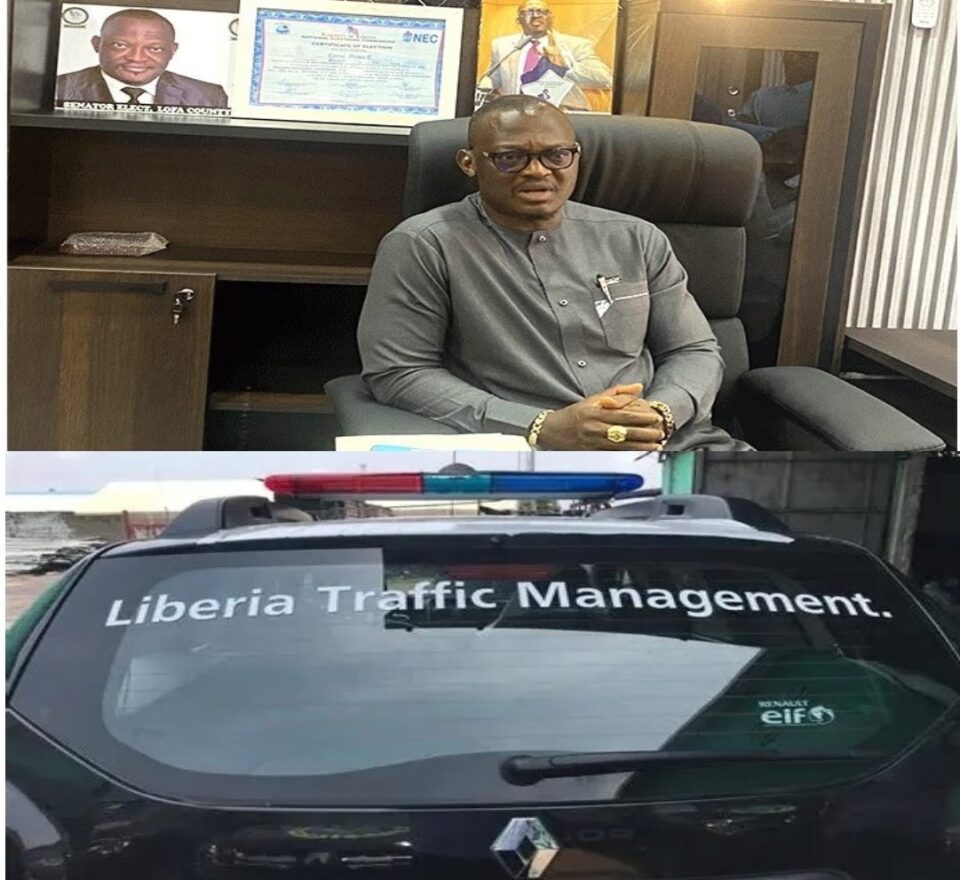
PHOTO: Sen. Momo Cyrus, Chair of the Senate Defense and National Security Committee, LTM Police vehicle below
By Our Staff Writer
What has been lingering on as a serious imbroglio over the Boakai government’s insistence on outsourcing Liberia’s vehicle registration and driver licensing to a foreign company—Liberia Traffic Management Services (LTML)—has apparently reached its head, with the Executive Mansion announcing that LTM will virtually take full charge of the Transport Ministry’s statutory function starting March 1 this year.
The takeover of the Transport Ministry’s functions, the Executive Mansion says, will exclude the Inspectorate division.
But the Chairman of the Senate Defense and National Security Committee, Lofa County Senator Momo Cyrus is again warning that such a move will have serious national security implications/threats in addition to fiscal loss to the country.
“This decision raises serious governance, fiscal, and national security questions at a time when Liberia’s internal security environment is becoming increasingly complex. Beyond administrative implications, the action reflects a troubling departure from established statutory order and introduces vulnerabilities into critical state systems that are central to public safety, identity management, and internal security coordination,” Sen. Cyrus said in a press statement issued yesterday, Monday, February 16, 2026.
Earlier, other Liberian lawmakers had opposed the LTM deal, describing it as “bogus” not in the country’s national interest.
In fact, the Legislature last year took a decision to freeze the LTM’s operation in the field issuing drivers’ licensing and vehicle registration, but despite the decision the LTM was operating parallel with the Transport Ministry.
The outsourcing by the Executive has also come under serious criticisms from some quarters in President Boakai’s ruling Unity Party (UP).
Back in January last year, former Deputy Minister for Administration at the Transport Ministry, J. Ebenezer Kolliegbo in the first UP government of former President Ellen Johnson Sirleaf sharply criticized the Liberian government’s decision to delegate vehicle registration and driver’s license issuance to the Liberia Traffic Management (LTM), a foreign-controlled company.
The transfer, scheduled to take effect this month, was recently confirmed by a public statement from the Liberia National Police.
“These tasks have been traditionally and legally the responsibility of the Ministry of Transport. The lack of transparency surrounding the shift suggests something deeper—and more troubling—may be at play,” Mr. Kolliegbo stated. Ex-Deputy Min. In Ellen Regime Backs Sen. Momo Cyrus’s Opposition To Outsourcing Liberia Traffic Management Services – News Public Trust
BELOW IS SEN. MOMO CYRUS’ LATEST WARNING THE LATEST DECISION ANNOUNCED BY THE EXECUTIVE MANSION ON THE LTM DEAL:
PRESS RELEASE
FOR IMMEDIATE RELEASE
Senate Defense and Security Committee Chair Raises Grave Governance, Revenue, and National Security Concerns Over Outsourcing of Vehicle Registration and Driver Licensing
Monrovia, Liberia
February 16, 2026
The Chairman of the Senate Committee on Defense, Security, Intelligence, and Veterans Affairs, Lofa County Senator Momo Tarnuekollie Cyrus, issues a formal statement expressing deep concern over the Government of Liberia’s decision to transfer vehicle registration and driver licensing functions from the statutorily mandated Ministry of Transport to Liberia Traffic Management, a foreign-controlled operator.
This decision raises serious governance, fiscal, and national security questions at a time when Liberia’s internal security environment is becoming increasingly complex. Beyond administrative implications, the action reflects a troubling departure from established statutory order and introduces vulnerabilities into critical state systems that are central to public safety, identity management, and internal security coordination.
Vehicle registration and driver licensing are not routine commercial services. They constitute a core sovereign function tied directly to national security, law enforcement intelligence, population movement tracking, and inter-agency coordination. These systems house sensitive personal, biometric, and vehicular data that must remain under direct state control, governed by clear accountability mechanisms and subjected to parliamentary oversight. Any fragmentation or externalization of such systems weakens the integrity of the national security architecture.
Recent security assessments underscore the urgency of this concern. Liberia, long regarded as one of the most peaceful states within the Mano River Basin, is now confronting emerging transnational threats, including cyber-enabled financial crimes, illicit telecommunications activities, and the presence of opaque private networks operating across borders. Preliminary intelligence briefings from national security institutions point to the exploitation of digital infrastructure for large-scale financial crimes, the misuse of telecommunications assets, and the concealment of encrypted data linked to international criminal syndicates operating across West Africa, Europe, Asia, and North America.
Of particular concern is the growing evidence that Liberia’s telecommunications and digital systems are being targeted by unscrupulous international actors using front businesses and sophisticated cyber tools to launder money, manipulate data, and obscure illicit networks. These developments significantly heighten the risk profile of outsourcing any function that intersects with national identity systems, vehicle movement records, or law enforcement databases to entities beyond direct sovereign control.
From an institutional standpoint, bypassing the Ministry of Transport undermines statutory clarity and erodes the coherence of the state. The Ministry is legally established to carry out these functions, and its displacement without comprehensive reform, legislative approval, or transparent justification sets a dangerous precedent. It signals institutional fragility and weakens public confidence in the rule of law.
The economic structure of the concession further compounds these concerns. Under the current arrangement, the foreign operator reportedly retains a disproportionate share of revenues generated from vehicle registration, driver licensing, and related services. The absence of clear revenue guarantees, growth-linked escalation clauses, or robust fiscal safeguards exposes the state to revenue leakage and constrains its capacity to reinvest in transport safety, institutional strengthening, and security infrastructure. At a time of fiscal pressure, such an arrangement undermines domestic revenue mobilization rather than enhancing it.
The human and institutional costs are equally troubling. Reports that more than two hundred Liberian professionals have been displaced as a result of this transfer point to a hollowing out of local technical capacity. Sustainable reform should strengthen national institutions and build domestic expertise, not substitute them with external operators in sensitive sectors.
The Committee is mindful of arguments suggesting that reviewing or suspending such contracts could send negative signals to investors. While the importance of investment confidence is fully acknowledged, no responsible state can subordinate its sovereign security interests to commercial convenience. A secure, well-governed, and law-abiding state is the strongest foundation for sustainable investment. Liberia’s attractiveness to credible investors is enhanced, not diminished, when contracts are lawful, institutions are respected, and core security functions remain firmly under sovereign control. National security and sovereignty cannot be compromised to preserve arrangements that expose the state to long-term strategic risk.
Taken together, these developments raise profound concerns about sovereignty, accountability, and state resilience. The issue is not opposition to private sector participation in public service delivery, but a principled objection to the privatization of a core security-linked function that, by its nature, must remain under direct state authority, particularly in an evolving regional and global threat environment.
In light of these concerns, the Senate Committee calls for the immediate suspension of the implementation of this arrangement and the commencement of a comprehensive legislative and security review. Such a review must examine the legal basis of the transfer, the fiscal terms of the concession, the security implications for national data systems, and the broader impact on institutional integrity, employment, and public trust.
The Committee respectfully urges the President of the Republic, Joseph Nyuma Boakai, to reconsider this decision in the overriding interest of national security, sound governance, and economic fairness. A deliberate reassessment will reaffirm Liberia’s commitment to safeguarding sovereign functions, strengthening statutory institutions, and providing a stable, lawful, and secure environment for legitimate investment.