
Story by thedailydigest.com
- 2h
Africa will ultimately divide into two©The Daily Digest
Scientific research indicates that Africa is gradually breaking apart, with a massive rift slowly but inexorably splitting this vast continent into two regions, which will eventually be divided by the emergence of a new ocean between them.
Two tectonic plates and the East African Rift©The Daily Digest
National Geographic reports that data from GPS stations reveal that this breakup is occurring along the East African Rift, a boundary that separates the Nubian plate—comprising most of Africa—from the Somali plate, which includes the eastern edge and the Horn of Africa.
A slow yet inevitable process©The Daily Digest
This separation, however, will not take place in the near future but will unfold over millions of years, according to multiple studies highlighted in Newsweek. The current rate of divergence is about 6.35 millimeters per year.
The Great Rift Valley©The Daily Digest
The Great Rift Valley, which aligns with the East African Rift, is a vast fault system visible today as a deep, elongated valley below sea level. Spanning approximately 3,500 kilometers in its African stretch, it extends from the Afar Triple Junction—where the Nubian and Somali plates meet the Arabian plate—to Mozambique.
The area where Africa is splitting apart©The Daily Digest
The Great Rift Valley marks the boundary where, millions of years from now, Africa will eventually break, and the Somali plate will form an independent landmass. National Geographic describes this as the location where the continent is “splitting in two.”
The separation process©The Daily Digest
Geology offers a clear explanation for this phenomenon. As the tectonic plates move and stretch the Earth’s crust, the rocks crack, allowing magma beneath to rise, cool, and solidify, forming new crust that will eventually become ocean floor.
Seawater will begin to flood the valley©The Daily Digest
Accordingly, Popular Mechanics reports that the Afar region of Ethiopia, where the three plates converge, has a thin crust and several areas below sea level. Scientists affirm that it will continue to subside, eventually allowing seawater to flow in.
The third arm still above water©The Daily Digest
Two branches of the East African Rift are already submerged: the Red Sea and the Gulf of Aden. Both connect through the Rift Valley in the Afar region, which is where seawater will gradually enter, ultimately giving rise to a new ocean that will divide the continent.
Faster progression in the north©The Daily Digest
The initial separation of the continent begins in the north for scientific reasons: in this region, the plates are moving apart at a relatively higher rate than in other sections, as geophysicist Sarah Stamps of Virginia Tech told Popular Mechanics
Fissures reveal the ongoing process©The Daily Digest
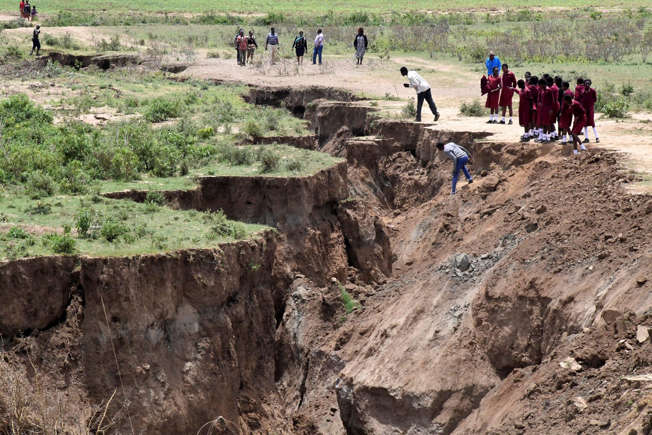
The appearance of large cracks in the region illustrates what is occurring. In 2005, a 60-kilometer-long fissure formed after a series of earthquakes and a volcanic eruption in the Afar desert, and in 2018, another crack disrupted a highway southwest of Kenya.
The process began thousands of years ago©The Daily Digest
This phenomenon is not recent. Geologists estimate that it began 25 to 30 million years ago in what is now northern Ethiopia, where the crust started to stretch and thin, eventually giving rise to valleys, lakes, and volcanoes.
Weakening of the Earth’s crust©The Daily Digest
Experts suggest that beneath the Afar region lies a vast column of magma, which pushes towards the surface through rhythmic pulses—what studies cited in Nature Geoscience have called a “geological heartbeat.” Heat weakens the already fragile crust, facilitating its fracture and plate motion.
Radical environmental shift: From lush land to desert©The Daily Digest
Beyond pure geology, other factors are at play, notably desertification. Over the past 5,000 years, East Africa has transformed from a verdant landscape during the African Humid Period to a desert.
Lack of water influences plate movement©The Daily Digest
How does this relate to Africa’s continental rifting? According to Popular Mechanics, water scarcity directly impacts fault movement, as large bodies of water, such as lakes, exert pressure that slows tectonic activity.
Climate does influence the process©The Daily Digest
“Climate can affect where deformation occurs and may influence the style of rifting (such as magmatic versus purely tectonic deformation) as continental rifts develop,” said Christopher Scholz, geologist, physicist, and professor at Columbia University.
Lake Turkana (Kenya)©The Daily Digest
Lake Turkana in Kenya, stretching 250 kilometers in length and 30 kilometers across, with a maximum depth of 120 meters, exemplifies this. Despite its vastness, its size has continually diminished over time, as confirmed by various studies.
Increase in tectonic separation rate©The Daily Digest
Scholz told Popular Mechanics that there is a direct link between water loss and accelerated rifting in this lake, with the annual tectonic separation rate increasing by 3% over the past 5,000 years.
First quantitative evidence©The Daily Digest
“This is the first quantitative evidence linking time-averaged fault slip rates to climate-driven lake level changes in the East African Rift System, by measuring how fault slip rates changed as Lake Turkana shifted from high to low levels at the end of the African Humid Period,” according to another study published in Nature.
More volcanic and tectonic activity©The Daily Digest
In addition to showing that fault expansion accelerated with water loss, Scholz also identified increased volcanic activity at South Island Volcano in Lake Turkana, with more molten rock filling its magma chamber, thereby intensifying tectonic movements along the fault.
Short-term implications for human life©The Daily Digest
While the visible splitting of the continent is a long-term process, scientists, as noted by Popular Mechanics, warn that there are current implications for human populations, including heightened risks of earthquakes and volcanic activity.
Never miss a story! Click here to follow The Daily Digest.