
Claims Poor Rule Of Law In Letter To ECOWAS, UN, EU, US Gov’t
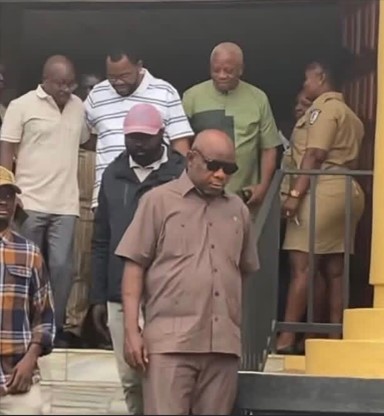
FLASHBACK: Ex-Minister Tweah at the Temple of Justice during his corruption trial
By Our Staff Writer
Monrovia- Former Liberian Finance Minister, Samuel D. Tweah, Jr., who has been facing trial with others in a US$6.2 million corruption case at the Criminal Court C, has written letters to the international community claiming that he is being subjected to “political persecution” by the ruling Unity Party government.
His recent letter is addressed to the sub-regional grouping ECOWAS, the United Nations, the African Union, the European Union, the United States Government, and multilateral institutions including the World Bank, the IMF, and the African Development Bank.
Mr. Tweah urged them to end what he calls a “deafening silence” and to engage the Boakai government directly over the deterioration of the rule of law.
“If no other juror could complain of jury misconduct immediately after the verdict, the jury forewoman should have complained,” Tweah writes, noting that the forewoman — who voted guilty on all charges — was herself in court when Judge Feika instructed him and Cooper to “go home as free men.”
He warned that a government which interprets the political opposition’s restraint — born of respect for the trauma of Liberia’s civil wars — as a license to intensify its abuses is misreading a situation whose mismanagement carries potentially catastrophic consequences for national stability.
“Prevention is cheaper than resolution,” Tweah writes
On May 8, 2026, Jurors at Criminal Court “C” handed down a not guilty verdict acquitting Tweah and several former senior officials of the gravest charges in the major case prosecuted by the government over the past months.
The criminal court in May launched an investigation into the alleged jury misconduct or tampering in Tweah and four other former CDC government officials.
In his letter to the international community, the former Finance Minister said:
“As Finance Minister, I oversaw financial transactions totaling over $3 billion for six years,” he writes, adding archly: “Maybe the Government intends to invite me for questioning on all these approvals. There is no clearer and better evidence of witch-hunt anywhere the world over.”
Criminal Court C Judge Ousman Feika’s decision was based on a complaint filed by three of the fifteen-man panel jurors, alleging that some of their colleagues were involved in jury tampering, which led to the acquittal verdict of defendants Tweah and Moses Cooper. But two other defendants were found guilty by the Jury.
Former Minister Tweah’s letter to the international community alleged that having been acquitted before twelve of his countrymen, that government was not prepared to accept his freedom by the not guilty verdict and was pursuing another route, something he vowed to resist openly and at whatever personal cost.
But the government of President Joseph Boakai has repeatedly said that it is committed to adhering to the tenets of the rule of law and upholding judicial independence.