
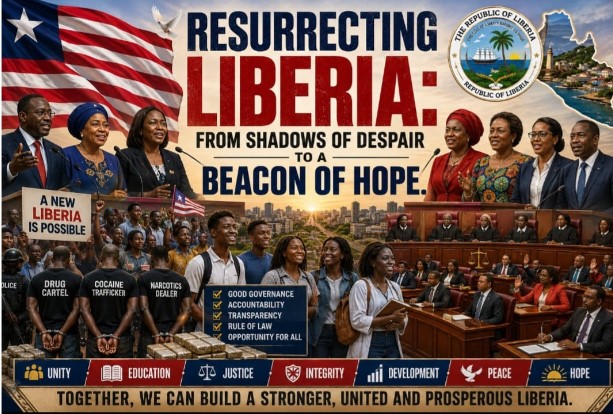
“Deeds and actions, not only words or rhetorical statements.”-Austin S. Fallah
By Austin S. Fallah – A True Son of the Planet Earth Soil: fallahas@yahoo.com
President Joseph Nyuma Boakai (August 6 2026, at the Swearing-in and Induction of Judges at the Executive Mansion): “To those who seek to bring illegal drugs into Liberia to destroy the lives of our young people, let them hear me today. To those who believe Liberia can be used as a transit point for international trafficking, to those who believe that their position, influence, wealth, or authority place them beyond the reach of justice, open your ears and hear me today. We will identify you. We will pursue you. We will find you, and we will deal with you in accordance with the law.”
President Joseph Nyuma Boakai has characterized illicit drug trafficking and substance abuse as an existential threat to Liberia’s survival and an aggressive attack on the nation’s future, framing the national crusade around the sentiment of resurrecting Liberia from the shadows of despair into a renewed beacon of hope.
President Joseph Nyuma Boakai: Honorable Legislators, drug abuse, especially the use of Kush, is a substantial threat to the existence of this country.” (From his inaugural address/State of the Nation address formally declaring a public health emergency)
President Joseph Nyuma Boakai: On Zero Tolerance and Accountability: “Liberia will not lose another generation to drugs — not on my watch.”
President Joseph Nyuma Boakai: “Non-Selective Enforcement: “The fight against drugs will be non-selective and relentless… no status, no title, no uniform, and no connection will protect anyone involved in drugs.”
Patriotic Obligation Over Partisan Politics: “The fight against narcotics trafficking is not a partisan contest. It is a patriotic obligation that belongs to every Liberian, regardless of political color. A criminal enterprise now threatens our national security, corrodes our youth, hollows out our public institutions, and endangers the future of this Republic.” (Editorial commentary reflecting national consensus in Liberian media).
On the Transition from Despair to Action: Civil society and institutional watchdogs emphasize that turning the tide against substance abuse requires moving past historical apathy: “This national emergency demands more than words — it demands bold, sustained and irreversible actions” to rescue the country’s marginalized youth from informal ghetto shelters and restore the nation’s integrity.
Liberia has long stood as a symbol of resilience and hope amidst adversity.
From the ashes of civil war to the challenges posed by the pervasive drug crisis, the nation finds itself in a struggle to redefine its identity and future.
The words etched in the hearts of the Liberian people resonate with anguish, urgency, and a call for justice: “Those who continue to bring hardship upon the Liberian people must understand that death will be a kindness to them.”
This sentiment, while emotionally charged, captures the frustration of a nation that has endured unimaginable suffering.
To move forward, Liberians must confront the historical injustices that have plagued their nation and take a collective stand against the destructive forces threatening its youth and future.
Understanding the Historical Context:
To comprehend the current challenges facing Liberia, Liberians must revisit its history.
The country emerged from a painful civil war that claimed the lives of over 250,000 individuals, leaving deep scars that continue to affect its society and millions of dollars worth of property damaged.
The consequences of that era are not merely historical footnotes; they live on in the struggles of present-day Liberians.
The war disrupted families, decimated infrastructure, and stripped away the hope of generations.
Following this tumultuous period, the emergence of drug trafficking, drug cartels, and addiction presented a new battle.
Vulnerable and disenfranchised, many of Liberia’s youth find themselves ensnared in a web of substance abuse, perpetuating a cycle of despair.
The drug trade operates as a parasite on the already fragile societal fabric, offering a short-lived escape for those who have seen their hopes dashed time and again.
It is crucial to recognize that the roots of this crisis lie not merely in individual choices but also in systemic failures.
Political instability, inadequate education, and economic deprivation have facilitated the spread of drugs, transforming Liberia from a place of promise to one rife with peril.
The Moral Responsibility to Act:
As we navigate these challenging waters, we must confront the moral implications of our collective silence in the face of these realities.
The Nigerian-born writer Chimamanda Ngozi Adichie poignantly stated, “The danger of a single story is that it creates stereotypes.”
In Liberia, the single narrative of poverty and violence oversimplifies a complex reality and perpetuates fatalism.
Instead of resorting to vengeance or resignation, we must channel our outrage into action.
Those who perpetuate the cycle of addiction and despair bear a heavy moral burden.
The statement that “death will be a kindness” reflects a deeper emotional truth: the suffering inflicted upon innocent lives merits not just retribution, but a reckoning.
While many may argue that justice can only be served through legal means, there is also a profound emotional and human imperative that demands accountability for the heinous acts committed against the Liberian people.
Yet, to seek retribution alone risks perpetuating the cycle of violence and hatred.
True justice must encompass healing, understanding, and constructive change.
Empowering the Youth:
At the heart of Liberia’s resurgence lies its youth.
The future of any nation rests upon the aspirations and actions of its younger generation, and the Liberian youth, once seen as unsuspecting victims of civil conflict, must emerge as champions of democracy and agents of change.
The potential of Liberia’s young people to rise above adversity must be recognized and nurtured.
With the right support, education, and guidance, they can transform the narrative surrounding their nation.
Programs dedicated to education, mental health, and workforce development are critical components to empower young Liberians.
The introduction of robust educational initiatives can rekindle the ambition that once characterized the nation’s youth.
An educated population can critically engage with their government, participate meaningfully in societal development, and ultimately contribute to a stable democracy.
Substance abuse prevention programs tailored specifically for younger audiences can also help mitigate the hold of drugs.
By offering alternatives, support, and opportunities, Liberians can foster resilience in a population that deserves an untainted chance to thrive.
Moreover, it is vital to engage youth positively, respectfully, and constructively in political processes.
Encouraging positive civic involvement and constructive representation allows young Liberians to actively participate in shaping their nation’s trajectory.
Through positive, not hooliganism, youth activism, they can constructively engage with a demand for accountability, advocate for reform, and work towards a drug-free society.
This, in turn, cultivates a sense of ownership and responsibility toward their future, which is essential for nation-building.
Restoring Liberia’s Identity and Purpose:
To heal from the wounds of the past and navigate toward a promising future, Liberia must also reclaim its identity and purpose.
Once considered a beacon of hope for freedom and democracy, Liberia can restore its status on the global stage.
As the country endeavors to rebuild, it must embrace its legacy of resilience and generosity.
The phrase “Liberia was the Umbrella during the rain; Liberia was the coat during the cold” poignantly emphasizes the nation’s role as a sanctuary in times of need.
A recommitment to international cooperation and partnership can pave the way for Liberia’s resurgence as a significant player in regional and global affairs.
The international community must take supportive, actionable steps to support Liberia’s fight against drug trafficking and addiction.
Collaborative efforts can offer resources, expertise, and funding to bolster educational institutions and recovery programs.
Initiatives that promote ethical investment can also be vital in encouraging economic growth while averting the pitfalls of corruption common in post-conflict nations.
Cultivating a Culture of Hope and Resiliency:
Reinforcing a culture of hope and resilience within Liberia is essential to overcoming both past and present challenges.
This involves not only building infrastructure and institutions but also fostering a national psyche engaged in healing and progress.
Empowering this mindset begins with dialogue that acknowledges the traumas of the past while focusing forward.
Grassroots initiatives, community-building projects, and shared stories of overcoming adversity can redefine what it means to be a Liberian; this could be done through the (a) national reconciliation commission.
In this journey, storytelling assumes a salient role.
Narrative and art serve as powerful mediums to express grief, resilience, and hope.
They document the struggles faced and underscore the triumphs of ordinary Liberians.
Such expressions forge connections among communities and ignite a collective spirit willing to uplift one another.
The healing power of art and storytelling can serve as catalysts for positive change, creating an environment where the past informs the future without imprisoning individuals in cycles of despair.
A Call to Action:
As Liberians stand at the crossroads of history, they must act decisively to safeguard the future of Liberia.
The pain inflicted upon the nation and its people must galvanize us toward collective action rather than vengeance.
Liberians must turn the tide on those who seek to destroy their communities through violence, addiction, and exploitation. Together, Liberians can redefine the narrative.
It is time for Liberia to shine again, to emerge as a beacon of hope for young people everywhere, demonstrating that even in the face of adversity, change is possible.
The country has the potential to reclaim its mantle as the “breadbasket that feeds many around the world.”
By nurturing the youth and constructing a unified society rooted in democracy, learning, and understanding, Liberia can rise anew.
The incendiary hope that once ignited the future of a nation must be kindled once more, not just for the sake of the living, but as a tribute to those lost amidst the turmoil.
With perseverance, compassion, and accountability, Liberia can redeem itself and become a flourishing testament to resilience on the global stage.