
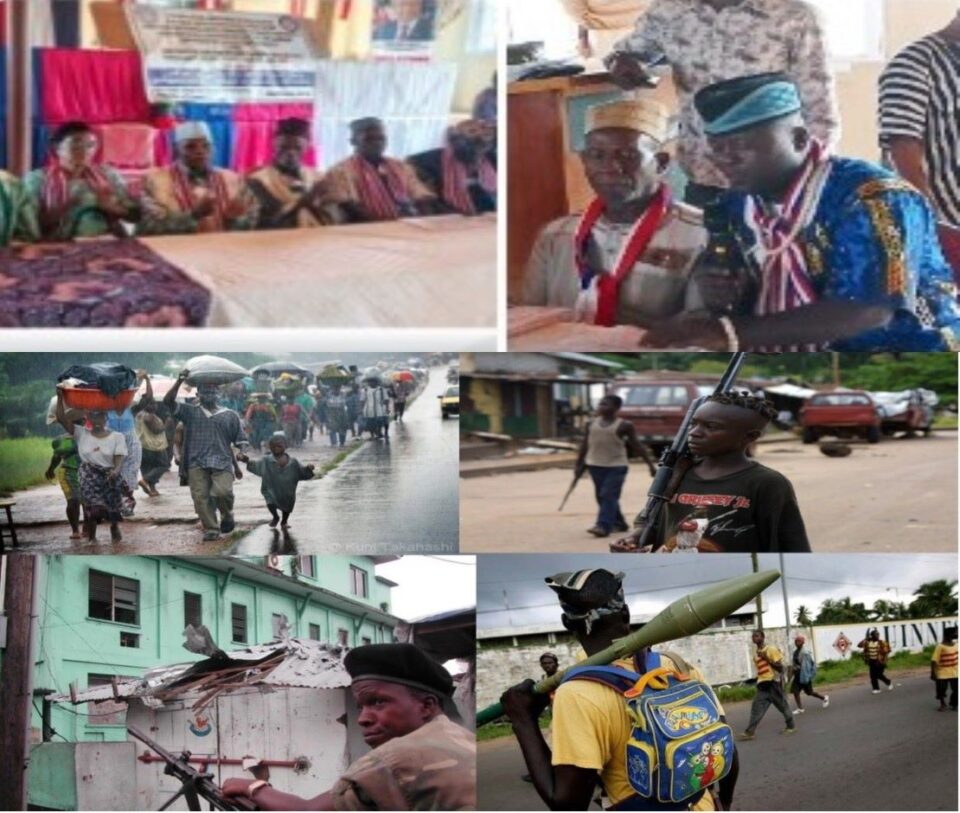
PHOTO: (above) Governors Council wants war & Anti-corruption courts (below) images of Liberian civil war
By Gabriel M C Parker
TUBMANBURG, Liberia–The National Council of Governors of Liberia has officially endorsed the establishment of the War and Economic Crimes Court (WECC) and the National Anti-Corruption Court (NACC) for Liberia, following a high-level national dialogue held here in the western Bomi County.
The endorsement came at the end of a two-day engagement held from March 5 to 6, 2026, organized by the Office for the Establishment of the War and Economic Crimes Court for Liberia in collaboration with the Local Government Ministry. Liberia’s 14-year-brutal civil war, which officially ended in August 2003, caused the deaths of about 250,000 people, according to United Nations estimate.
In its conclusion, the Truth and Reconciliation Commission (TRC) report released in 2009 said:
- “All factions to the Liberian conflict are responsible for abuses, including war crimes and crimes against humanity.
- The massive wave of gross violations and atrocities assumed a systematic pattern of abuse.
- All factions committed gender based violence against women and recruited children to participate in acts of violence.
- “External state actors in Africa, North America and Europe participated, supported, aided, abetted, conspired and instigated violence, war and regime change for political, economic and foreign policy advantages and gains (Consolidated Final Report, Vol. II, p. 18).”
The TRC report therefore, recommended the establishment of a war and economic crimes court for Liberia. TRC report.pdf
This week’s dialogue in Bomi County was held under the theme “Understanding the WECC and NECC Draft Laws, Empowering Governors to Educate the People.” The meeting brought together governors representing various ethnic groups across Liberia to discuss the proposed legal framework for the courts.
Reading the official endorsement statement on behalf of the council was Abel Carr, Governor representing the Krahn ethnic group.
In the statement issued on Friday, March 6, 2026, the governors congratulated the Liberian Legislature for passing Joint Resolution No. 001/2024, which laid the groundwork for establishing the two courts.
The council also commended Joseph Boakai, President, for approving the resolution and demonstrating leadership in the effort to establish mechanisms for justice and accountability.
Additionally, the governors praised the President for issuing Executive Order No. 131 on May 2, 2024, which created the Office for the Establishment of the War and Economic Crimes Court, and later issuing Executive Order No. 148 to replace the earlier order.
The statement further recognized the Government of Liberia for providing financial support to the office responsible for the court’s establishment, while also thanking the international community and civil society organizations for their continued assistance.
The council acknowledged that the nationwide consultations conducted by the office helped increase awareness and encouraged collaboration with local leaders across the country.
The governors said the two-day dialogue in Tubmanburg provided them with deeper insight into the draft laws intended to establish the War and Economic Crimes Court and the National Anti-Corruption Court.
According to the statement, the discussions allowed the governors to make further contributions to the proposed legislation and gain the necessary knowledge to educate citizens in their respective communities.
“With the dialogue exposing us fully to the contents of the two draft laws and allowing us to make further inputs, we acknowledge that we have gained the capacity and knowledge to educate our people,” the statement declared.
The governors concluded by pledging their commitment to support the process, stating, “We voluntarily commit to work fully with the Office for the Establishment of the War and Economic Crimes Court and confirm that we agree with and accept these draft laws for submission to His Excellency President Joseph Nyuma Boakai, Sr., for onward submission to the Honorable Liberian Legislature.”