
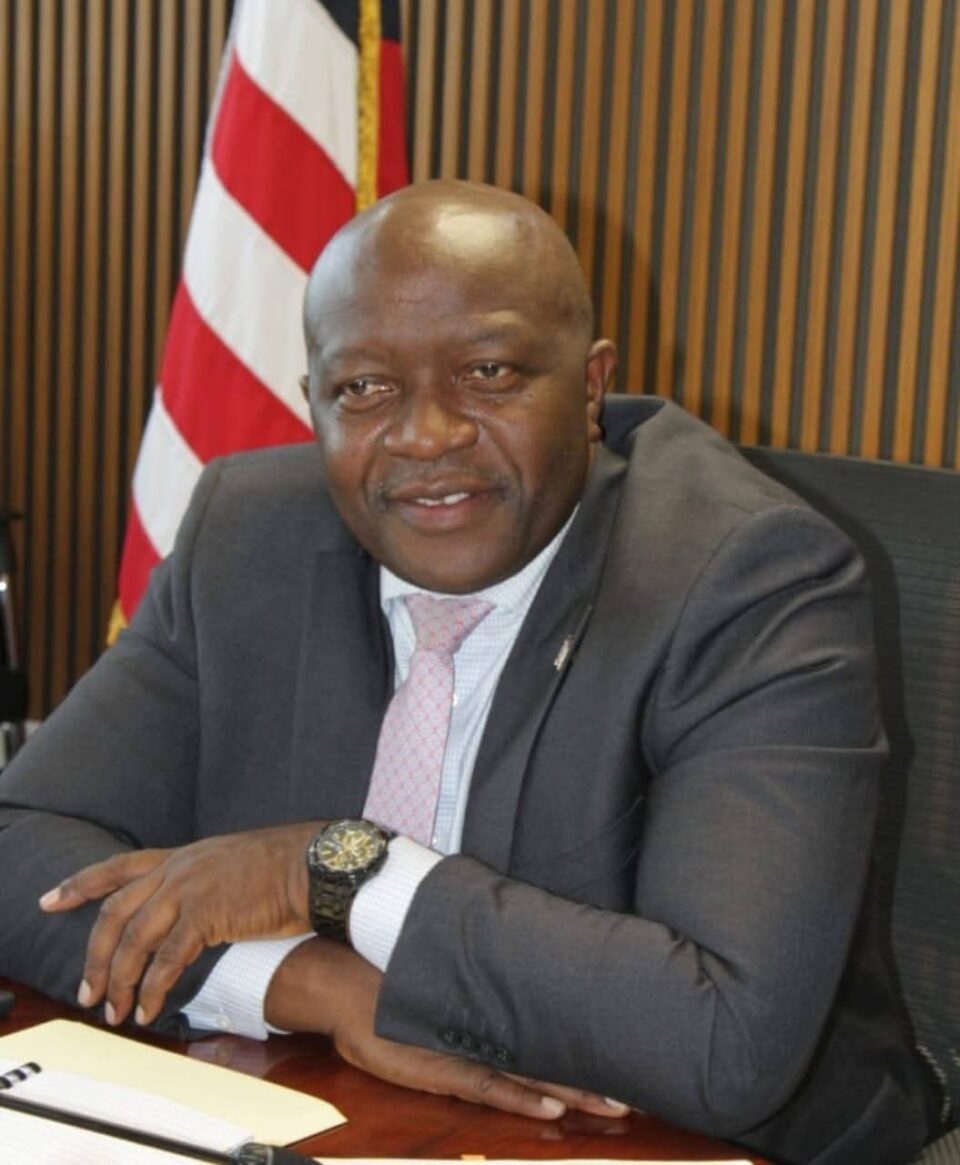
PHOTO: Augustine Kpehe Ngafuan, Minister of Finance and Development Planning
By Nicholas D. Nimley
“Beyond Turbulence: Discipline, Reform, and the Recalibration of Liberia’s Economic Future”
Amid global uncertainty and the turbulence surrounding shifting international support, Liberia’s economic leadership is charting a deliberate and disciplined course. Under President Joseph Nyuma Boakai’s leadership, with Augustine Kpehe Ngafuan at the helm of the Ministry of Finance and Development Planning, the country’s economic trajectory reflects not just motion but direction, purpose, and resilience.
The metaphor of a high-speed flight is fitting. Liberia’s economy is not merely moving; it is advancing with intent aimed not at short-term political milestones, but at long-term structural stability capable of withstanding external shocks. Interestingly, this approach underscores a fundamental truth: sustainable economic management requires foresight, discipline, and the courage to make difficult decisions.
Ngafuan’s leadership has been defined by action rather than rhetoric. His policy choices reflect a willingness to take the “road less traveled,” echoing Robert Frost’s timeless observation that meaningful difference often lies in unconventional decisions.
Rather than maintaining past practices that delayed or distorted fiscal balance, Ngafuan opted for early intervention introducing austerity measures to stabilize the economy in anticipation of uncertainty.
This was not an easy path. Managing an import-dependent economy in a volatile global environment demands more than technical competence; it requires strategic clarity and relentless execution.
Within the Ministry, this commitment has translated into a culture of intensified work and accountability. Extended working hours and late-night policy sessions have become routine, reflecting a shared understanding that national stability outweighs institutional comfort.
The results are tangible. Liberia has witnessed a marked improvement in salary payment consistency, enhanced debt compliance, and stronger fiscal discipline. These gains represent a clear departure from a past characterized by delays, liquidity constraints, and uncertainty in public financial management.
One of the most notable milestones under Ngafuan’s tenure is the presentation of Liberia’s largest national budget in history, theUS$1.249 billion in 2026.
This represents a nearly 70 percent increase from the 2018 budget of US$738 million, signaling both economic expansion and improved revenue mobilization.
Growth projections remain encouraging, with the economy expected to expand by over 5 percent, driven by mining, agriculture, and infrastructure investment, while inflation has stabilized after years of volatility.
Equally significant is the push toward digital transformation. The introduction of the Electronic Document Management System (EDMS) marks a critical step in modernizing public financial administration.
Digitizing records and streamlining processes is essential, as the system reduces bureaucratic delays, strengthens transparency, and enhances accountability key pillars for building public trust and investor confidence.
On the international stage, Ngafuan has effectively articulated Liberia’s progress and ambitions. Presenting the country’s 2026 Voluntary National Review at the United Nations, he emphasized that Liberia is not merely reporting achievements but actively accelerating progress toward the Sustainable Development Goals.
Central to this effort is the ARREST Agenda for Inclusive Development (2025–2029), a comprehensive roadmap aligned with 83 percent of the SDGs and structured around critical sectors such as agriculture, infrastructure, education, and governance.
The data supports this narrative of progress. Economic growth remains steady, inflation has declined to manageable levels, and poverty rates have fallen.
Human development indicators are also improving, with Liberia achieving its highest post-conflict Human Development Index score.
Access to clean water, electricity, and sanitation continues to expand, while infrastructure development—including road construction and digital connectivity—advances at a measurable pace.
Social sectors are also benefiting. Maternal health outcomes are improving, disease surveillance systems have strengthened, and educational access is expanding through technical and vocational programs. Financial inclusion has surged, driven by the rapid growth of mobile money services, opening new economic opportunities for millions of Liberians.
These achievements, however, have not come without challenges. Liberia continues to navigate significant external pressures, including reductions in international assistance, global commodity price shocks, rising debt obligations, and increasing climate vulnerability. These factors place considerable strain on public resources and underscore the importance of domestic resilience.
Yet the response has not been retreating, but ownership. The government is intensifying domestic revenue mobilization through improved tax administration and digital systems, expanding technical education, and advancing climate adaptation strategies.
Importantly, these efforts are being pursued inclusively, with strong participation from civil society, women, youth, and marginalized groups.
Looking ahead, Liberia’s commitments are clear: accelerate inclusive growth, expand renewable energy, deepen digital governance, strengthen institutions, and ensure that development leaves no one behind. These are not abstract ambitions but actionable priorities grounded in measurable progress.
In this broader context, Ngafuan’s presence in government is not incidental; it is consequential. His leadership represents a blend of technical expertise, strategic vision, and disciplined execution at a time when such qualities are indispensable.
In crossing uncertainty while maintaining forward momentum, he embodies a model of governance that prioritizes results, resilience, and long-term national interest.
Ultimately, the significance of Ngafuan’s role lies not just in the policies he implements, but in the stability and confidence those policies inspire. In a world of shifting economic winds, Liberia’s course appears steadier and that, in itself, makes all the difference.
About the Author:
Nicholas Dweh Nimley is a Liberian writer, journalist, and university lecturer. He’s also a socio-and development economist with degrees in economic development, journalism and communication and a doctoral researcher in global communications. He can be contacted using +231776-586-433/886-582-830, or email: nimleynicholasd@gmail.com