
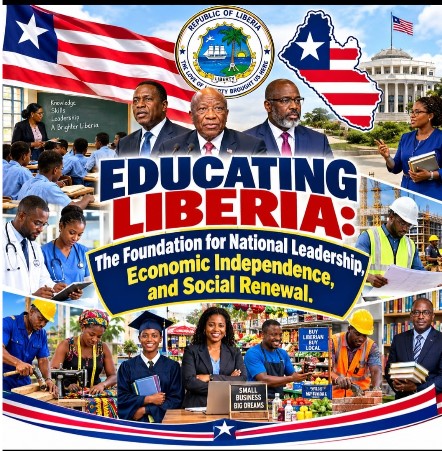
Economic Independence And Social Renewal
By: Austin .S Fallah – A True Son of the Planet Earth Soil: fallahas@yahoo.com
https://www.facebook.com/share/r/1JsWuPtN1N/
https://www.facebook.com/share/r/1DFybEX9Rc/
https://www.facebook.com/share/r/19fF7WR4JJ/
https://www.facebook.com/share/r/1CH3J2AhRP/
“Educating Liberia is not merely an investment in schools; it is an investment in the knowledge, skills, leadership, productivity, civic responsibility, and economic independence necessary to build a self-reliant nation.”
President Nyuma Boakai: “We must begin to rethink and retool how we address the challenges of our educational system in ways that best serve our developmental needs.”
President Boakai made this statement in his January 22, 2024, Inaugural address, linking education reform to vocational training, science education, workforce development, productivity, employment, and Liberia’s ability to compete globally.
Former President of Liberia George Manneh Weah: “There is a definite link between a well- educated citizenry and economic growth.”
In remarks on education and human-capital development, former President Weah linked quality education to sustained economic growth and emphasized investment in Liberia’s human capital.
Former President of South Africa Nelson Mandela — “Education is the most powerful weapon we can use to change the world.”
This famous statement by former President Mandela has been reproduced in an official United Nations address and in a 2026 address by South African President Cyril Ramaphosa.
It captures the connection between education, individual capacity, social transformation, and national development.
Plato — Ancient Greece: “Education, I said, and nurture: If our citizens are well educated, and grow into sensible men, they will easily see their way through these, as well as other matters.”
This quote comes from Plato’s Republic and directly connects citizens’ education with a society’s ability to adapt to 21st-century affairs.
Technologies are advancing rapidly. Training has been central to Singapore’s progress, while its SkillsFuture system emphasizes lifelong learning, skills upgrading, and a highly skilled workforce.
Political slogans, imported expertise, or endless arguments over personalities will not secure Liberia’s future.
It will be secured by systematically educating and training Liberians in every field needed to build, manage, and sustain a modern economy.
From academic disciplines and information technology to marketing, tailoring, construction, agriculture, accounting, nursing, doctors, engineering, manufacturing, entrepreneurship, and handyperson repairs, Liberia must invest in its people.
A nation that trains its citizens well creates opportunities for individuals, strengthens communities, improves public institutions, and builds an economy less dependent on outsiders.
The central question is simple: Who should lead Liberia’s economy?
Should the nation continue to rely heavily on foreign nationals to serve as supervisors, managers, chief financial officers, chief executive officers, chief operating officers, engineers, consultants, and technical specialists? Or should Liberia build a highly qualified workforce capable of leading every sector?
The answer should be clear. Foreign investment and international cooperation can be valuable, but they should complement, not replace, the development of Liberian talent.
Liberia cannot claim true economic independence if its most important businesses, institutions, and industries are managed primarily by non-Liberians because Liberians have not been adequately prepared to lead.
A skilled and educated workforce is not a luxury.
It is the essential infrastructure of a prosperous nation.
Paved roads, ports, electricity, buildings, and telecommunications systems matter, but none can function effectively without competent people to plan, operate, maintain, regulate, and improve them.
A modern hospital requires trained doctors, nurses, nursing assistants, pharmacists, laboratory technicians, accountants, administrators, and maintenance workers, not those confused, unintelligent, and insulting spewing small, small made foot soldiers parading in intellectual circles as having the professional expertise to liberate the masses from the dungeons of social and economic degradation.
A successful bank requires economists, financial analysts, compliance officers, auditors, cybersecurity professionals, customer-service representatives(tellers), and executives, not the plenty good-for-nothing spewing propagandists.
A construction company requires architects, engineers, surveyors, electricians, plumbers, welders, masons, project managers, and procurement, not the socalled being to school but learned nothing.
Every area of national life depends on knowledge, discipline, and practical skill.
For too long, public debate in Liberia has been dominated by unproductive, empty rhetoric that has not helped the downtrodden.
Plenty of people can make promises, repeat political talking points, or spew propaganda.
Yet speeches alone do not build an economy.
It is not built on fake political slogans, empty chants, or a society denied access to quality education and vocational training.
Citizens build it by solving problems, meeting deadlines, maintaining professional standards, balancing budgets, developing products, marketing services, repairing equipment, and creating jobs.
Liberia needs fewer theatrical displays of political loyalty and more serious conversations about competence.
This does not mean politics is unimportant, but good governance matters deeply.
However, politics without capacity becomes a dangerous form of performance.
It may exasperate citizens, especially young people who are searching for meaningful work and a sense of direction.
When leaders make grand promises but fail to invest in schools, technical institutes, teacher training, business development, and modern infrastructure, they create disappointment and distrust.
Citizens become frustrated because they see opportunities passing them by while others benefit from positions for which Liberians could have been prepared.
The solution begins with a national commitment to education at every level.
Liberia must strengthen early childhood education, primary schools, secondary schools, universities, community colleges, and vocational institutions.
Children must learn to read, write, calculate, think critically, and communicate effectively.
High schools must prepare students for both higher education and employment.
Universities must produce graduates with relevant knowledge in business, public administration, agriculture, law, medicine, engineering, computer science, economics, environmental studies, and education.
At the same time, vocational and technical programs must be treated with equal dignity.
Not every student will become a lawyer, professor, or corporate executive, and they shouldn’t have to.
A country needs skilled technicians as much as it needs scholars.
Liberia must train electricians who can safely wire homes and businesses, mechanics who can repair vehicles and industrial equipment, plumbers who can install reliable sanitation systems, carpenters who can build durable structures, solar technicians who can support renewable energy, tailors who can stitch and design fabrics, and computer technicians who can maintain digital systems.
Handyman repairs may sound ordinary, but they are fundamental to daily life and economic activity.
A broken generator, damaged water pipe, malfunctioning refrigerator, or failed electrical connection can disrupt a household, school, clinic, small business, or factory. Practical skills create dignity, income, and resilience.
Marketing and entrepreneurship also deserve greater attention.
Many Liberians have ideas, products, talents, and ambitions, but they may lack the training to transform those assets into sustainable businesses.
A farmer may grow high-quality crops but lose income because of poor packaging, weak transportation, limited market information, or an inability to negotiate fair prices.
A tailor may have exceptional skill but lack branding, digital payment systems, customer-service training, and access to broader markets.
A young technology innovator may develop a useful application but struggle to find investors or understand intellectual-property protections.
Training in marketing, accounting, business planning, supply-chain management, customer relations, and digital commerce can help ordinary citizens create enterprises that employ others.
Technology must be at the center of Liberia’s workforce strategy.
The global economy is increasingly digital, and countries that fail to prepare their young people for technological change will be left behind.
In the 21st century and beyond, technologies such as AI are advancing rapidly, and only the well-prepared will meet the demands.
Liberian students should have access to computer literacy, coding, data analysis, cybersecurity, graphic design, digital marketing, online research, and artificial intelligence tools.
These skills are not only for large corporations. They can help farmers track crop prices, help small businesses reach customers, help schools access educational materials, help hospitals manage records, and help government agencies deliver services more efficiently.
Technology can vivify a national development agenda by making information, opportunity, and innovation more accessible to citizens across the country.
Liberia can learn important lessons from Singapore, a country that transformed itself from a small, resource-limited society into a globally respected economic center.
Singapore’s success was not accidental. It resulted from deliberate investments in education, workforce development, public institutions, infrastructure, discipline, and long-term planning.
The country made human capital a national priority.
It recognized that natural resources alone do not guarantee prosperity.
A nation’s greatest resource is its people, especially when they are educated, healthy, organized, and held to highgh standards.
Liberia should not blindly imitate Singapore because every country has its own history, geography, culture, and challenges.
Nevertheless, Liberia can adopt the principle that national progress requires serious, enforceable standards.
Laws should not exist merely on paper. They must be applied fairly and consistently.
Corruption, fraud, abuse of public funds,drugs trafficking, drug cartelism, reckless disregard for public safety must carry real consequences.
Businesses should be able to operate under clear rules. Workers should know that merit, productivity, and integrity are rewarded.
Investors should trust that contracts will be respected and disputes addressed through credible institutions.
Stringent and enforceable laws are not enemies of freedom.
When applied justly, they protect citizens from exploitation and create confidence in the future.
A market vendor needs protection from extortion.
A student needs protection from unsafe schools and predatory practices.
A business owner needs protection from arbitrary regulations and dishonest competitors.
An employee needs protection from wage theft and discrimination.
A community needs protection from environmental destruction and public corruption.
The rule of law creates the stability in which education, investment, and innovation can flourish.
At the same time, Liberia must avoid the mumpsimus of maintaining outdated assumptions simply because they have been repeated for generations.
One such assumption is that political connections matter more than qualifications.
Another is that vocational work is inferior to office work.
Another is that young people should be used as campaign foot soldiers rather than developed as future professionals, entrepreneurs, scientists, and leaders.
These beliefs keep citizens dependent and discourage excellence.
A young person with energy and ambition should not be reduced to chanting empty-headed slogans for politicians.
That young person should be learning a trade, completing a degree, building a business, mastering a technology, or participating in civic life with knowledge and independence.
The country must also reject the culture of personal attacks.
Disagreement is natural in a democracy, but it should be based on facts, policies, and evidence.
Too often, public discourse descends into insults, rumors, and churlish behavior.
Some individuals act as political quockerwodgers, moving only when manipulated by others and repeating claims they have not verified.
Others become lickspittles, praising powerful figures not because those figures are right, but because they seek personal advantage.
Liberia needs citizens who can think independently, ask difficult questions, examine evidence, and hold all leaders accountable.
This is not an attack on ordinary people who have lacked educational opportunities.
On the contrary, it is an argument for giving every Liberian a genuine chance to succeed.
The problem is not that citizens are incapable; the problem is that too many have been denied the schools, training, resources, and mentorship needed to develop their full potential.
Calling people “you are a tribalist,” does not build a nation.
Humiliating or insulting people with different opinions do not create jobs.
Meaningful national progress requires investment, discipline, and respect.
It requires replacing despair with opportunity and replacing manipulation with civic education.
Liberia must be especially vigilant against snallygosters, self-serving political actors who use public language while pursuing private interests.
Such leaders may encourage division because division makes citizens easier to control.
They may prefer an uninformed electorate because informed citizens demand results.
They may foster dependency because dependent people are easier to influence.
But a trained workforce changes the balance of power.
Educated workers can understand contracts, question unfair practices, start businesses, organize professionally, and compete for leadership positions.
They are less vulnerable to deception and less likely to accept excuses from those in authority.
Workforce development can also reduce recidivism by creating pathways for citizens who have been involved in crime, incarceration, or social exclusion.
People who leave prison or struggle with unemployment should have access to literacy programs, counseling, vocational training, apprenticeships, and opportunities for reintegration.
A society that provides no path toward lawful employment should not be surprised when desperation leads some people back into harmful behavior.
Job training is therefore not only an economic policy; it is also a public safety policy and a human-dignity policy.
The responsibility for this transformation must be shared.
Government must invest responsibly in schools, teachers, technical institutes, broadband access, electricity, and scholarships.
Businesses must offer internships, apprenticeships, and entry-level opportunities for Liberian workers.
Universities must align programs with labor-market needs.
Positive civil society organizations must promote civic education and transparency.
Parents and communities must encourage discipline, reading, attendance,writing acceptable E
Liberians living abroad, particularly the well-learned, well-schooled, inlellectually capable, can contribute through mentorship, investment, professional exchanges, and partnerships.
International partners should support local capacity-building rather than creating permanent dependence on foreign consultants.
Ultimately, Liberia’s liberation will not come from rhetoric; it will come from competence.
It will come when Liberian engineers design and maintain national infrastructure, when Liberian accountants manage corporate finances, when Liberian software developers build digital systems, when Liberian marketers promote local products, when Liberian technicians repair essential equipment, and when Liberian executives lead successful enterprises.
It will come when the country’s best positions are filled not through favoritism, but through merit and preparation.
Liberia has intelligent, resilient, creative, and hardworking people.
What is needed is a national system that develops those qualities into professional strength.
For those who question the use of technology, you must understand that Bill Gates, Mark Zuckerberg, Elon Musk, and many others are billionaires today because they invented technological tools for human advancement.
Liberian youths must learn from this and stop following people who have no contribution what so ever in the 21st-century, but make lots of empty propaganda noise and spewing slogan that hold no iota of logical waters.
Technical makes money when people use it.
The country must choose education over ignorance, skills over empty slogans, evidence over propaganda, discipline over disorder, and national development over personal ambition.
If Liberia trains its people in every field, enforces fair laws, ends destructive personal attacks, and places competence at the center of public life, it can build an economy led by Liberians and respected by the world.