
Connecting With Kerkula Foeday: Reflections & Impact Issue 29 Friday, September 4, 2026💡
A Reflective Commentary on Revenue, Public Value, Per-Capita Development, and Regional Equity
By Dr. J. Kerkula Foeday
______
Two days ago, on September 2, 2026, Liberians at home and abroad received good news that deserves acknowledgment and appreciation. Mr. James Dorbor Jallah, Commissioner General of the Liberia Revenue Authority (LRA), reported that the Authority had collected US$954.7 million in domestic revenue, putting the country on the path of crossing the US$1 billion domestic-revenue threshold before the end of September. Reports further indicate that the Government is on track toward its broader 2026 revenue target.
This is not a trivial accomplishment. For a country that has struggled over the years with a narrow domestic tax base, weak fiscal capacity, and considerable dependence on external resources, the ability to mobilize nearly one billion United States dollars domestically represents an important institutional and fiscal development. The International Monetary Fund (IMF), in its May 2026 Country Report No. 26/98, described the country’s approved 2026 budget by the National Legislature in December 2025 as a historically high national budget with contingent revenues. Indeed, Liberia’s 2026 budget of approximately US$1.25 billion is a historically high budget envelope, and, from all indications, the Government of Liberia stands to reach its target by the end of the fiscal year. Liberians should therefore celebrate this milestone, but celebration must not become complacency.
The more consequential question is not simply whether Liberia can raise one billion dollars. The question is: What does one billion-plus United States dollars actually mean for the ordinary Liberian? This is the question that should occupy the national conscience.
Lest we forget, a billion dollars is a huge achievement, but it is not development. There is an important distinction between mobilizing resources and transforming society. Revenue collection tells us something about the government’s capacity to extract resources from the economy. A national budget tells us something about the resources the government has authorized itself to spend. Neither, by itself, tells us whether citizens are becoming healthier, better educated, more productive, safer, wealthier, or more economically secure. A government can preside over a historically large budget while citizens continue to experience poor roads, unreliable electricity, inadequate healthcare, overcrowded classrooms, unemployment, food insecurity, and limited economic opportunity. Consequently, Liberia must resist the temptation to confuse fiscal magnitude with developmental achievement.
We should remember further that a billion-dollar budget is an input, and development is an outcome. This distinction is fundamentally critical. The LRA’s historic achievement should, therefore, be best understood as an opportunity for Liberia: the milestone must provide a larger fiscal space within which the Liberian government can potentially do more for its people. In itself, it is not evidence that Liberia has become more developed.
The Per-Capita Question: How Much of the Billion Belongs to Each Liberian?
Perhaps the simplest way to interrogate and understand the meaning of a billion-dollar budget is to ask a deceptively straightforward question: How much is that money per Liberian? Let’s ask the question differently: How much of the billion dollars can each Liberian get if divided among all Liberians? Liberia’s 2022 National Population and Housing Census recorded a population of 5,250,187. LISGIS projects the population to continue rising, with the medium projection reaching approximately 5.9 million by 2027. Using the 2022 population merely as an illustrative benchmark, a US$1.25-billion budget amounts to roughly US$238 per person per year. That figure is not money that each citizen receives in cash. It is a conceptual measure of the country’s fiscal resources relative to the population. It helps us understand the scale of government resources available to provide public goods and services. And this is where the conversation becomes more serious. If Liberia’s budget grows from hundreds of millions to more than one billion dollars, but the quality and quantity of public services experienced by ordinary citizens do not correspondingly improve, then the increase in the headline budget has limited developmental meaning. The real measure must, therefore, be effective per-capita public value.
How much public value does the government create for each Liberian? How many children receive quality education? How many pregnant women can safely access maternal healthcare?How many communities have all-season roads? How many Liberians have reliable electricity? How many young people acquire marketable skills? How many farmers receive meaningful support? How many citizens outside Monrovia experience tangible improvements in their communities? These questions matter more than the number printed on the cover of the national budget.
From Budget Size to Budget Quality
The national conversation must consequently move from “How big is the budget?” to “How well is the budget designed and executed?” A US$1.25-billion budget can be impressive on paper and disappointing in practice. Why? Because the ultimate value of a budget, in my view, depends on at least five interconnected factors: revenue quality, expenditure priorities, budget execution, geographic distribution, and measurable outcomes.
First, Liberia must ask how much of its revenue is genuinely recurrent and sustainable and how much depends on exceptional, contingent, or one-off sources. Second, it must ask whether public resources are being directed toward investments capable of expanding the productive capacity of the economy. Third, it must examine whether appropriated funds are actually spent as intended. Fourth, it must ask where the money is being spent. Fifth, perhaps most importantly, it must ask what citizens receive in return.
The IMF has already raised an important warning or caution in this regard. In one of its May 2026 appraisal notes, it cautioned that Liberia’s additional revenue gains should be directed toward productive investments and critical social programs instead of being absorbed by less productive expenditures. It also emphasized the importance of maintaining a prudent and intentional fiscal stance on spending. That warning deserves national attention. Revenue growth without expenditure discipline can produce a bigger government without producing a better society.
The Monrovia Question: Can a billion dollars develop the entire Liberia, or merely concentrate it?
This is perhaps the most important critical question to consider. Liberia is not Monrovia. Liberia is Bomi, Bong, Gbarpolu, Grand Bassa, Grand Cape Mount, Grand Gedeh, Grand Kru, Lofa, Margibi, Maryland, Montserrado, Nimba, River Cess, River Gee, and Sinoe. A genuinely national budget must therefore be genuinely national in its developmental consequences. The danger is that an expanding national budget could reinforce an old pattern in which economic opportunities, infrastructure, public institutions, employment, and government services remain disproportionately concentrated in Montserrado. That would produce national fiscal growth without balanced national development.
The 2022 Census provides a demographic warning as well. Montserrado’s share of Liberia’s population has increased dramatically over the decades, reaching 36.6 percent in 2022, while Liberia has also become increasingly urbanized. This concentration creates a vicious cycle. For example, people migrate toward Monrovia because opportunities are concentrated there. The government invests more heavily where the population is concentrated. Greater investment attracts more people. The population grows further. Infrastructure becomes increasingly congested. Rural communities lose human capital. Economic activity becomes even more concentrated. This is not balanced national development. It is geographic concentration masquerading as national growth.
The Evidence from County Development Planning
There is already evidence that Liberia’s county-level development financing requires serious attention. A recent UNDP-supported analysis reported that counties received only 11.4 percent of the estimated US$90 million required to implement their County Development Agendas, leaving an 88.6 percent financing gap. The same assessment found that only 44.38 percent of allocations were fully aligned with County Development Agenda priorities, while 32.35 percent were not aligned. These figures should provoke reflection. If communities participate in identifying their development priorities, but the resources required to implement those priorities do not follow, then decentralization risks becoming an exercise in consultation without corresponding fiscal empowerment.
A national budget cannot legitimately be called transformative merely because its total amount has crossed one billion dollars. Transformation must be visible where Liberians live. A road in Lofa is development. A functioning hospital in Grand Kru is development. A reliable water system in River Gee is development. An agricultural processing facility in Bong is development. A vocational training center in Gbarpolu is development. A functional port or industrial investment in Grand Bassa is development. A modern school in Maryland is development. A reliable electricity network in Nimba is development. A functioning local government institution in Sinoe is development. These are the things that convert fiscal resources into human development.
The Agriculture Paradox
There is another critical question that Liberia can not ignore. What happens when a country has a billion-dollar-plus budget but continues to underinvest in the productive sectors that could make its people economically self-reliant? Agriculture is a particularly important example. In the Supplementary Budget FY2026 published on June 3, 2026 on the website of the Ministry of Finance & Development Planning (MFDP), it is reported that 1.1 percent of the total national budget was allocated for agriculture! This deserves scrutiny in a country where agriculture remains central to livelihoods, rural employment, and food security. A billion-dollar budget should not merely enable the country to consume more. It should enable Liberia to produce more. The ultimate objective should be to expand domestic production, reduce unnecessary import dependence, create employment, strengthen local value chains, increase household incomes, and broaden the tax base. Otherwise, Liberia risks creating a paradox: a government with increasing revenue capacity but a population without proportionately increasing productive capacity. That is not sustainable development.
Another Side of the Debate
Revenue mobilization must become a social contract. Liberians should not demand better public services while simultaneously normalizing tax evasion, customs fraud, illicit financial practices, and other forms of revenue leakage.
The LRA’s success must also be a story about the responsibilities of citizens and businesses. When citizens pay legitimate taxes, they are contributing to the social contract. None the less, taxation creates a corresponding obligation on government as well. If the citizen pays, the government must account. The stronger Liberia’s domestic revenue mobilization becomes, the stronger the demand for transparency, accountability, and demonstrable public value should become. A growing domestic tax base should therefore not merely strengthen government coffers. It should strengthen the relationship between the Liberian citizen and the Liberian government. The question should increasingly become: “What did the government do with the taxes we paid?” Asking such a question is not an act of disloyalty. It is responsible citizenship.
A Bigger Budget Must Produce a Bigger Development Dividend
Liberia’s billion-dollar milestone should be judged against a development dividend. That dividend, in my opinion, should be visible in at least seven areas, as follows:
- Human Capital – More resources should translate into better schools, better teachers, stronger universities and technical institutions, improved healthcare, and greater investment in children and young people.
- Productive Capacity – The budget should help Liberians produce more through agriculture, fisheries, manufacturing, digital services, tourism, small and medium enterprises, and value-added processing.
- Infrastructure – Roads, bridges, electricity, water, sanitation, telecommunications, and public facilities should connect communities to one another and to markets.
- Regional Equity – Every county should have a credible development pathway, rather than development being disproportionately concentrated in Monrovia.
- Employment – Public spending should stimulate sustainable private-sector employment rather than becoming primarily a mechanism for expanding public-sector payrolls.
- Social Protection – The poorest and most vulnerable Liberians should experience tangible protection from economic shocks.
- Accountability – Citizens should be able to follow the money from the day the budget is approved, to how appropriations are expended, to when projects are completed, and to how results are measured.
These are the metrics that should accompany the celebration of the billion-dollar milestone.
The budget must be measured in oads, jobs, classrooms, and lives improved. There is a danger in reducing national development to financial arithmetic. US$1 billion sounds enormous. But money itself does not build a road. Institutions do. Money does not educate a child. Effective schools, teachers, and educational systems do. Money does not save a mother’s life. Competent health workers, functioning facilities, medicines, transportation, and referral systems do. Money does not create a prosperous farmer. Access to land, inputs, extension services, finance, technology, roads, and markets does.
Thus, the challenge before Liberia is not simply to raise more money. It is to convert money into public value. That requires competent institutions, rigorous planning, transparent procurement, effective monitoring, decentralization, evidence-based policymaking and consequences for corruption and waste.
From One Billion to One Liberia
The greatest opportunity presented by Liberia’s expanding fiscal capacity is not merely the ability to finance a larger central government. It is the opportunity to build one economically connected Liberia, a Liberia in which a young person in Zwedru does not have to migrate to Monrovia simply to find opportunity, a Liberia in which a farmer in Lofa can reach a market, a Liberia in which a student in River Gee can access quality education without leaving the county, a Liberia in which a pregnant woman in Vahun can obtain emergency obstetric care, a Liberia in which an entrepreneur in Belle Yallah can access electricity, credit and telecommunications, and a Liberia in which rural communities are not merely places from which natural resources are extracted, but places in which wealth is created and retained. That is what regional development means. And that is what a billion-dollar budget should begin to make possible.
The Billion-Dollar Test
Therefore, Liberia should establish a simple national test: If the national budget grows, but poverty does not substantially decline, what has grown? If revenue rises, but unemployment remains stubbornly high, what has improved? If the budget crosses US$1 billion, but roads, schools, and hospitals outside Monrovia remain neglected, who has benefited? If public expenditure increases, but per-capita access to quality public services does not improve, can we honestly call that development? If the country raises more revenue but remains heavily dependent on imports, what productive transformation has occurred? These questions are deliberately meant to be uncomfortable. Of course, they should be. Because public finance is ultimately about people.
The Billion Dollar Budget Must Become a Billion-Dollar Promise
Liberia should therefore congratulate the LRA, its leadership, its employees, all institutions contributing toward the improvement of domestic revenue mobilization. The reported US$954.7 million milestone is significant. The prospect of crossing US$1 billion in domestic revenue is historic. And the US$1.25-billion 2026 budget represents a fiscal opportunity that Liberia should not squander. But the celebration should end where the harder work begins.
A billion-dollar budget should mean better lives. It should mean more development outside Monrovia. It should mean greater investment in people. It should mean stronger productive capacity. It should mean more jobs and better livelihoods. It should mean better roads, schools, hospitals, water and electricity. It should mean stronger counties and communities. It should mean greater equity in the distribution of national opportunities. And above all, it should mean that the ordinary Liberian can look around and say: “Yes, my country is collecting more revenue, and I can see the difference.”
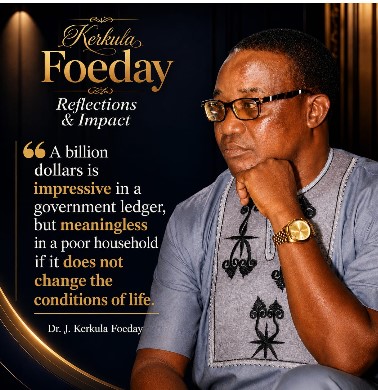
That is the ultimate test. Because a billion dollars is impressive in a government ledger but meaningless in a poor household if it does not change the conditions of life. Liberia must therefore move beyond celebrating the size of its budget. It must begin measuring the size of its development dividend.
The real milestone will not be the day Liberia raises its first billion dollars. The real milestone will be the day every county, every community, and every ordinary Liberian can feel that billion working for them. That is when a billion-dollar budget will cease to be merely a fiscal achievement and become a national development achievement. And until then, the billion is not the destination. It is the test.
____
NOTE:
You can also read 📚 this commentary on my blog at
https://jkerkulafoeday.wordpress.com/2026/09/04/beyond-the-billion-dollar-budget-what-must-us1-25-billion-mean-for-every-liberian/