
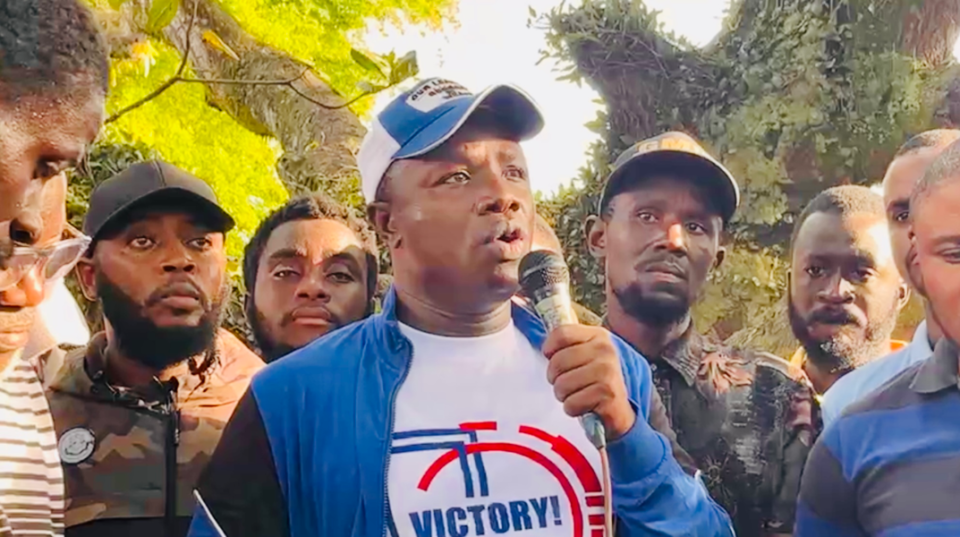
PHOTO: Jefferson Tamba Koijee, CDC Secretary General & former Monrovia City Mayor
A Response to the Liberia National Police, Regarding its April 21, 2026 Press Release; discrediting my communication to the U.S. Embassy on scrutinising US funding toward LNP and gross Human Rights Violation in Liberia.
After a few hectic days on my exams for the past week, I bumped into a press release issued by the Liberia National Police in which the institution is refuting empirical facts I recently unveiled linking to gross human rights violation and misused of both the Americans and Liberians tax payers money. Those who know me beyond everyday politics understand that I am deeply involved in the Liberian reality. I don’t observe these issues from a distance, I live them, and I carry the weight of what it means to be Liberian.
Over time, I have built close relationships with survivors and victims of human rights abuses, and their experiences have become part of my own lived reality. When citizens are brutalized by police officers, teargassed, or subjected to sexual abuse, they do not become fairytales to me, they are communicating the inability of the Police under Mr. Coleman to save lives and properties.
My documentation of human rights abuses stems from an acknowledged fact that there are immediate threats and challenges that still exist under Liberia’s domestic human rights response mechanism. That is why, even officers of the Liberia National Police are found guilty of rape, harrassing innocent citizens and distorting rule of law to favor a class system. Interestingly, Mr. Coleman argues that my assertions were misleading yet, mayhem was directed against innocent students of the Vanguard Students Unification Party and a cross-section of national civil society activists. They were subsequently tear-gassed and wrongfully imprisoned, stripped naked and tortured for demanding jobs and justice in a country that gives no hope under President Boakai.
Dangerously, there was an assassination attempt on the life of a sitting lawmaker, Representative Saah Foko without an investigative outcome.
On February 29, 2024, while executing your bloody onslaught in Kinjor, Grand Cape Mount County, citizens were shot dead on sight for appealing to concession companies to respect their labor values, Liberians were maltreated in police cells that have no decency to human life. In my earlier communication to the U.S. government, I reported nine unprecedented human rights violations, additionally here are some major cases that continue to sit at the apex of impunity under the watch of Mr. Coleman:
Essah Massaley and Abraham Kerkula shot dead in Kinjor, Grand Cape Mount County by the Liberia National Police. See link: https://liberianinvestigator.com/update/families-demand-30-million-from-bea-mountain-over-kinjor-protest-deaths/#google_vignette.
March 24, 2026, Senior Officer of the Liberia National Police allegedly raped a 24-year-old girl in Margibi County (See Link https://www.thenewdawnliberia.com/lnp-investigates-senior-officer-over-alleged-rape-of-pregnant-inmate/)
March 20, 2026, officer of the Liberia National Police (LNP)-Grand Bassa Detachment was reportedly arrested and handcuffed over allegations of rape.https://web.facebook.com/61567725736467/videos/report-coming-says-an-officer-of-the-liberia-national-police-lnp-grand-bassa-det/1948352829102370/
Matthew Mulbah, a mentally challenged man was shot several times in the head by officers of the Liberia national police in Congo town in 2025. https://wadr.org/liberian-police-face-backlash-over-killing-of-mentally-ill-man/
On May 13, 2025, a pregnant liberian woman was beaten to death by officer Sayon Wolah, also known as Ricky Ross See link https://web.facebook.com/theliberianinfluence/photos/sad-news-the-commander-of-the-zone-three-police-station-in-old-road-sayon-wolah-/1253849456747498/?_rdc=1&_rdr
These human rights violations I have brought forward are neither misleading nor exaggerated, as suggested by the Liberia National Police. On the contrary, the institution’s attempt to dismiss these claims only reinforces the depth of the crisis within its ranks. The pattern of denial, rather than transparent engagement with the facts, raises serious concerns about accountability and the willingness of the LNP leadership to confront systemic failures.
At the center of this concern is the leadership of Gregory Coleman who has undermined the professional ethics of the police by creating cliques who are now turning the police into state sanctioned malicious, thereby ostracizing professional police officers with institutional knowledge.
Effective law enforcement demands not just authority, but responsibility, credibility, and responsiveness to public grievances. When credible allegations of brutality, sexual abuse, and misuse of public resources are met with dismissal instead of decisive action, it signals a breakdown in both leadership and institutional integrity.
In light of these concerns, there is a compelling case for the temporary suspension and comprehensive review of both domestic and international funding directed toward the police. Resources provided by Liberian taxpayers and international partners are intended to strengthen public safety, uphold the rule of law, and protect vulnerable populations. When those same resources risk enabling abuse or shielding misconduct, it becomes necessary to pause, reassess, and ensure that every dollar is aligned with public interest and accountability standards.
Beyond leadership failures, the everyday experiences of citizens further validate these concerns.
More troubling, on January 13, 2026, Human Rights lawyer, Cllr.Tiawan Saye Gongloe requested a full disclosure of a DNA finding in which police exonerated Brayant McGill for allegedly raping a 15-year-old child. Nearly four months later, Mr. Coleman has failed to disclose publicly the outcome of the DNA. This action of the Liberia National Police in a high-profiled case raises serious doubts about transparency and equal justice. It also shows that Gregory has become more of a political tool than a man prepared to advance Liberia’s criminal justice system.
Such action also points to a deeply entrenched culture of corruption that extends beyond isolated incidents and reflects broader systemic decay.
Ultimately, this is not just about individual misconduct, it is about the credibility of an institution entrusted with protecting the public. Addressing these issues requires more than public denials. It demands independent investigations, enforcement of disciplinary measures, institutional reforms, and a renewed commitment to restoring public trust. Until these steps are taken, the gap between the police and the people they serve will only continue to widen. In short, the Police must acknowledge this. They owe it to the Liberian People, to whom they lie to protect.
Amid these developments, there are growing concerns that Gregory Coleman has played a role in weakening the operational independence of the Liberia Drug Enforcement Agency for undermining former LDEA Director Abraham S. Kromah, and masterminded the appointment of his surrogate, who was former Deputy Commissioner of Police, Fitzgerald T. M. Biago as LDEA boss, thereby leveraging the opportunity to run the both institutions concomitantly. Such interference raises serious questions about the integrity of drug law enforcement in Liberia. More worsening is; the unfolding controversy surrounding the missing or disputed US$150,000 seized at the Bo-Waterside border as conflicting testimonies from within the LDEA, showing that investigative reports were altered.
This is the Gregory influence and such gaps cannot be dismissed as routine errors and misleading information. Importantly, this raises legitimate oversight questions for institutions like the Liberian National Police, which plays a central role in national security coordination. Under the leadership of Inspector General Gregory Coleman, the public now expects clarity about the missing US$150, 000.
Until there is a transparent, independent review of this case, questions will remain. And in the absence of answers, public confidence in Liberia’s fight against drug trafficking risks further erosion.
When enforcement agencies are compromised in this way, it not only weakens accountability but also creates space for illicit networks to operate with reduced scrutiny. These blatant acts are turning our country into a narcotic state.
Responding to my U.S. Sanction with Clarity and Resolve:
I had intended to let this matter rest as I continue to demand for institutional effectiveness within the Liberia National Police and democratic reform. However, it is telling that instead of addressing the serious issues I have raised, Gregory Coleman has chosen to deflect by referencing my sanction case.
Let me be clear: the sanction imposed on me by the United States Government was not the result of a transparent, merit-based process, but one shaped by political narratives and circumstances beyond my knowledge.
It is important to draw a clear and necessary distinction between sanctions and legal conviction. Sanctions, by their very nature, are administrative or policy tools used by governments, including the United States Government, to signal concern, apply pressure, or restrict certain forms of engagement. They are not the product of a judicial process, nor do they represent a formal determination of guilt under the law.
A conviction, on the other hand, is the outcome of a structured legal process grounded in due process, where evidence is presented, examined, and tested before a competent court of law. It requires the opportunity for defense, adherence to legal standards, and an impartial ruling based on facts. Sanctions do not meet these thresholds. They are not subject to the same evidentiary rigor, nor do they provide the accused with the full protections guaranteed within a judicial system.
Conflating sanctions with convictions undermines the very principles of justice and fairness. It creates a dangerous precedent where individuals can be judged and condemned outside of established legal frameworks, without the benefit of transparency or the right to defend themselves in a court of law. This is what I face today. This is particularly concerning in contexts where such measures are used to shape public perception rather than establish legal accountability.
In any system that claims to uphold the rule of law, allegations must be tested through credible and independent institutions. Until that process takes place and a competent authority renders a judgment, a sanction remains exactly what it is: an administrative action, not a legal verdict. Maintaining this distinction is essential to preserving both the integrity of justice and the rights of individuals therefore Mr. Coleman must understand this basic context.
Additionally, If the allegations carried real evidentiary weight, I expected that the Liberian government, particularly under the leadership of Joseph Boakai, would have taken concrete steps to investigate them. Yet, more than two years later, there has been no formal investigation. This absence of due process raises legitimate concerns about the credibility and consistency with which such matters are handled domestically.
Secondly, rather than engaging with verifiable concerns around human rights violations, abuse of authority, and systemic corruption within the police, this attempt to redirect the conversation is both evasive and unproductive.
The issues I have raised are not personal, they are institutional, and they speak directly to the lived realities of Liberians who continue to face abuse without redress.
Accountability cannot be selective. If we are serious about justice and reform, then both allegations against individuals and evidence of institutional failure must be subjected to the same standard of scrutiny, transparency, and due process.
During the time when the Coalition for Democratic Change was in power, nearly every incident involving death, protest-related violence, or alleged abuse was swiftly and consistently attributed to Jefferson T. Koijee. Public narratives were shaped with accusation, there was no hesitation in assigning blame, often without the benefit of thorough, evidence-based investigations. The environment at the time was one where political actors and commentators spoke with confidence, framing these incidents as clear examples of human rights violations tied to me.
Fast forward to the present moment, and the pattern of human rights concerns has not disappeared. In fact, many Liberians would argue that some of these violations have persisted, and in certain instances, intensified. Reports of police brutality, excessive use of force, and abuse of authority continue to surface. Yet, what has noticeably changed is the tone and reaction from those who were once the most vocal critics. The same urgency, condemnation, and direct attribution that characterized the previous period are now largely and hypocritically absent.
Where is Jerome Verdier who publicly accused me for murdering the innocent daughter of Gloria Musu Scott? Instead of Coleman mustering the courage to invite Mr. Verdier to bring his facts and evidence to help the Liberian people find out about the gruesome murder of Charlotte Musu, the young, innocent soul with so much untapped potential, he is shamelessly engaged in unnecessary showmanship. Why haven’t Mr. Coleman investigated the cases of the three missing boys and three murdered auditors?
Where is Cornelia Wonkerleh Kruah, Youth and Sports Minister who claimed I was responsible for the District #13 Political violence in 2018, November 19 bi-election and the murder of three Liberians, where are the family members of those murdered.
After this, Kruah sits as Minister of Youth of sports who presides over taxpayer money, where is Mo Ali current Managing Director of the LWSC who alleged that I purchased a property in 2018 worth US$250,00, the same property that the current vice-president is claiming now, where is Boakai Jaleiba who one time took to his face book page alleging that I was surreptitiously burying three persons that he claimed I murdered in the 2018 district #13 political violence. Where is the family of those he claimed I murdered, where are the CSOs’ actors who worked their ways out to ensure Koijee is sanctioned? Today they are current employees of the government: Madam Loretta Alethea Pope-Kai, member of the Board of the Forestry Development Authority (FDA), Where is Facia Harris who works for the Liberia Government in New York, Maima Robertson, who works on the Asset Recovery team, and Cllr Mmonbeydo Nadine Joah appointed as Acting County Attorney for Gbarpolu County?
Man could successfully deceive mankind but cannot deceive time.
“A fortune made by a lying tongue is a fleeting vapor and a deadly snare”.
Proverbs 21:6
Thank you for your attention and consideration.
Sincerely,
Jefferson T. Koijee
National Secretary General
Mighty Congress for Democratic Change
Cc:
Independent Human Rights Commission, U.S. Embassy, Human Rights Watch, African Union, ECOWAS, UN, European, Amnesty International, Human Rights Watch.