
By Dr. J. Kerkula Foeday
Kerkula Foeday: Reflections & Impact, Issue 25*, Saturday, August 22, 2026
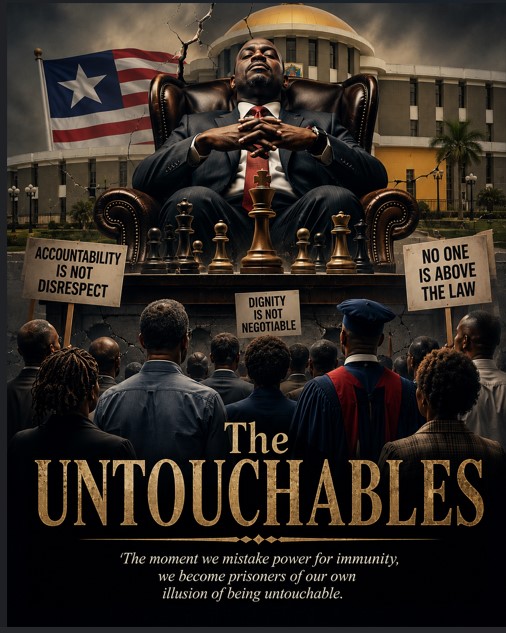
The moment we mistake power for immunity, we become prisoners of our own illusion of being untouchable.
There are those who walk beneath the flag
As though the flag were stitched for them alone …
Who enter halls of power
And mistake the chair for a throne,
The office for a kingdom,
The title for a crown,
And silence for permission.
They are the untouchables …
Not because the law has declared them so,
But because they have convinced themselves
That the law will never touch them.
They are the powerful
Who confuse position with permanence,
Influence with innocence,
Connections with immunity,
And authority with entitlement and the right
To put down another human being.
They sit in offices …
In universities, ministries, agencies,
Corporations, political party meetings,
And corridors where decisions are made.
Some wear academic gowns.
Some wear official suits.
Some carry titles.
Some carry influence.
Some carry nothing but a familiar name
And the confidence of those
Who have learned that accountability
Can sometimes be negotiated.
And some are not powerful by position at all.
They are powerful by perception.
For power, sometimes,
Is constructed in the mind
Before it is displayed in the world.
Henry LeRoy Atwater reminds us:
That perception is reality.
And perhaps that is where
The great danger starts.
When a person perceives himself or herself
As being beyond correction or reproach,
He or she begins to behave
As though correction or reproach is impossible.
When an administrator believes
No colleague can challenge him,
He or she speaks without restraint.
When an official believes
No citizen can question him or her,
Arrogance becomes a commonplace policy.
When a leader believes
An institution belongs to him or her,
Rules become obstacles,
People become inconveniences,
And applying the rules
For the good of the institution becomes discretional.
When the untouchables look into the mirror,
They may no longer see
Themselves as human beings accountable to others.
They see power.
Only power.
And power without reflection
Is a dangerous thing.
Gary Zukav gives us another mirror:
“Reality is what we take to be true.
What we take to be true is what we believe.
What we believe is based upon perceptions.”
So what happens
When the perception becomes:
I cannot be challenged.
I cannot be questioned.
I cannot be removed.
I can say whatever I want.
I can do whatever I want.
Nothing will happen to me.
Then perception becomes belief.
Belief becomes behavior.
Behavior becomes culture.
And culture, when left unchecked,
Can become a machinery of impunity.
That is how a workplace loses its humanity.
That is how a university forgets
That knowledge without humility
Is merely arrogance wearing a gown.
That is how public service becomes private dominion.
That is how authority becomes abuse.
That is how the law begins
To bow before the powerful
Instead of standing equally before the people.
And somewhere beneath
The noise of insults,
Decrees, threats, withheld rights
And wounded dignity,
One question remains unanswered:
Who watches the watchers?
Who questions the powerful
When the powerful control the question?
Who corrects the arrogant
When those appointed to correct them choose silence?
Who protects an institution
When loyalty to a person
Is mistaken for loyalty to principle?
Who protects the worker
When speaking truth
Is branded as rebellion?
Who protects the citizen
When the officeholder
Has mistaken public authority
For personal property?
These are not merely questions for a university;
They are questions for a nation.
For the culture of untouchability
Does not begin with one person
And does not end with one institution.
It grows wherever people learn
That connections can defeat consequences,
That titles can silence truth,
That political proximity can purchase protection,
That insults can be excused as strength,
And that the powerful can break the rules
While demanding obedience from everyone else.
But history has a stubborn memory.
It remembers the arrogant.
It remembers those
Who believed their chairs could never empty,
Their names could never fade,
Their influence could never diminish,
Their allies could never leave,
And their actions could never return
To stand before them.