
Source: VATICAN NEWS
By Isabella Piro
“Humanity, created by God in all its grandeur, is today facing a pivotal choice: either to construct a new Tower of Babel or to build the city in which God and humanity dwell together.”
The opening words of Pope Leo XIV’s first encyclical, Magnifica humanitas: On Safeguarding the Human Person in the Time of Artificial Intelligence, summarize its underlying reasons and purpose.
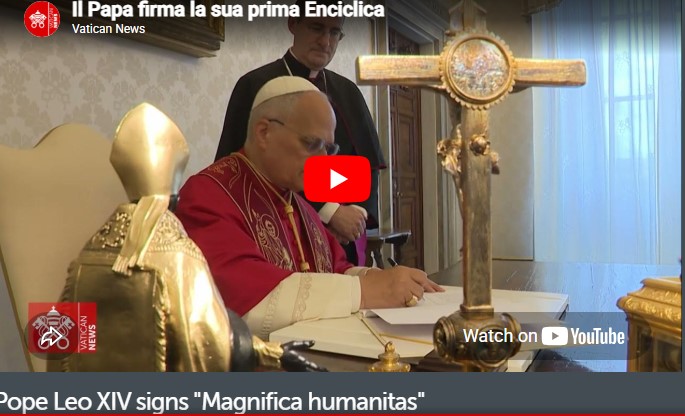
Published on Monday, May 25, the Pope signed the encyclical on May 15, the 135th anniversary of the promulgation of Pope Leo XIII’s Rerum novarum.
Pope Leo XIV has taken up the legacy of his predecessor, writing a social encyclical which addresses one of the principal challenges of the contemporary age: artificial intelligence.
Divided into five chapters, Magnifica humanitas has an underlying premise: technology is not “a force antagonistic to humanity” (4), nor is it “inherently evil” (9). However, “technology is never neutral, because it takes on the characteristics of those who devise, finance, regulate, and use it.
Therefore, Pope Leo XIV appeals for people to build “for the common good” and to “remain human,” following a courageous mentality of shared responsibility and communion, so that the world “will come to recognize the human heart as the place where God desires to dwell” (16).
Church’s social doctrine
The first chapter—“A Dynamic Approach Faithful to the Gospel”—traces the Social Doctrine of the Church in recent magisterium and the Second Vatican Council, highlighting “its dynamic character” (17). Far from being “a handbook of principles and norms to be applied,” the Church’s social teaching is rather a “theology of communion in history” (27), which guides our reading of events in light of the Gospel. Pope Leo XIV recalls the writings of his predecessors: from Pius XII – the first to use the expression “Social Doctrine of the Church” in his Apostolic Exhortation Menti Nostrae of 1950 – to Pope Francis. He recalled Pope Leo XIII’s Encyclical Rerum Novarum of 1891, which “constitutes a milestone in the development of the Church’s social teaching” (30). In the years following, each successor of Peter “interpreted historical changes according to the Gospel, bringing to light different aspects of a single heritage: the dignity of the person, the value of work, the universal destination of goods, solidarity and subsidiarity, care for creation and the centrality of peace and fraternity” (45).
Safeguarding human dignity
In the second chapter, Pope Leo XIV explores the “Foundations and Principles of the Social Doctrine of the Church”.
These foundations, he says, include the dignity of the person, created in the image and likeness of God. It is important to recall this since “the pressure of new ideologies or certain highly powerful interests” can reduce the human person to “a resource to be used and exploited” or “on what they achieve or produce” (51). On the contrary, “the fundamental dignity of each person…is neither acquired nor earned, nor does it need to be justified” (53). A second foundation of the Social Doctrine of the Church is the inviolability of human rights, among which the first is the right to life “from conception to its natural end.” In this regard, Leo XIV defines induced abortion, the killing of the innocent, and euthanasia as “choices that the Church considers gravely wrong” (55). The third foundation is the recognition of the rights of minorities, with particular attention to women. The Pope calls for “concrete decisions” in their favor regarding laws, employment, education, in social and political responsibilities, so that they may be truly heard and valued (57).
‘Gravely immoral’ to subjugate a nation
Pope Leo XIV then identifies five principles of the Social Doctrine of the Church. The first is the common good, and the Pope defines it as “the social expression of the dignity recognized in every person” (59).
He forcefully affirms that “the promotion of the common good can never be separated from respect for the right of peoples to exist, to preserve their own identity and to contribute their unique qualities to the family of nations.”
Therefore, he says, “any attempt or plan to eliminate or subjugate a nation is gravely immoral and therefore unacceptable” (64).
For more read: Pope Leo’s ‘Magnifica humanitas’: AI must serve humanity not concentrate power – Vatican News