
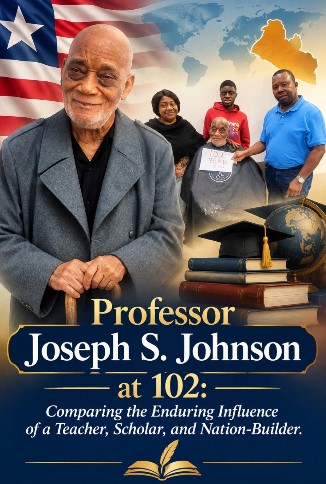
By Austin S. Fallah – A True Son of the Planet Earth Soil: fallahas@yahoo.com
https://www.facebook.com/share/r/19WtKfyKU2/
https://www.facebook.com/share/r/1JRHzxRdNs/
https://www.facebook.com/share/r/1Do8nj14w6/
Minister of Education Dr. Jarso Maley Jallah: In September 2026, addressing Presidential Scholars, she asked: “Your country has invested in your education. What will Liberia receive from that investment?”
“Any education that is not placed at the service of the masses is useless.”
— Dr. Henry Boima Fahnbulleh Jr.
“Access to education for all is key to nation building, growth, peace and stability.” — Dr. E. Othello Gongar, former Liberian Minister of Education.
Dr. Togba-Nah Tipoteh: Has written extensively about education, learning, Liberian culture, and national development. In a 2021 discussion of how he approached societal problems, he recalled the lessons taught by his parents and grandparents: “My grandparents and Parents taught me the lesson about how good it is to go to school.”
“Education is the most powerful weapon which you can use to change the world.” — Nelson Mandela.
Former Minister of Education Prof. D. Ansu Sonii Sr.: “Education is the basis for all other capacities.”
“Education lies at the heart of the 2030 Agenda … [and] is a force for economic, social and political transformation.” — UNESCO.
“If we stayed the course, followed the traditional ways of doing things, we would not catch up with our neighboring counterparts.” Hon. George K. Werner, former Liberian Minister of Education.
“The truth is that it is teachers more than any other single group of people who determine these attitudes and who shape the ideas and aspirations of the nation.” — Julius K. Nyerere.
Hon. Alexander Torbor Kun: “Age counts the years; wisdom measures what those years have given to others.”
“Intellectuals have a special contribution to make to the development of our nation, and to Africa.” — Julius K. Nyerere, Uhuru na Maendeleo (1973).
“A great teacher does not merely leave knowledge in the minds of students; he leaves questions, principles, values, and a capacity for thoughtful citizenship that continues long after the classroom has disappeared.”— Tribute to Professor Joseph S. Johnson at 102, by Austin S. Fallah.
African proverb: “When an old man dies, a library burns to the ground.”
Hon. Edward Wesee: “At 102, Professor Joseph S. Johnson represents more than a remarkable age; he represents a living archive of experience, scholarship, teaching, memory, and service.”
On September 23, Professor Joseph S. Johnson will celebrate his 102nd birthday.
This extraordinary milestone invites reflection not only on the length of his life but also on the depth of his contribution to Liberia.
A person may live for many years without leaving a lasting mark on society; however, Professor Johnson’s life demonstrates the opposite.
His years have been marked by service, teaching, scholarship, discipline, and an enduring commitment to young Liberians’ intellectual development.
As an educator who served at the University of Liberia, the Kakata Rural Teachers Training Institute, Ricks Institute, Sinoe High School, the College of West Africa, and the Roberts International Airport Staff School, Professor Johnson has influenced thousands of lives across generations.
Professor Johnson’s contribution can be compared to that of other important national builders, such as political leaders, public administrators, and community activists.
While elected officials often make visible changes through laws, public policies, and national programs, educators make equally important, though sometimes less visible, changes through the minds and character of the people they teach.
In this sense, Professor Johnson’s legacy is both personal and national.
His work reminds Liberians that a country’s future is not built only in government offices, courtrooms, or legislative halls.
It is also built in classrooms, libraries, school assemblies, teachers’ colleges, and everyday conversations between a dedicated teacher and a determined student.
The significance of Professor Johnson’s life becomes even clearer when his professional journey is compared with Liberia’s changing educational needs.
He served in institutions that represented different levels of learning, different regions, and different social purposes.
At the University of Liberia, his work connected him with higher education and the preparation of future professionals, leaders, and intellectuals.
At the Kakata Rural Teachers Training Institute in Margibi County, his service directly helped train teachers who would go on to educate children in towns, villages, and communities throughout Liberia.
At schools such as Ricks Institute, Sinoe High School, the College of West Africa, and the Roberts International Airport Staff School, he shaped young people at formative stages of their lives.
Although each institution had a distinct role, Professor Johnson brought the same essential purpose to all of them: advancing knowledge and developing responsible citizens.
A key difference exists between teaching students directly and training teachers who will later teach others.
A classroom teacher may influence dozens or hundreds of students during a career.
A teacher educator, however, may have an even wider impact because the teachers they train carry that knowledge into countless other classrooms.
Professor Johnson’s service at the Kakata Rural Teachers Training Institute therefore represents a particularly powerful part of his legacy.
By helping prepare rural teachers, he contributed to an educational chain that reached far beyond the institute’s walls.
Each trained teacher could influence hundreds of children, who could later become nurses, farmers, businesspeople, civil servants, scientists, pastors, lawyers, parents, and leaders.
This multiplying effect distinguishes educational service from many other forms of public service.
A road may connect communities, and a hospital may save lives, but education equips people to build roads, manage hospitals, lead communities, and solve future problems.
Professor Johnson’s work can thus be compared to planting seeds in fertile soil.
The immediate result may be difficult to measure, but the long-term harvest is visible in the lives of former students and in the communities they serve. Liberia’s gratitude toward him is therefore not merely appreciation for a retired educator; it is recognition of a man whose intellectual influence continues through generations of Liberians.
Professor Johnson’s career also reveals the difference between information and wisdom.
Many people possess information. They may know facts, procedures, dates, formulas, or professional techniques.
Yet wisdom involves using knowledge responsibly, ethically, and constructively.
A true educator does more than prepare students to pass examinations.
A true educator teaches them how to think, communicate, treat others, work through difficulty, and contribute to society.
The description of Professor Johnson as a “reservoir of intelligence and academia” suggests that his value has not been limited to academic knowledge alone.
Rather, he has represented the kind of intellectual maturity that inspires confidence, discipline, and respect.
This distinction is especially meaningful in Liberia, where education has remained central to national development.
Like many countries, Liberia has faced periods of political uncertainty, economic hardship, social change, and the challenge of rebuilding institutions. During such times, educators become even more essential.
They help preserve standards, build young people’s capacity, and offer hope through learning.
Political leaders may change every few years, but a respected teacher’s influence can endure for decades.
A student may forget a particular lesson, but they often remember the teacher who demanded excellence, encouraged confidence, or provided guidance at a critical moment.
Liberia’s current President, Joseph Nyuma Boakai, was once a student at the College of West Africa during Professor Johnson’s service there, demonstrating the far-reaching importance of education.
This connection should not be understood as an attempt to give Professor Johnson credit for the President’s entire career or achievements.
Rather, it highlights a larger truth: teachers often influence people who later occupy important positions in society.
When a student sits in a classroom, no one can fully predict what role that student will play in the future.
One may become a president, another a teacher, another a doctor, another a farmer, another a business owner, and another a community organizer.
The teacher’s responsibility is to prepare them all with seriousness and fairness, because each student carries potential.
Comparing Professor Johnson’s work with that of political leaders shows that education and leadership are deeply connected.
A political leader may guide a nation through decisions, policies, and public vision.
An educator, however, helps develop the people who will later make those decisions and carry out
The relationship is similar to that between a builder and an architect.
The architect may design a structure, but the builder provides the skill and labor that transform the design into reality.
In national life, leaders may articulate goals, but teachers help develop the informed citizens and competent professionals needed to achieve those goals.
Professor Johnson’s work belongs to this foundational level of nation-building.
His experience at several institutions also allows comparison across urban, rural, private, public, and s
The University of Liberia represents the country’s highest level of academic aspiration, where students pursue advanced learning and professional preparation.
The Kakata Rural Teachers Training Institute reflects the crucial need to strengthen education beyond major urban centers.
Schools such as Ricks Institute, Sinoe High School, and the College of West Africa are places where young people receive foundational academic instruction and moral guidance.
The Roberts International Airport Staff School, meanwhile, points to the role of education in specialized communities connected to public service and national infrastructure.
By serving in these different settings, Professor Johnson demonstrated adaptability.
Not every educator can succeed in every educational environment.
Teaching at a university requires one set of skills, while working at a teachers’ training institute requires another.
Teaching secondary school students calls for patience, structure, and the ability to inspire young minds at a sensitive stage of development.
Working in a staff school may involve responding to the needs of families connected to a particular institution or workplace.
Professor Johnson’s ability to contribute in several settings suggests that he understood education as a broad human responsibility rather than as a narrow job description.
Another meaningful comparison is between fame and influence. Some people are widely known because they hold high office, appear regularly in the media, or possess wealth and public recognition.
Others may not receive the same level of national attention, yet their influence is profound because they transform individual lives.
Professor Johnson’s legacy belongs strongly to the second category. His name may be especially familiar to those who studied under him, worked with him, or encountered him in Liberia’s educational community.
Yet his work has traveled far beyond the places where he taught.
Every former student who became productive, principled, and committed to Liberia carries part of that influence forward.
This kind of influence is often quiet, but it is not small.
A teacher may never know how many students were encouraged by a word of advice, corrected by a firm instruction, or motivated by an example of professionalism.
The results may appear years later, perhaps when a former student chooses honesty over corruption, service over selfishness, or perseverance over surrender.
In this way, Professor Johnson’s life can be compared to a river whose source may be narrow but whose waters eventually reach many places.
His direct instruction may have begun in individual classrooms, but its effect has extended into homes, workplaces, communities, and national institutions.
The testimony of his son-in-law Mr. Theo Saah Nyumah, and his daughter, Mrs. Jadee Johnson Nyumah, of Brooklyn Park, Minnesota, adds a personal dimension to this public legacy.
hey describe him as a wonderful person who, even at his advanced age, continues to make a difference in the lives of people he meets.
This observation is important because it compares professional accomplishment with personal character.
A person may be highly educated but unkind. Another may be professionally successful but distant from family and community.
Professor Johnson’s story suggests a more complete model of achievement: intellectual excellence joined with human warmth, humility, and continuing concern for others.
At 102, Professor Johnson represents more than longevity.
He represents continuity between Liberia’s educational past and its future.
His life connects earlier generations of students with the current generation of Liberians who are still striving for quality education, strong institutions, and national progress.
In an age when societies often focus on speed, technology, and immediate results, his example reminds people of the value of patience and lifelong service.
The most meaningful contributions are not always made quickly. They are often built slowly through years of commitment, daily preparation, and faithful attention to the needs of others.
Professor Johnson’s continued ability to make a difference also challenges common assumptions about aging.
In many societies, older people are sometimes viewed only through the lens of retirement, dependency, or physical limitation.
While it is important to recognize the care and respect elders deserve, it is equally important to recognize the wisdom they possess.
Older citizens carry memories, experiences, and lessons that younger generations may not yet understand.
Professor Johnson’s life shows that age can be a source of insight and inspiration.
Even when a person is no longer teaching every day in a formal classroom, he or she can continue to teach through conversation, counsel, example, and presence.
Ultimately, Professor Joseph S. Johnson’s 102nd birthday is an occasion for celebration, gratitude, and relection.
His life compares favorably with the work of Liberia’s most important nation builders because he helped build the human foundation upon which national development depends.
Through his service at the University of Liberia, the Kakata Rural Teachers Training Institute, Ricks Institute, Sinoe High School, the College of West Africa, and the Roberts International Airport Staff School, he made education a tool for personal growth and national advancement.
His influence reached students at different levels and in different communities, including individuals who later assumed significant responsibilities in the country.
Liberia is fortunate to have such an accomplished educator and reservoir of intelligence.
More importantly, Liberia is fortunate to have a man whose scholarship has been matched by character and whose age has not diminished his ability to inspire others.
Professor Johnson’s legacy confirms that a teacher’s work does not end when a class is dismissed or when a career officially concludes.
The lessons of a dedicated educator continue in the achievements, values, and service of the people he or she has influenced.
As he turns 102, Professor Joseph S. Johnson stands as a powerful example of how one life devoted to knowledge can continue to shape a nation.