
By Austin S Fallah – A True Son of the Planet Earth Soil: fallahas@yahoo.com
Lee Kuan Yew: Believed that once a political system becomes corrupt from top to bottom, fixing it is nearly impossible without a revolution or a top-down, systematic cleansing led by individuals of unquestioned integrity. https://www.facebook.com/share/v/1Cg4324zy2/
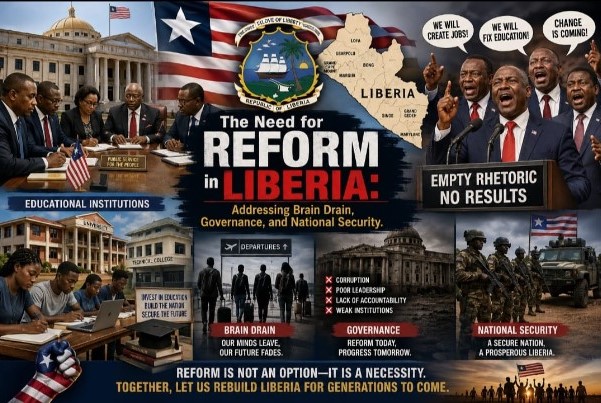
“A nation cannot secure its future when its brightest minds are driven abroad by limited opportunities; Liberia must reform its institutions, invest in its people, and create conditions where talent can return, contribute, and build the nation.”
Niccolò Machiavelli: “For one can say this generally of men: that they are ungrateful, fickle, pretenders and dissemblers, evaders of danger, eager for gain.”
“Argued that people will pledge everything—their blood, property, lives, and children—when a ruler is successful, and danger is far away.”
“The moment a leader faces a crisis or actual need, those same people will turn away or revolt.”
These observations lead to Niccolò Machiavelli’s famous political conclusion that it is safer for a ruler to be feared than to be loved, because bonds of affection are easily broken when self-interest takes over, whereas fear of punishment remains constant.
“Stop carrying gossip to President Joseph Nyuma Boakai, and stop undermining one another and the government. Such ugly acts undermine the government’s ARREST and RESCUE agendas, which are designed to resuscitate the Liberian people from abject poverty to prosperity.”
“Brain drain is not merely the departure of professionals—it is the loss of national capacity. Liberia’s reform agenda must make education, merit, accountability, and opportunity pillars of sustainable development.”
“Government officials must stop spreading gossip, undermining colleagues, and weakening the government from within. Such ugly acts undermine the ARREST and RESCUE agendas aimed at lifting the Liberian people from abject poverty to prosperity.”
“Good governance is the foundation of national security. When institutions are transparent, accountable, and responsive to citizens, Liberia becomes stronger against corruption, drug trafficking, drug cartels, instability, and threats to its sovereignty.”
“Stop the gossip, stop the bad-mouthing, stop the undermining, and start working together. Such ugly acts only weaken the government’s ARREST and RESCUE agendas and hinder the collective effort to resuscitate the Liberian people from abject poverty and move Liberia toward prosperity.”
“Liberia’s national interest must rise above personal, political, and institutional interests. Meaningful reform requires leaders who place competence, integrity, justice, and service to country above partisan advantage.”
“The future of Liberia depends on the courage to reform today: retain our human capital, strengthen our institutions, protect our national security, and build a government worthy of the confidence of its people.”
Liberia, a nation grappling with the aftermath of extended civil conflict and economic instability, stands at a critical juncture in its history.
Brain drain has left the country bereft of valuable human capital, while some in appointed political power often lack the requisite qualifications and moral integrity to lead effectively.
The need for governance reform is pressing, as some poorly educated individuals in appointed political power only exacerbate the challenges facing the nation.
President Joseph Nyuma Boakai and Vice President Jeremiah Kpan Koung must take decisive action to address these issues, reclaim the trust of the Liberian people, and pave the way for a brighter future.
In this disquisition, I will argue that the current political landscape, characterized by some unqualified individuals in positions of power, a culture of impunity, and unprofessional relationships among government officials, significantly hinders Liberia’s potential for growth and development.
First, Liberia’s brain drain crisis is multifaceted.
High levels of emigration among skilled professionals have led to the loss of essential human capital, which is critical for a nation that needs to rebuild and develop its infrastructure, economy, and institutions, as seen in Singapore during its early development.
Various factors, including political instability, limited economic opportunities, and inadequate educational resources, primarily drive this talent outflow.
As a result, many qualified Liberians have sought better prospects abroad, leading to a significant loss of expertise that could otherwise contribute to national progress.
In addition to the brain drain, the presence of some individuals lacking proper education and qualifications in political positions is alarming.
Those who occupy key roles in government often prioritize rhetoric over substantive action, contributing to a culture of logomachy, an obsession with argumentation rather than effective governance.
This phenomenon creates a political environment where sincere and capable Liberians are marginalized and their voices stifled. Instead of being welcomed into decision-making processes, accomplished individuals with genuine intentions for the nation’s welfare are dismissed as “black cows,” further entrenching a culture of impunity and distrust.
Moreover, the current political elite’s tendency to surround the presidency with unqualified advisors not only dilutes the quality of governance but also threatens national security.
When sensitive government information falls into the hands of individuals who lack the professional acumen to handle it responsibly, the state’s security and stability are at risk.
The issue becomes even more pronounced when unprofessional relationships emerge among government officials.
For instance, a government official romantically involved with another official within the same institution raises ethical concerns that jeopardize transparency, accountability, and ultimately, national governance.
This unprofessional behavior reflects a larger systemic issue that permeates Liberia’s political culture.
The normalization of personal relationships over professional competence fosters a climate where governance is overshadowed by favoritism and the pursuit of self-interest.
Such practices not only undermine public trust but also perpetuate a cycle of corruption and inefficiency that trivializes the urgency of national development. Therefore,
President Boakai must recognize and address these unprofessional behaviors within his administration, fostering an environment that prioritizes merit-based appointments and professional conduct.
In this light, meaningful reform is possible, but it requires courageous leadership and a commitment to policies that promote accountability and transparency.
President Boakai must take decisive action to root out unqualified individuals in positions of power and replace them with knowledgeable and morally upright citizens who have Liberia’s best interests at heart.
This includes establishing rigorous selection criteria for government officials, ensuring that individuals in power possess both the technical expertise and ethical grounding necessary for effective governance.
Additionally, fostering an inclusive political environment is vital to rejuvenating Liberia’s democracy.
Sincere Liberians willing to contribute positively to the nation must be welcomed into the political conversation, allowing diverse perspectives to enrich policymaking.
This can be achieved through increased community engagement, open forums for discussion, and mechanisms that allow citizens to voice their concerns and opinions.
By dismantling the barriers that prevent capable individuals from participating in governance, Liberia can leverage its untapped potential and foster a participatory democracy that drives progress.
Furthermore, addressing the culture of impunity is paramount for establishing a stable and functioning governance framework.
Accountability should be non-negotiable; individuals found engaging in unethical practices must face appropriate consequences.
This includes developing and enforcing robust codes of conduct for government officials that outline acceptable behaviors and relationships within the political sphere.
By instilling accountability, Liberia can rebuild public trust and confidence in its institutions.
Liberia’s struggles with brain drain, some unqualified political leadership, and a culture of impunity represent serious challenges that must be addressed through decisive reforms.
President Joseph Nyuma Boakai and Vice President Jeremiah Kpan Koung have the opportunity to break the cycle of unprofessional conduct and promote a governance model that values competence, integrity, and accountability.
By prioritizing the recruitment of qualified individuals, fostering an inclusive political environment, and combating impunity, Liberia can turn the tide on its path to rejuvenation and progress.
It is time for the country to reclaim its dignity and harness the potential of its citizens, enabling a brighter future for generations to come.
By taking these necessary steps, Liberia can ascend from the shadows of its past and emerge as a beacon of hope and prosperity in West Africa.