
By Austin S Fallah – A True Son of the Planet Earth Soil, fallahas@yahoo.com
Happy and blessed May 25, 2026-Organization of African Unity-Day-Established-Formed on May 25, 1963. Now known as the African Union, the organization changed its name on July 9, 2002.
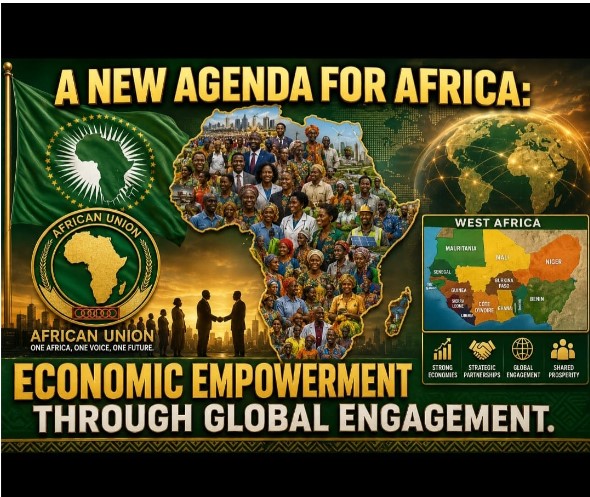
The theme of A New Agenda for Africa: Economic Empowerment Through Global Engagement highlights the continent’s shift from a passive recipient of aid to a dominant global economic powerhouse. Grounded in Pan-African frameworks such as the African Union Agenda 2063, these insights highlight youth empowerment, intra-African trade, and self-reliance.
“Africa’s future cannot be built on aid alone. We must move toward partnerships that empower our industries, create jobs for our people, and ensure that the wealth we generate stays within our economies.” — Anonymous Consensus (representing the sentiment of the 2026 Africa Forward Summit)
President Joseph Nyuma Boakai: [“Building a new Liberia should not be just a dream; we must promise a new mindset of collective responsibility. Our young people are the enablers of change, and we are committed to equipping you with the tools to lead our country into a brighter, economically empowered future.”
“We must form strategic global engagements to redefine and reset our urgent priorities. We are creating a conducive atmosphere for innovation, where youth energy and digital skills will be the driving force behind our economic growth.”]
Former President Ellen Johnson Sirleaf: [“The new agenda for Africa is a triangular approach. Not just government administrations, not just Civil Society, and not just private sector organizations. To grow Africa, all three sectors must be improved and engaged together.”
“To women and young people, you are not only the future—you are shaping the present with your courage, creativity, and resilience. When they are given opportunities to lead, innovate, and contribute, entire nations thrive.”]
Former President George Manneh:[“We must start from the simple premise that Africa’s future is up to Africans… Our focus should be on building a New Africa where peace, unity, democracy, and equal opportunity for all become the cornerstone and foundation for the future.”
“Africans in the diaspora and Africans in Africa are one people. Let us invite them to help build a New Africa where peace, unity, cooperation, and equal opportunity for all will be the cornerstone and foundation for the future of Africa.”
“We must start from the simple premise that Africa’s future is up to Africans… Our focus should be on building a New Africa where peace, unity, democracy, and equal opportunity for all become the cornerstone and foundation for the future.”]
“The more united Africa is, the more productive our engagement with partners will become. Africa does not have to ask for a seat at the table.” — Paul Kagame, President of Rwanda.
“Global business and investors should look at Africa as a partner and come to do business with Africa, not in Africa.” — Sanda Ojiambo, Assistant Secretary-General and CEO, UN Global Compact.
“We can’t keep depending on what others are saying or doing about us. We need to be working together with other countries on the global stage… As Africans, we have to be able to define which direction we want to take.” — Paul Kagame, President of Rwanda.
“Unlocking intra-African trade is one of the greatest economic opportunities of our generation. Africa has the resources, talent, and entrepreneurial dynamism to become a major engine of global growth.” — Sanda Ojiambo, UN Global Compact.
Our continent can not build scale by looking outward first. We must invest in one another, trade more with one another, build the corridors that connect our markets, and give African businesses the confidence to expand across African borders.” — Bola Ahmed Tinubu, President of Nigeria.
Kwame Nkrumah, former President of Ghana: “The forces that unite us are intrinsic and greater than the superimposed influences that keep us apart.”
Former Ghanaian President, Kwame Nkrumah: “We must unite now or perish… Without necessarily sacrificing our sovereignties, we can forge a political union based on defense, foreign affairs, and diplomacy, and a common citizenship.”
Former President of Tanzania, Julius Nyerere: “Without unity, there is no future for Africa… Together, we, the peoples of Africa, will be incomparably stronger internationally than we are now with our multiplicity of unviable states.”
Emperor of Ethiopia and first Chairman of OAU, Haile Selassie I: “That which pulls us apart and divides us must be resisted with all our strength. That which unites us must be pursued relentlessly and inexorably.”
Former South African President, Nelson Mandela: “I dream of the realization of the unity of Africa, whereby its leaders combine in their efforts to solve the problems of this continent.”
Liberian proverb: ” United we stand, divided we fall.”
Swahili Proverb: “Unity is strength, division is weakness.”
Ethiopian Proverb: “When spider webs unite, they tie up a lion.”
Bondei Proverb: “Sticks in a bundle are unbreakable.”
Zulu & seSotho (Ubuntu): “A person is a person because of other people.”
African proverb: “Where there are many, nothing goes wrong.”
“This will allow Africa to design its own AI solutions, tailored to its realities… We can address our most pressing challenges… on our own terms.” — Strive Masiyiwa, Founder of Econet Global / Cassava Technologies (regarding AI factories).
“Africa is home to the world’s biggest youth population… With the right tools, education, resources, and encouragement, these young people represent a living solution to the issues that plague the continent.” — Global Citizen Youth Forum.
Youth Forum in Ghana Sep 17, 2022 — At Global Citizen, “the voices of young people are at the heart of our mission to drive change and end extreme poverty now.”
“The more united Africa is, the more productive our engagement with partners will become. Integration, for Africa’s business community, is an opportunity to grow.”
By: Austin S Fallah – A True Son of the Planet Earth Soil: fallahas@yahoo.com.
Africa is frequently presented as a continent of need, often relegated to the role of a beneficiary in the global narrative.
This perception persists despite the vast resources and untapped potential that Africa, particularly West Africa, possesses.
It is time for Africa to redefine its role on the global stage, transitioning from a passive recipient of aid to an active partner in economic development.
The second quarter of the 21st century and beyond should mark a pivotal shift that propels Africa into a leadership position, wherein it can contribute significantly to the global economy.
One fundamental question arises: when will Africa step forward to host a global conference or symposium focused on its economic capabilities to assist other continents, just as it has continuously supported Africa?
To instigate this transformation, it is essential to understand the implications of the current economic dynamics.
For decades, Africa has been characterized as a continent reliant on foreign assistance, a narrative that complicates its journey toward economic self-sufficiency and sustainability.
This dependency is akin to living off “handouts like cassava leaves,” perpetuating a cycle of underdevelopment and diminishing its potential to contribute meaningfully to the global economy.
The reality is that Africa is rich in natural resources, human capital, culture, and innovation.
However, the historical context of colonization, coupled with ongoing economic exploitation, has created a landscape where external powers dictate the terms of engagement.
This narrative needs to change; Africa must take ownership of its resources and influence the global economic framework.
The initiative to hold a conference is not merely about economic discussions; it is about creating opportunities and frameworks for collaboration that can lead to mutual growth.
One could argue that Africa’s development should not hinge solely on external investments and financial assistance but be anchored in homegrown solutions, innovation, and partnerships that acknowledge the continent’s agency.
For instance, consider the burgeoning technology sector in places like Nigeria and Kenya.
These countries are not just recipients of technology but are nurturing ecosystems that can and should produce technology solutions for global markets.
By formally showcasing these advancements and inviting international partners to collaborate, Africa could shift the narrative from one of dependency to one of innovation and exchange.
The need for economic empowerment becomes even more urgent when considering Africa’s demographic trends.
The continent is home to the world’s youngest and fastest-growing population, which presents both challenges and opportunities.
If Africa can harness the power of its youth by providing educational and economic opportunities, it can transform not only its internal economy but also its position in the global marketplace.
A focused conference could serve as a platform to discuss educational reforms, drive investment in human capital, and promote entrepreneurship among young Africans.
This holistic approach would cultivate a generation of leaders equipped to tackle socioeconomic challenges head-on and to innovate for a better future.
Moreover, Africa’s changing trade relationships, particularly with emerging economies such as China and India, can be leveraged to create a more balanced economic dialogue.
Rather than being seen as a market to be exploited, Africa can set the terms of trade that favor equitable partnerships.
For instance, Africa’s participation in the African Continental Free Trade Area (AfCFTA) aims to create a single market for goods and services across the continent, which could significantly bolster intra-African trade and economic resilience.
Conventions and discussions spearheaded by African leaders on platforms like these are necessary to establish a common agenda that prioritizes Africa’s interests and to create frameworks that advance collective growth and sustainability.
Financial independence is another pivotal aspect of Africa’s new vision.
The African Development Bank (AfDB) has highlighted the importance of Africa’s financial institutions in promoting local investments and reducing reliance on foreign capital.
A conference that emphasizes establishing sovereign wealth funds, investment banks, and public-private partnerships can provide countries with pathways to mobilize domestic resources.
By encouraging international investors to support African innovation, infrastructure, and agriculture, Africa can build a robust economic landscape that transcends the historical reliance on foreign aid.
Beyond economic metrics, the cultural narrative surrounding Africa needs to be elevated and celebrated.
The continent is rich in diversity with countless languages, traditions, and practices that have the potential to shape a unique identity in the global marketplace.
An international symposium would allow African leaders and cultural ambassadors to showcase their heritage while simultaneously promoting Africa as a desirable investment and travel destination.
Culturally rooted initiatives in tourism, art, and literature can draw global attention, fostering a deeper understanding of Africa’s contributions to world culture and economy.
In considering the path forward, there is an urgent need for African states to collaborate and consolidate efforts for this envisioned transformation.
African unity, historically challenged by geopolitics, tribalism, and colonial legacies, could be the key to robust representation on the global stage.
Egypt, Ghana, Senegal, and Rwanda stand as exemplary models of progressive governance, characterized by innovation, resilience, and a commitment to transparency.
By rallying under a common vision, these nations could effectively advocate for Africa’s interests on platforms that influence global economic policy.
Critics may argue that Africa’s existing frameworks, such as the African Union, already work towards these objectives.
However, the effectiveness and visibility of such institutions should be scrutinized in light of their outcomes.
The push for a pan-African economic conference is not an indictment of existing structures but rather a call to amplify Africa’s voice and innovative capacity in the global dialogue.
Such initiatives must break from traditional formats, utilizing technology and social media to engage younger generations that demand progress and accountability.
Africa stands at a critical juncture where it can jumpstart its transformation from an aid-receiving continent to a key player in global economic development.
As the world begins to address sustainability, economic inequality, and social justice, Africa’s contributions cannot be marginalized any longer.
The second quarter of the 21st century should herald an era of empowerment, collaboration, and innovation, with Africa leading the charge.
It is time for Africa to reclaim its narrative and assert its role in the global economy.
The momentum for change is palpable, and the generation of tomorrow’s Africans must grow up inheriting a legacy that celebrates initiative, autonomy, and partnership.
This is not merely a dream; it is a necessary reality whose time has come. Africa, embrace your future and let the world watch as you transform from a continent of need to a beacon of hope and prosperity.