
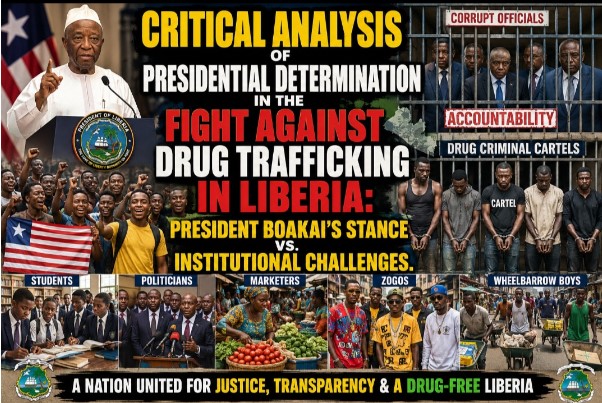
A Critical Analysis Of Presidential Determination In The Fight Against Drug Trafficking In Liberia
By Austin S Fallah – A True Son of the Planet Earth Soil: fallahas@yahoo.com
“Life is a gift, not a problem to solve.” Austin S Fallah
Liberia’s security apparatus cannot be an institution where kakistocrats are hired or an institution of kakistocracy if genuine progress is to be made in the fight against drugs and drug cartels.”
President Joseph Nyuma Boakai: “Any individual, group, or network that seeks to exploit our territory, corrupt our institutions, endanger our youth, or undermine our national security will be identified, pursued, and brought to justice.”
President Joseph Nyuma Boakai: “Liberia will not be used as a haven, transit point, warehouse, financial center, or operational base by criminal networks engaged in narcotics trafficking.”
Austin S Fallah: “Liberia should not be used as a haven, transit point, warehouse, financial center, or operational base by criminal networks engaged in narcotics trafficking.”
Austin S Fallah: “Fighting the cartel outside government is only half the battle. Fighting corruption inside the institutions responsible for fighting the cartel is the other half.”
The ongoing battle against drug trafficking remains one of the most pressing and complex issues faced by nations worldwide, and Liberia is no exception.
President Joseph Nyuma Boakai has emerged as a stalwart against this menace, asserting a strong anti-drug narrative with impassioned declarations about safeguarding Liberia’s sovereignty and security.
His statements make it clear that Liberia will not serve as a breeding ground for narcotics traffickers or related criminal enterprises.
This korero seeks to explore President Boakai’s statements against drug cartels, juxtaposed with the very real challenges that institutions in Liberia face, particularly in holding public officials accountable and dismantling entrenched networks of corruption that often empower these illicit activities.
The Presidential Narrative Against Drug Trafficking:
President Boakai’s pronouncements against drugs and drug cartels convey a resounding commitment to curb the pervasive influence of narcotics trading in Liberia.
For example, he has declared, “Though I maintain that Liberia is open for business, Liberia is not open for the business of drug trafficking.”
This statement encapsulates a dual commitment: on one hand, it recognizes the potential economic opportunities available in Liberia, while on the other, it emphasizes a zero-tolerance stance for narcotics-related activities.
President Boakai’s assertion should be understood in the context of Liberia’s challenging past, characterized by civil war and instability that the infiltration of drug trafficking networks has exacerbated.
The core of Boakai’s position is rooted in a desire to protect Liberia’s youth and future.
By saying, “Any individual, group, or network that seeks to exploit our territory, corrupt our institutions, endanger our youth, or undermine our national security will be identified, pursued, and brought to justice,” he expresses the urgency of preventive measures alongside punitive actions.
His commitment to accountability and justice sets a clear standard; this is a president determined to draw a line in the sand against those who would exploit the vulnerabilities of Liberia.
However, merely proclaiming a stance against drug trafficking is not sufficient to dismantle the complex, adaptive networks that exist in this arena.
The realities on the ground present a daunting challenge, as Boakai’s declarations prompt deeper questions about their tangible implications: Are there mechanisms in place to ensure that these bold statements are transformed into actions?
Is there a framework for transparent investigations and appropriate prosecutions of implicated individuals, particularly public officials who might serve as obstacles to enforcement?
The Institutional Challenges in Liberia:
To fully comprehend the difficulties inherent in President Boakai’s promises, one must consider the state of Liberian institutions and governance.
Linear rhetoric can only go so far; substantial institutional frameworks need to accompany these declarations to effect real change.
The assertion by one of Liberia’s finest academicians and intellectuals (Austin S Fallah) in many of his articles on the danger of drugs and drug cartels;- that drug cartels do not flourish solely due to the sophistication of their traffickers but rather because institutions are penetrated, compromised, intimidated, or inadequately supervised by corrupt money-eating hyenas and vampires- resonates deeply within Liberia’s socio-political landscape.
Historically, Liberia has grappled with corruption at multiple levels of governance.
The presence of crooked officials who may turn a blind eye to drug trafficking for financial gain creates fertile ground for criminal enterprises to flourish.
Without the rule of law, the capacity to conduct transparent investigations, seize illicit assets, and prosecute diminishes significantly.
As Fe-Nya-Nah, Keh-Keh President Boakai calls for justice, we must examine whether the legal frameworks and institutional integrity exist to support this call.
For instance, Liberia’s law enforcement agencies have often been cited for their underfunding and lack of resources, which severely limit their operational capabilities.
The police departments may lack adequate training, technology, and workforce to enforce drug laws effectively, and the judicial system remains burdened by inefficiencies, leading to delays in the prosecutorial process.
These systemic weaknesses not only stall justice but raise doubts about the sincerity of President Keh-Keh Boakai’s statements.
The Role of International Support and Collaboration:
A significant element in combating drug trafficking effectively is the role of international cooperation and support.
The transnational nature of narcotics trafficking requires countries to collaborate in intelligence sharing, joint operations, and capacity building.
Moreover, countries facing similar challenges can learn from each other’s successes and failures.
In this context, President Boakai’s declarations of justice resonate with potential for international partnerships that could reinforce Liberia’s institutional strengths.
For example, neighboring countries that have experienced successes in similar battles can provide guidance, resources, and shared intelligence.
The support from international organizations, such as the United Nations Office on Drugs and Crime (UNODC), offers a framework within which Liberia can develop more robust mechanisms to combat trafficking.
While President Boakai sets a moral tone against drug trafficking, establishing partnerships could translate lofty rhetoric into actionable steps, bolstering Liberia’s ability to investigate and prosecute drug-related crimes effectively.
Without external assistance and strategic global partnerships, the fight against drug trafficking may become a Sisyphean endeavor, one that sees temporary successes immediately reversed by underlying institutional weaknesses.
The Importance of Civil Society Engagement:
Another crucial aspect that President Boakai must incorporate into his anti-drug trafficking agenda is the engagement of civil society.
Grassroots organizations and community leaders play a pivotal role in creating awareness, mobilizing local populations, and monitoring government actions.
They can serve as a vital check on power, ensuring that the ramifications of drug trafficking are addressed at the community level.
Civil society can also assist in advocacy efforts, encouraging transparent governance and holding public officials accountable.
If communities feel empowered to denounce drug activity and support officials who act against it, the environment becomes far less hospitable for traffickers.
President Boakai’s patriotic statement could thus amplify voices of reform within communities, promoting a culture that is less tolerant of corruption and directly influencing the effectiveness of potential investigations and prosecutions.
The Power of Education and Prevention:
As President-Keh-Keh Boakai looks to act against drug trafficking, an effective approach must incorporate educational initiatives targeting the youth.
The toxic allure of drug use and trafficking can be mitigated through comprehensive education programs that inform young people about the risks associated with drug involvement.
By fostering resilience and understanding, these programs can help combat the narrative that glorifies drug culture and trafficking.
President Boakai’s rallies against drug trafficking can be more potent when coupled with initiatives that prioritize education, job creation, and community support.
When youth and young adults envision viable and constructive futures, their susceptibility to the influences of drug trafficking diminishes significantly.
President Joseph Nyuma Boakai’s strong proclamations against drug trafficking present a powerful moral stance for Liberia at a crucial moment in its history.
However, for these words to have substantive meaning and lead to tangible changes, they must catalyze a series of structural shifts within the country’s institutions, engage civil society, promote preventive education, and leverage international support.
Ultimately, the fight against drug trafficking is not primarily about rhetoric, but about reform and resilience, building strong institutions that are transparent and free from corruption, ensuring that justice is administered fairly, and empowering communities to combat the effects of narcotics from the ground up.
The challenge lies in transforming President Boakai’s impassioned declarations into a viable strategy that confronts the systemic issues plaguing Liberian governance while mobilizing support from every segment of society.
Only then can Liberia hope to emerge as a nation unyielding against the perils of drug trafficking and associated criminal enterprises.