
By Austin S Fallah – A True Son of the Planet Earth Soil: fallahas@yahoo.com
RHETORIC — When Politics Weaponizes Identity: “Rhetoric becomes dangerous when a politician teaches citizens to see a fellow Liberian first as a tribe, and only afterward as a human being. The loudest tribal slogan may win an election, but it can lose a nation.”
African wisdom reminds us: “When brothers fight to death, a stranger inherits their father’s estate.”
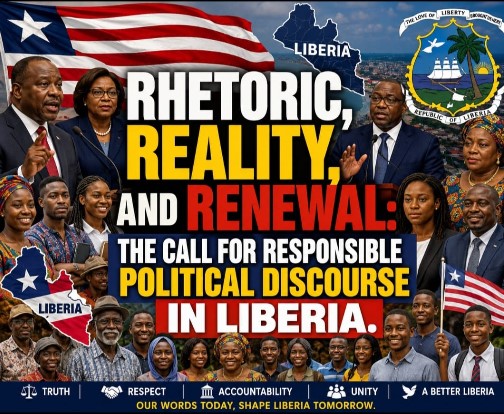
Rhetoric, Reality, and Renewal: The Call for Responsible Political Discourse in Liberia:
REALITY — The Cost of Division: “The reality of tribalism is not found in campaign speeches; it is found in broken trust, divided communities, unequal opportunity, and citizens who begin to doubt whether Liberia belongs equally to them all.”
As Ngũgĩ wa Thiong’o warned through his literature, division can become more destructive than the weapons used against a people.
Rhetoric, Reality, and Renewal: The Call for Responsible Political Discourse in Liberia: TRIBALISM — A Political Trap:
“Tribalism is a political trap: today it may be used to defeat your opponent; tomorrow it may be used to deny your own child an opportunity.
When identity replaces merit, Liberia loses twice—once in justice and again in progress.”
African proverb: “He who has people is richer than he who has money.”
Let our people be our strength—not our political weapons.
Rhetoric, Reality, and Renewal: The Call for Responsible Political Discourse in Liberia: ACHEBE — The Danger of Fighting Ourselves:
“Chinua Achebe’s wisdom reminds us that society cannot survive when its people stop listening to one another.
Liberia must never allow political competition to turn our ethnic and cultural diversity into a battlefield.”
The lesson is simple: diversity should produce dialogue, not domination; differences should produce understanding, not hatred.
Rhetoric, Reality, and Renewal: The Call for Responsible Political Discourse in Liberia: THE POET’S WARNING — Words Have Consequences:
“A poet understands the power of a word; a responsible politician must understand it too.
One careless ethnic insult can travel farther than a thousand speeches of reconciliation.
Political leaders must, therefore, measure their words by the wounds they might create-and the peace they could preserve.”
African proverb: “If one finger brought oil, it soiled the others.”
In Liberia, words must heal the republic, not fracture it.
Rhetoric, Reality, and Renewal: The Call for Responsible Political Discourse in Liberia: RENEWAL — From Tribe to Nation: “Renewal begins when Liberians refuse to inherit political hatred simply because it was handed down to them.
Our ancestors gave us identities, cultures, languages, and traditions; they did not permit us to destroy one another.”
As African literary traditions repeatedly teach, a community survives through dialogue, collective responsibility, and the recognition of our shared humanity.
Rhetoric, Reality, and Renewal: The Call for Responsible Political Discourse in Liberia: THE LIBERIAN CHOICE — Democracy or Division: “Liberia’s greatest political test is not whether one tribe defeats another; it is whether Liberians can build a democracy in which no tribe must defeat another for the nation to win.
Let our rhetoric speak truth, let our reality demand justice, and let our renewal begin with responsible political leadership.”
Emperor Haile Selassie warned African leaders to avoid the “pitfalls of tribalism,” arguing that division along tribal lines opens the door to outside intervention and weakens the continent.
In Liberia’s political landscape, where the echoes of past conflicts are still prominent, divisive rhetoric that perpetuates falsehoods and deceitful narratives is not only unproductive but detrimental to the nation’s progress.
The harmful discourse employed by some self-proclaimed saviors has created a miasma that suffocates the potential for growth and reconciliation.
Politicians who wield their influence through a “barmecide” allure of empty promises must abandon these detrimental strategies and embrace a narrative that uplifts the nation’s spirit.
Liberia’s leaders must engage with their constituents in a way that cultivates hope and positivity rather than fear and division.
The significance of responsible political rhetoric cannot be overstated.
It shapes public perception, influences policy, and ultimately determines the course of national development.
In Liberia, a country grappling with the scars of civil war and the persistent shadow of poverty, the use of disingenuous rhetoric serves to deepen the divides within society.
The ramifications of this approach are not merely local; they also shape the international community’s perception of Liberia.
When politicians indulge in mammonish sentiments, prioritizing personal gain over the well-being of the populace, they perpetuate a cycle of disappointment and mistrust.
The despair this rhetoric creates resembles a festering miasma.
Rather than celebrating the potential of the nation and its people, this toxic atmosphere breeds fear and pessimism; it hampers collaboration, innovation, and growth.
Liberia’s history is marked by struggle, yet the resilience and hope of its citizens have always been its greatest assets.
Political leaders must recognize and harness this potential rather than exploit the vulnerabilities that arise from a history tainted by conflict.
An essential aspect of hope lies in the language used.
The incessant barrage of falsehoods and harmful narratives instills helplessness among the populace.
Liberians, weary from repeated disappointments, are ready for a new chapter.
A palinode, a retraction or correction of previous statements, might be necessary for politicians who have historically engaged in such practices.
They must acknowledge their past mistakes and actively work towards crafting a narrative that empowers rather than disorients.
This shift is not merely a necessity; it is a moral obligation for those who aspire to lead the nation.
Furthermore, as Liberia stands on the precipice of a new era, characterized by advances in technology and global interconnectedness, the call for authentic political engagement is more critical than ever.
The proliferation of social media serves as both a blessing and a curse.
While it can amplify positive narratives of change and empowerment, it also allows the rapid spread of disinformation.
Political leaders must be vigilant custodians of truth, using their platforms to foster dialogue and understanding rather than deepening misconceptions and distrust.
The consequences of neglecting this responsibility are dire.
The notion that Liberia is a time bomb waiting to explode is not unfounded; it reflects the collective anxiety stemming from socio-economic inequities and unresolved tensions.
However, perpetuating this metaphor only amplifies fears instead of addressing the root causes of these sentiments.
Instead, political and religious leaders should strive to transform Liberia into a beacon of hope and resilience, counteracting pervasive narratives of doom by showcasing stories of change and success that resonate with the lived experiences of ordinary Liberians.
Liberia is home to a tapestry of cultures, histories, and aspirations.
Emphasizing this diversity can be a unifying force.
Politicians must foster an inclusive narrative that celebrates each community’s unique contributions.
Engaging different segments of society in meaningful dialogue is crucial to building a shared vision for the nation’s future.
Such an approach not only deters divisive rhetoric but also cultivates a sense of belonging among the populace, essential for building a cohesive and progressive nation.
Education is an integral part of this transformative process.
Leaders must commit to investing in educational frameworks that prioritize critical thinking and media literacy.
By empowering citizens with the knowledge to discern fact from fiction, the cycle of misrepresentation can be curtailed.
Moreover, educated citizens are better equipped to participate actively in their governance, demanding accountability and transparency from their leaders.
Moreover, the role of international partnerships and aid organizations cannot be overlooked.
There is an opportunity for collaborative efforts that prioritize genuine developmental needs over political gain.
The approach should go beyond financial aid and include initiatives that build capacity, foster local ownership, and emphasize sustainable practices.
Policymakers should shift from a dependency on external support to empowering local communities through skill-building and resource allocation.
In light of these considerations, Liberians are indeed weary of empty tautologies and rhetoric that serves no purpose other than to perpetuate fear.
Liberation from the metaphorical gutters of abject poverty is not merely a call for aid but a rallying cry for self-determination; now is the time to uplift spirits and enable growth.
The path forward requires a concerted effort from all stakeholders, government, civil society, international partners, and the wider community to construct an inclusive narrative that embodies peace, love, and happiness for all Liberians.
Liberia’s political landscape is at a crossroads.
The imperative for politicians to halt the destructive cycle of divisive rhetoric has never been clearer.
By replacing falsehoods with truth, fear-mongering with empowerment, and mammonish pursuits with altruism, a renewed narrative can resonate with all Liberians.
The choice is not merely about political survival; it is about the collective future of a nation yearning for peace and prosperity.
Each leader has the potential to be a catalyst for change, crafting a vision that embodies the aspirations of a united Liberia.
Embracing such a vision is critical not only for the country’s healing but also for the resurgence of hope among its citizens.
The time for a palinode, from divisive rhetoric to a narrative of liberation is now.
As Liberia emerges from the shadows of its past, it is a shared responsibility for all to work collaboratively towards a brighter future.
A future where the oceans of peace, love, and happiness truly reign, with each citizen equipped and empowered to participate actively in the nation’s journey.
It is time to stop sitting on this proverbial time bomb and instead, together, detonate the forces of unity and progress that will lead Liberia into a hopeful tomorrow.