
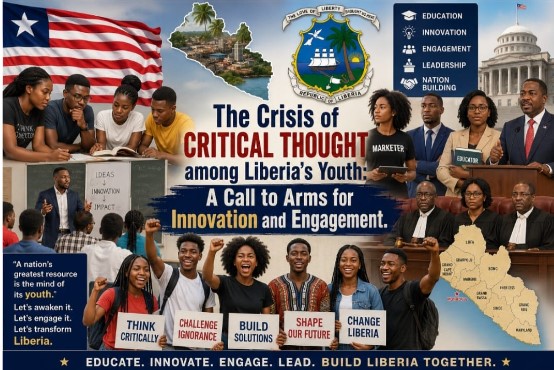
A Call To Action For Innovation And Engagement
By Austin S. Fallah – A True Son of the Planet Earth Soil: fallahas@yahoo.com
President Joseph Nyuma Boakai: “These scholarships are not just about imbibing theories; they are about nation-building. They are about equipping Liberia to feed itself, heal itself, and power itself forward. Let us call for a new national chapter in which education becomes a national obsession, youth a national treasure, and learning a tool of liberation and progress.”
Former President George Weah: “Our kids deserve the best, and we must provide them that. There are people here who have no opportunities and are seeking them to help improve their lives. We, as a government, must be in a position to help lift them out of their predicaments.”
Former President Ellen Johnson Sirleaf: “Our educational system is a mess. The students’ failure did not come from the university, but rather from the schools that prepared them. If you call yourself a student and you don’t embrace education, you are failing yourself, your community, and your country. We need everyone to develop their talents, their skills, and their intellect to help us solve our nation’s problems.”
Former President William R. Tolbert Jr.: “We must build a wholesome functioning society. Our youth must move away from the passive absorption of facts and become active, innovative participants in the development and transformation of our nation.”
Former President William V.S. Tubman: “The future of this country rests upon the type of education given to our young people. It must not only be an education of the book, but an education that disciplines the mind to think clearly, act justly, and serve patriotically.”
Former President Samuel K. Doe: “The development of Liberia requires the technical know-how and dedication of its young people. If our youth do not challenge themselves to think and innovate, the progress of this nation will always be stagnant.”
Dr. Edward B. Kesselly (Renowned Liberian Statesman and Scholar): “National consciousness cannot grow in an environment where minds are trained only to repeat and not to question. The ultimate liberation of the Liberian populace depends entirely on an educational system that rewards intellectual curiosity and structural innovation.”
Hon. Gabriel Baccus Matthews (Veteran Politician and Progressive Leader): “The mobilization of the youth must not merely be for political rallies or emotional slogans. It must be a mobilization of the intellect. True political awareness begins when young minds learn to critically analyze their socio-economic realities rather than blindly following political figures.”
Ambassador Cllr. Henry Boimah Fahnbulleh Sr. “We are teaching children what to think instead of how to think. If our curriculum remains a rigid mechanism of rote memorization, we will continue to harvest a generation that lacks the creative autonomy necessary to drive an independent state.”
Dr. Theophelous Sonpon & John G. Ramsey (Prominent Educators/Critical Thinkers): “The crisis of critical thought is the quiet emergency of our time. Innovation does not happen by chance; it happens when the youth are given the tools to question assumptions, challenge tradition constructively, and actively engage with global scientific advancements.”
Historical Perspective from Former Presidents of the University of Liberia: “A university is not a factory for degrees; it is a laboratory for critical inquiry. When our students default to compliance rather than analytical debate, the university loses its soul. We must foster an environment where dissent is intellectual and engagement is innovative.”
Liberian National Student Union (LINSU) / University of Liberia Student Union(ULSU): “We refuse to be a generation defined by political exploitation or intellectual stagnation. We call for an educational revolution that equips students with tech-driven, problem-solving skills. Our engagement must shift from the streets to intellectual arenas where the blueprint for Liberia’s future is designed.”
Nelson Mandela (Former President of South Africa): “Education is the most powerful weapon which you can use to change the world. But true education must teach our youth to think for themselves, to innovate, and to cultivate a vibrant civic responsibility.”
Global Educational Experts (Reflecting on Critical Thinking Initiatives in Liberia)”Teachers learn strategies to improve their students’ performance and support their own ability to conduct self-reflective problem solving and active engagement in the educational process. Democratic practices in schools play an important role in the transition toward more open societies.”
As the clock ticks into the latter half of the 21st century, the world observes a significant shift in how young people are engaging with their realities, both locally and globally.
The youth-young people of Liberia, however, find themselves grappling with a profound crisis rooted in an alarming lack of intellectual engagement, innovative thinking, and critical analysis.
This predicament, marked by an inclination toward baseless propaganda often steeped in outdated ideologies, hinders the potential of a generation poised to contribute meaningfully to their country and the world.
In examining this crisis, it is clear that Liberian youth must undergo a transformative awakening that embraces fresh perspectives, nurtures critical thinking, and inspires innovative engagement so their voices can thrive, both nationally and on the global stage.
To appreciate the context of this crisis, one must recognize the historical and sociopolitical backdrop against which these young Liberians find themselves.
The remnants of civil conflict, compounded by systemic poor governance and a prolonged atmosphere of economic instability, have fostered a pervasive sense of disillusionment among the youth.
With their formative years marred by chaos and uncertainty, many Liberians aged 18 to 35 have inherited a narrative of division, despair, and mediocrity.
This prevailing mindset is not merely a byproduct of circumstance; it is perpetuated through a troubling cycle of outdated beliefs that undermine the pursuit of intellectual growth and critical thinking.
The vocal discourse among Liberia’s youth reveals a troubling trend, a consistent reliance on medieval-age propaganda that not only divides but also stifles the potential for competitive growth on a global scale.
Conversations and media interactions are often dominated by rhetoric that reflects an unwillingness to evolve beyond historical grievances and unfounded conspiracies.
Instead of fostering a sense of unity and collective ambition as seen among their counterparts in the Mano River Union Basin, ECOWAS, and beyond, young Liberians are ensnared in a web of ideological confinement that distances them from constructive engagement.
This environment ultimately paves the way for a debilitating cycle of stagnation, feeding into a narrative that perpetuates ignorance rather than progress.
Indeed, when juxtaposed against the backdrop of global youth culture, the limitations of Liberian youth become glaringly evident.
In contrast to young people from other nations who leverage their innovation to craft solutions and generate impactful ideas, Liberia’s youth often find themselves trapped in unproductive discourse.
Social media, a powerful tool for connectivity and idea-sharing, becomes a platform for echoing outdated narratives rather than challenging them.
While the youth of more progressive nations use social media to share creative ideas and analyze critical issues, Liberian youth’s engagement often retreats into traditionalist frameworks that stifle genuine dialogue and innovation.
The critical-thinking gap among Liberia’s youth manifests in their communication styles and modes of engagement.
Too often, conversations devolve into unproductive cycles in which ad hominem attacks and rhetoric trump reasoned discourse and empathetic understanding.
The arts of persuasion, dialogue, and constructive criticism, hallmarks of intellectual engagement, are rendered impotent as young people favor binary narratives over nuanced discussions.
Engaging in this manner not only limits individual growth but also entrenches societal divisions that ultimately hinder national progress.
The propagation of outdated ideologies breeds an echo chamber that discourages dissent, exploration, and the healthy clash of ideas necessary for societal advancement.
It is thus imperative that Liberian youth embark on a new journey towards arming themselves with the tools of critical thinking.
Such an awakening necessitates deliberate efforts to cultivate an education system that fosters intellectual curiosity and innovative thinking.
Educational institutions must move beyond rote memorization and outdated curricula, integrating critical thinking, creativity, and problem-solving into the genesis of learning.
Young people must be encouraged to question, critique, and innovate rather than accept prevailing narratives unchallenged.
Additionally, creating safe spaces for dialogue among youth from varying backgrounds will serve as a breeding ground for new ideas and initiatives.
Whether through youth-led forums, online platforms, or community organizing, opportunities for meaningful discourse must be prioritized, rather than continually engaging in tautologies that have led them nowhere in their pursuit of better opportunities.
Encouraging a culture of respect for differing opinions can foster a more vibrant democratic ethos while enabling young people to coalesce around shared goals that transcend historical grievances.
Liberian youths-young people must also grasp the importance of understanding their identity in a global context.
Engaging with international perspectives can enrich the local discourse and inspire innovative approaches to solving domestic issues.
By learning from how other nations have navigated challenges, young Liberians can chart a course tailored to their context.
Moreover, collaborations with global counterparts can facilitate exchanges that foster creativity while providing mentorship opportunities, ultimately bridging the gap between local and global engagement.
Moreover, since economic empowerment plays a crucial role in fostering innovation and critical engagement, more focus must be placed on entrepreneurship.
Developing initiatives that stimulate the entrepreneurial spirit among youth will be vital in encouraging self-sufficiency and creative problem-solving.
Sustainable agricultural practices, technology, driven business models, and local craftsmanship can serve as avenues for young Liberians to express their creativity, challenge norms, and flourish.
The familiar phrase, “a mind is a terrible thing to waste,” resonates deeply within the narrative of Liberia’s youth.
As they grapple with their identity and future amid the remnants of conflict and divisive narratives, they must recognize the urgent need for a cognitive renaissance.
By embarking on a critical journey that champions innovation, genuine engagement, and intellectual rigor, young Liberians can reclaim their narrative, redefine their place in society, and ultimately carve pathways to a more hopeful and promising future.
The existential challenges faced by Liberia’s youth, stemming from a lack of intellectual engagement and innovation, call for a transformative awakening.
This awakening must champion critical thought, open dialogue, and meaningful engagement with the wider world.
By dismantling outdated ideological dogmas and fostering a culture of curiosity and creativity, Liberian youth can empower themselves and emerge as leaders who will navigate their nation towards a brighter, competitive future.
“Knowledge is power; the more you know, the more informed you are to make better decisions.”
Embracing this call to arms requires a collective effort that prioritizes education, dialogue, and entrepreneurship, an endeavor that will not only elevate them nationally but also position them favorably on the international stage as empowered contributors to global discourse.
The future awaits their innovation; it is time for Liberia’s youth to seize it.