
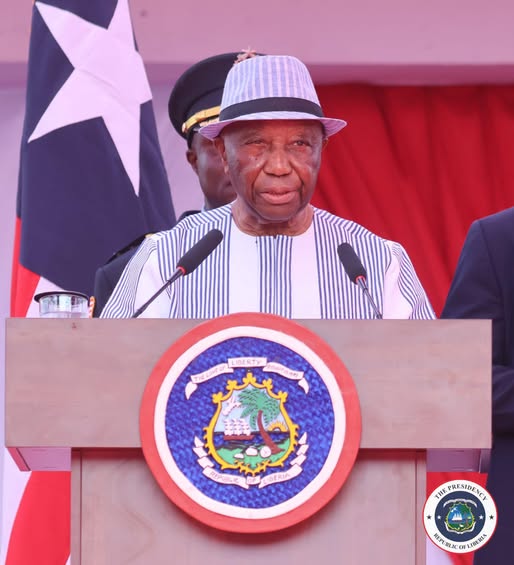
Below is full text of Pres. Boakai’s SONA:
ANNUAL MESSAGE DELIVERED BY H.E. JOSEPH NYUMA BOAKAI, SR.
PRESIDENT, REPUBLIC OF LIBERIA
To the 55th Legislature
Monday, January 26, 2026
THEME: From Resolve to Results: Building on Progress and
Delivering for the Liberian People.
Mr. Vice President;
Madam First Lady;
Mr. Speaker, and Members of the House of Representatives;
Madam Pro Tempore and Members of the Senate;
Mr. Chief Justice, Associate Justices, and Members of the Judiciary;
Madam Dean and Members of the Cabinet;
Mr. Doyen and Members of the Diplomatic Corps;
Former Presidents;
Former Officials of Government present;
Heads and Officials of Political Parties;
Prelates and Members of Religious Organizations;
Our International and Local Partners;
Traditional Leaders, Chiefs, and Elders of our land;
My Fellow Liberians;
Distinguished Ladies, and Gentlemen:
Our deep gratitude is to God Almighty, the Sustainer and Preserver of our nation, for His enduring grace and blessings over the past year and throughout our history.
We are gathered here in fulfillment of Article 58 of the Liberian Constitution, which requires the President to present an annual message on the State of the Republic, the condition of the economy, and the legislative Agenda for the year ahead.
This Annual Message reviews our progress in the second year of this Administration, and sets forth our priorities for 2026. It reflects our commitment to reform, accountability, and results that improve the lives of the Liberian people.
Mr. Speaker and Honorable Members of the Legislature, we are painfully reminded, again, of last year’s arson attack on the Capitol Building. This attack on our symbol of democracy has forced us, for the second year, to meet in this courtyard instead of the historic chamber.
The legal process to bring those responsible for this heinous act is still ongoing. I, however, assure every Liberian that my administration is pursuing this matter with resolve and impartiality, and that anyone found guilty will bear the full weight of the law! I use this time to remind those driven by narrow personal interests that this country is moving forward, not backward.
As Winston Churchill once observed, we must “never yield to the power of the adversary if it contradicts honor.” In that spirit, our democracy will not be intimidated, our institutions will not be diminished, our commitment to the rule of law and constitutional governance remains unshaken, and the progress we continue to make will not be thwarted.
Honorable Members of the Legislature, over the past two years, my Administration worked to tackle inherited challenges, stabilize the economy, and deliver key development milestones. Despite limited resources, we made progress across key sectors, including agriculture, infrastructure, education, health, tourism, and the rule of law, alongside important legislative initiatives. I am pleased to inform you that our country is in a better state than it was a year ago, and the progress of the past two years is real.
Looking ahead, we will continue implementing the ARREST Agenda to improve livelihoods, strengthen democratic governance, and enhance Liberia’s standing in the world.
THE LEGISLATIVE AGENDA
Mr. Vice President, Mr. Speaker, Madam President Pro-Tempore, and Honorable Members of the Legislature. Through collaboration and prompt passage of priority legislation, the government aims to strengthen institutions, grow the economy, and improve the well-being of all Liberians. Over the course of last year, the Executive submitted several bills to you for enactment into law.
I thank the members of this Body for your service and collaboration in passing several crucial bills during the Second Session of the Legislature. Key amongst those passed and signed into law are: the Ministry of Local Government Act to decentralize the government and allow greater participation in decision making at the local level; the Liberia National Tourism Authority Act to stimulate economic growth by leveraging the nation’s natural attractions and cultural heritage; an Act to establish the National Food Assistance Agency; and nine financing agreements between Liberia and our bilateral and multilateral development partners.
While the passage of these laws is commendable, urgent attention must now focus on advancing pending legislations. Key among these are the Presidential Transition Act to establish procedures for the transition from one elected government to the next. Our experience shows the need for these procedures to avoid arbitrary processes and conflicting expectations during periods of transition.
Also pending before you are the bills to establish the Civil Service Commission, and the Third Amendment to the Mineral Development Agreement with ArcelorMittal Holdings, among others. Delays in passing these measures will weaken the reforms needed for economic growth and institutional integrity.
Mr. Speaker and Honorable Members of the Legislature, I have also submitted four amendments to existing anti-corruption laws, including legislation to address illicit enrichment and to remove the existing statute of limitations on corruption cases.
In 2026, we will submit additional priority bills, including legislation to establish a National Planning Commission to strengthen development planning and budgeting, and a specialized court for property disputes to reduce the backlog of land cases. We will propose a universal health insurance program, and a bill to establish a National Road Authority dedicated to road construction and maintenance. We will also resubmit the revised Charter of the University of Liberia to accommodate needed reforms and administrative structures.
We will expand the Liberia Agriculture Commodities Regulatory Authority’s mandate to enhance the output, processing, and marketing of quality agricultural commodities. We will also seek an amendment to the Executive Law to restructure the Ministry of Foreign Affairs so it can better serve citizens and adapt to our evolving international responsibilities.
Finally, we will submit bills to repeal outdated People’s Redemption Council era decrees that created public institutions that no longer serve today’s governance needs.
Beyond legislation, my Administration issued sixteen Executive Orders to advance governance, economic, and social priorities in line with our national development goals. Each action, whether by law or order, was taken for one purpose: the benefit of the Liberian people.
We remain dedicated to fostering cooperation among all branches of government through mutual respect and open dialogue, as the Constitution requires.
STATE OF THE ECONOMY & 2026 ECONOMIC OUTLOOK
Mr. Vice President, Mr. Speaker, Madam President Pro-Tempore, and members of the Legislature; Fellow Liberians. Last year, we emphasized the economic challenges inherited by this Administration—not as an excuse, but to highlight the hurdles faced and the progress achieved.
Through disciplined fiscal management, sound policies, and robust partnerships, we began restoring stability and trust. As of 2024, the economy showed resilience, with steady growth, declining inflation, stronger reserves, and renewed momentum across key sectors. This progress continued into 2025, with macroeconomic stability and private-sector growth strengthening our commitments to the Liberian people.
We are proud to announce that the economy grew by 5.1 percent in 2025. This exceeds both the 4.6 percent forecast, and the 4.0 percent growth recorded in 2024. The achievement was driven by significant gains in mining, agriculture, fisheries, and services. Mining expanded by 17 percent, and exports rose by 31.5 percent.
Looking ahead, ongoing reforms and infrastructure investments are expected to boost growth to over 5 percent in 2026, with average growth projected at about 6 percent from 2026 to 2028. Inflation fell to 4 percent by December 2025 – the lowest in over two decades, down from 10 percent when we took over in 2024. These achievements signaled effective monetary and fiscal policies coupled with anticipated ease in import costs.
Liberia’s external sector performed well in 2025. Gross international reserves increased from $475 million in 2024 to $576 million, surpassing the previous year by US$101 million. Also, net international reserves exceeded IMF targets, potentially reaching $280 million by December 2025 and exports grew over 31 percent to about $2.1 billion.
Our medium-term strategic gold initiative, or gold purchase program, is expected to further strengthen reserves, enhancing economic resilience. We are proud to report that we met nearly all IMF Performance Criteria in June 2025, reaffirming our commitment. The IMF External Credit Facility remains crucial for rebuilding reserves to cover 3.3 months of imports by 2027, supported by prudent fiscal measures.
Foreign investments in iron ore mining will also boost exports and the current account. Since September 2025, the foreign exchange market has been stable due to good liquidity management, fiscal discipline, and strong export earnings. The Liberian dollar appreciated by at least 3 percent against the US dollar. We are committed to maintaining currency confidence and stability.
To promote financial inclusion, we accelerated Liberia’s digital finance revolution—processing over 275,000 transactions valued at more than 375 million Liberian Dollar and US$2.7 million by December 2025. Our goal is to raise financial inclusion from 52 percent in 2024 to over 70 percent by 2029.
The Central Bank is rebuilding public trust by strengthening governance and accountability and managing government securities more openly. In 2025, it issued US$44.4 million, rolling over US$132.1 million, and 7.6 billion Liberian Dollars. And for the first time in decades, the Bank recorded consecutive operational surpluses in 2024 and 2025.
ECONOMIC RELATIONS WITH BILATERAL AND MULTILATERAL PARTNERS
Mr. Speaker and Honorable Members of the Legislature, despite real achievements in 2025, our development program faced one of its toughest tests. An abrupt slash in donor support during the second quarter disrupted financing for essential social and economic projects. This led to job losses, reduced incomes, and hardship for many families. The government stepped in to close funding gaps and keep critical services running, but the disruption slowed implementation and strained our plans.
Notwithstanding these challenges, we are pleased to report that we weathered the storm by instituting a package of measures that included tighter fiscal controls, while protecting critical social expenditure in health and education, and significantly enhancing domestic resource mobilization efforts.
Reaffirmed commitment from donor partners for 2025 amounted to US$381 million, including US$63 million in direct budget support and US$321.5 million for programs and projects.
During the year under review, the Government concluded nine financing agreements totaling US$334.98 million including US$98.58 million in concessional loans and US$236.4 million in grants, to advance national priorities. These agreements supported investments in infrastructure, human capital development and natural resource management.
Mr. Speaker and Honorable Members of the Legislature, I also informed you last year that our engagement with the United States had positioned Liberia for a Millennium Challenge Corporation Compact. I am pleased to report that after a review and reassessment by the new US Government, Liberia’s eligibility for a second MCC Compact was reaffirmed in December 2025. The compact development process has begun, focusing on investments in energy and job creation.
We extend profound appreciation to our bilateral and multilateral partners—including the United States of America, European Union, the People’s Republic of China, the, the United Kingdom, Japan, Qatar, United Arab Emirates, Kuwait, Morocco, the International Monetary Fund, the World Bank, the African Development Bank, the United Nations and its agencies, the African Union and the Economic Community of West African States, and the Mano River Union—for their trust, support, and ongoing commitment to Liberia as we strive to restore stability and bring essential relief and opportunities to our people.
REVENUE AND EXPENDITURE
STRENGTHENING DOMESTIC REVENUE MOBILIZATION TO BUILD FISCAL RESILIENCE
Last year’s external funding cut was a wake-up call. It exposed how vulnerable we become and the risks to our security when we rely too much on external support. In my Annual Message last year, I pledged to strengthen domestic revenue by aligning reforms with regional benchmarks, improving tax compliance, and investing in digital systems, including a modern customs inspection center at the Freeport of Monrovia. We have made real progress on these commitments, and the results are clear.
Liberia can finance more of its own development if we put the right policies in place and collect what is due. For FY2025, we approved a national budget of US$880.5 million, funded largely by US$804.6 million in domestic revenue. By year-end, total revenue reached US$885.8 million, exceeding the target by US$5.1 million. Domestic revenue alone amounted to US$847.7 million, surpassing the target by US$43.1 million—the highest ever recorded in Liberia. That is an increase of US$148 million over 2024, the largest single-year gain in our history. Last year, we submitted and you approved a budget of more than US$1.2 billion for FY2026, representing the highest budget in the history of our country.
Over the past two years, domestic revenue has risen by US$235.7 million. This reflects stronger policy choices, improved administration, digitalization, and better compliance. I commend the Liberia Revenue Authority and all partner institutions for their professionalism, and I call on this Legislature to work with us to sustain these gains and direct every dollar toward results that improve the lives of our people.
Mr. Speaker and Honorable Members of the Legislature, I am pleased to report that on account of the robust revenue performance for 2025, the fiscal authorities are concluding processes that will lead to the submission of a supplemental budget to the Legislature next month—the first in many years.
EXPENDITURE
As of the end November 2025, government spending totaled US$709.7 million, including both recurrent and capital spending. Spending on roads accounted for a major share of capital expenditure.
DEBT STOCK AND DEBT SERVICE
Public debt stood at US$2.8 billion as at end December 2025. Domestic debt—mainly owed to the Central Bank and commercial banks—was US$1.2 billion. External debt, largely to the World Bank and the African Development Bank, was US$1.6 billion.
Despite fiscal pressures, the Government remained largely current on its debt commitments, paying US$120.1 million in debt service to both domestic and external creditors in 2025. We will continue prudent debt management and fiscal discipline.
POLICY REFORMS
To strengthen the economy and address fiscal constraints, my Administration has introduced major financial management reforms to boost revenue. enacted the Tax Expenditure Bill, tightened exemption controls, and are preparing to implement a Value-Added Tax system by 2027.
To support the FY2026 US$1.2 billion budget, we will expand the tax base by cracking down on evasion, updating tax rules, raising the Goods Tax by a modest one percent, and revising Excise Rates.
ATTRACTING INVESTMENT TO BUILD A PRODUCTIVE ECONOMY
The Government has strategically leveraged opportunities to attract credible investments and responsibly exploit natural resources for the benefit of Liberians.
In 2025, the Government signed key agreements to boost economic growth, infrastructure, and employment, including a Concession and Access Agreement with Ivanhoe for the Yekepa–Buchanan rail corridor, and an amended deal with ArcelorMittal Liberia. Together, these represent approximately US$4 billion in committed investments.
The Government has commenced the process of reactivating the Putu Iron Ore Mine. This will boost job creation and accelerate development in Grand Gedeh County and the southeastern region.
In the hydrocarbon sector, the Government signed eight new petroleum agreements—four with TotalEnergies and four with Oranto Petroleum. Once fully developed, these projects are expected to bring in about US$800 million in investments to boost the sector.
MAKING LIFE MORE AFFORDABLE FOR LIBERIANS
Mr. Speaker and Honorable Members of the Legislature, despite ongoing global supply pressures, our actions have helped lower the cost of essential goods. Prices have eased for rice, flour, and fuel—relief that families can feel in their daily lives. For instance, a 25kg bag of Indian parboiled rice now retails at US$14.50, and flour has dropped to US$35 per 100lb bag.
Fuel has also stabilized at about US$4 per gallon, helping to reduce transport costs. We strengthened supply and quality by completing a 17,000-cubic-meter fuel storage tank and a modern testing laboratory at the Liberia Petroleum Refining Company, thereby improving storage capacity, fuel standards, and national energy security.
Mr. Speaker and Honorable Members, I commend the Vice President and the Price Committee for acting to prevent unjustified price increases that harm our people. Let me be clear: businesses that exploit consumers will be held accountable!
Job creation remains a top priority for my Administration. Our job creation strategy has focused on addressing the binding and structural constraints to growth, including investments in roads, energy, etc. In this connection, we have created more than 70,000 short and medium-term jobs across Infrastructure, Agriculture, Social Protection, and small businesses, among other sectors.
Going forward, the Youth Entrepreneurship and Investment Bank project, launched in 2025, will support 30,000 youth-led businesses, creating over 120,000 direct and indirect jobs for youth. A National Employment Acceleration Strategy, focused on agriculture, public works, skills training, and support to small enterprises is being finalized. This will facilitate more Liberians to earn decent livelihoods with dignity.
THE NATIONAL DEVELOPMENT PLAN
Honorable Members of the Legislature, on January 15, 2025, the Liberian Government launched the ARREST Agenda for Inclusive Development (2025–2029) and the Fifteen County Development Agendas in Buchanan, Grand Bassa County. These initiatives reaffirm the country’s commitment to Vision 2030, focusing on delivering measurable results through decisive implementation. The current budget allocates US$290 million for capital investments in Public Sector Investment Projects, making this one of the largest recent government programs.
The ARREST Agenda aims to diversify Liberia’s economy beyond extraction and boost productivity through more than 370 interventions across sectors like agriculture, infrastructure, energy, tourism, governance, education, health, and sanitation, targeting annual growth above 5 percent. The broader goals will include raising GDP per capita above US$1,050 by 2029, reducing the trade deficit, and lowering poverty rates.
THE STATE OF THE REPUBLIC
DELIVERING RESULTS ACROSS SECTORS FOR IMPROVED LIVELIHOOD
AGRICULTURE: AT THE HEART OF THE ARREST AGENDA
Mr. Vice President, Mr. Speaker, Madam President Pro-Tempore, and members of the Legislature, I am pleased to report today that we have made substantial progress across key sectors, including agriculture, the heart of the ARREST Agenda for Inclusive Development and a driver of job creation, food security, and growth.
In 2025, over 198,000 farmers received government support, leading to expanded rice and cocoa cultivation, and increased aquaculture output. Infrastructure improvements, including the completion of 166 kilometers of feeder roads, have reduced transport costs and enhanced market access, resulting in 33,755 Liberians moving from food insecurity to food security.
In 2026 we will prioritize agribusiness, scaling rice production, expanding mechanization, operationalizing the One County—One Priority Commodity program, and improving sector financing through new banking legislation.
Additionally, the introduction of Liberia’s first fiberglass semi-industrial fishing vessel, the SEA KING, marks a milestone in boosting domestic fish production and food security. The government encourages private sector and investor engagement to drive inclusive agricultural growth.
INFRASTRUCTURE
ROAD DEVELOPMENT – CONNECTING COMMUNITIES
Mr. Speaker and Members of the Legislature, nearly three years ago, I assured the nation that roads would be our focus—not as a slogan but rather a commitment to connecting communities with opportunities.
In furtherance of this commitment, we focused on restoring key corridors and expanding secondary roads. We increased Liberia’s paved roads from under 12 percent to at least 20 percent, and maintained more than 780 km of major routes, ensuring year-round access. Connectivity improved between Brewerville and Bopolu, Salayea and Mendikorma, Tappita and Zwedru, as well as Buchanan and Greenville, reducing costs and easing hardships for citizens.
Key roads like Ganta–Saclepea (now 56 percent), Saclepea–Tappita (up to 92 percent), and Sanniquellie–Logatuo (at 86 percent) have advanced, while the Kelipo–Fish Town route is now fully paved.
Additional projects, including the Buchanan–Greenville highway, are in the pipeline, thanks to partner support from the African Development Bank, World Bank, and others. Efforts will be made to make Vahun more accessible to the rest of the country via road. The Army Corp of Engineers will play role in delivering this initiative.
In our ongoing commitment to maintain road access for our citizens, I am pleased to announce that the widely discussed 285 “Yellow Machines” procured by the government last year are currently being shipped to Liberia. These assets will be situated at county hubs and used to support road maintenance efforts and form crucial part of our disaster response preparedness efforts across the country.
Mr. Speaker, Honorable Members of the Legislature, Fellow Liberians, we continue to make progress in connecting county capitals and major assets. Although the RIA Road Corridor project faced delays due to ongoing audits and changes in scope, we were still able to increase the length of pavement from 20 to 25 kilometers. With the audit and rescoping nearing completion, full work on this corridor is expected to resume in 2026.
The Pavifort Concession Agreement, which is designed to promote public-private partnerships in road development, has been signed following your approval. Covered under this agreement are the Saint Paul Bridge to Bo Waterside, Medina to Robertsport, and Mendikorma to Voinjama corridors. Construction on this project is scheduled to begin next month with a groundbreaking ceremony.
Urban improvements on alleyways, drainages, and lighting in communities such as Sinkor, Vai Town and Caldwell, the Japan Freeway and Marshall are ongoing, improving access and security for communities. Work on the overpasses on Tubman Boulevard have commenced and are set for completion by 2027.
In rural areas, 411 km of rural roads and 122 km of urban roads have been paved since this Administration began. Looking ahead, the goal is to surpass 485 km of paved roads by 2029, strengthening national unity.
ENERGY: THE STATE OF ELECTRICITY
Mr. Speaker, Honorable Members of the Legislature, electricity is the critical enabler for industrialization and other critical development programs.
In 2025, the Government, through the Liberia Electricity Corporation, focused on stabilizing the energy sector and expanding access as part of the ARREST Agenda and our National Energy Compact.
Over 63,000 new connections were established, covering communities in Montserrado and electrifying 124 villages in Grand Bassa, Rivercess, Bong, and Nimba. Through these initiatives, 17,000 households have access to power for the first time.
Electricity tariffs have been cut to ease household costs, positioning energy as a driver for growth.
Through the Rural and Renewable Energy Agency, we used solar power to provide electricity for 88 clinics across 14 counties in rural regions. Harper, Barclayville, Kanweaken and Zorzor cities have each benefit 117 streetlights at part of lighting up rural communities.
We have installed 3,791 streetlights through the CLSG Rural Electrification program, benefiting over 124 towns and villages in Nimba, Grand Bassa, River Cess, and Bong Counties. The program also provided electricity to two universities (ABC and Cottington), two hospitals (River Cess District and Mother of Light Rehab), and is strengthening the cross-border grid in Nimba, Bong, and Margibi Counties.
Mount Coffee Hydropower remained reliable, outages decreased, and electricity sales rose by 24 percent. Revenue topped US$71 million, and collection efficiency reached 94 percent. Further investment in reforms at the LEC will aim at addressing inefficiencies, stabilizing the utility and ensuring reliable service.
In 2026, we plan to have 100,000 new connections, deploy advanced transmission lines and smart meters, and reduce system losses to 35 percent, with more improvements ahead. Major projects underway include a 250MW gas-to-power plant, a 200MW solar plant with storage, and a new hydropower project on the St. John River, alongside existing solar, thermal, and hydropower capacity—totaling over 700MW.
TELECOMMUNICATION, CONNECTIVITY AND DIGITAL TRANSFORMATION
Through our digital initiative, we created a new ICT Strategic Action Plan to modernize the national telecom framework, and half of government agencies have transitioned to a unified ICT system. By November 2025, 56 percent of these entities had fiber-optic network installed, and 80 percent of critical ICT infrastructure was secured with cybersecurity measures.
Digital finance advanced with mobile money use rising from 46 percent to 58 percent in 2025. The Central Bank launched the Inclusive Instant Payment System, enabling real-time transactions and cross-border payments across Africa. Mobile network coverage expanded into underserved areas, improving access and participation in the digital economy.
PORT INFRASTRUCTURE DEVELOPMENT (AIR AND SEA)
The National Port Authority remains a critical gateway to Liberia’s economy. Following my visit to Morocco last November, a Moroccan port development entity agreed to invest in equipment and logistics for the Port of Monrovia, breaking a longstanding monopoly and boosting competition.
Master plans for the ports of Monrovia and Buchanan have been developed. Tariff reforms are driving revenue growth. Further upgrades will include dredging the port of Monrovia for larger ships, easing congestion, reducing costs, and introducing 24-hour operations.
At Roberts International Airport, significant upgrades were completed, including the reopening of Taxiway Bravo, rehabilitation of the apron and jet bridge, and installation of new navigational aids. These improvements were finalized ahead of Turkish Airlines’ inaugural flight on May 11, 2026 representing a major advancement for Liberian aviation.
Additionally, an agreement has been secured with South Korea’s Make Group to develop a ship recycling center and establish a Private Public Partnership domestic airline in Liberia with an initial fleet of three aircrafts.
PUBLIC TRANSPORT
Mr. Speaker and Honorable Members of the Legislature, public transport is a vital service that every Liberian deserves. The National Transit Authority has long faced neglect, with deteriorated infrastructure and unchecked corruption. We are changing that.
Last year, we procured 64 buses, now deployed and serving Liberians nationwide. We also broke ground for a modern NTA headquarters, a step that will enhance service delivery and transform public transport in our country.
Reclaiming Our Global Maritime Presence
Since 1948, Liberia’s maritime program has been central to our economy and global standing, featuring the world’s largest open ship registry and skilled mariners. Recent modernization initiatives in the sector include a Domestic Watercraft Monitoring Program with AIS, the first in decades, and Vessel Monitoring System technology for enhanced safety.
Also, our re-election to the International Maritime Organization’s Category A affirms Liberia’s leadership in maritime governance.
SECTOR INTERVENTIONS: ADVANCING SOCIAL DEVELOPMENT FOR BETTER LIVELIHOODS
EDUCATION
Education is fundamental to Liberia’s renewal and growth in human capital. In furtherance of the unified, data-driven reform adopted in 2024, access to quality learning for all children has been guaranteed. Teachers’ dignity was restored by removing over 1,000 ghost names from the payroll. Consequently over 2,000 qualified volunteer teachers were hired across all counties.
Through the US$88.7 million EXCEL Project, supported by the World Bank and the Global Partnership for Education, we prioritized literacy and numeracy for Grades 1-3, ensuring basic skills by third grade.
Our National Digital Learning Platform now reaches remote villages with multimedia lessons, including sign language support. Also 156 schools have been equipped with computer labs and nearly 300 teachers have received technology training.
Still under education, we improved the learning environment by supplying over 26,000 desks and chairs through the “One Child, One Chair” initiative. We also invested in building model schools in Bong, Margibi, and Nimba Couties in addition to renovating 40 schools, and distributing 22,000 STEM kits.
Through partnership with Tuskegee University and Booker Washington Institute, young Liberians will have the opportunity for further technical training in a host of vocations. Our national school feeding programs supported more than 239,000 students. Transparency and governance improved with the Annual School Census covering 6,394 schools after a four-year pause.
We launched of a Digital School Permit Platform, and expanded scholarships with local recipients increasing from 378 to 1,000, while all arrears for 210 students abroad were settled. Funds were also allocated to renovate the University of Liberia and public schools to address congestion and improve facilities.
To further demonstrate our commitment to education, funds were provided for the renovation of the University of Liberia and several public schools across the country. This intervention will address the longstanding post–civil war problem of
congestion.
HEALTH
Last year, the health sector saw significant improvements: maternal deaths dropped nationwide, immunization coverage for children under one reached 88 percent, and medicine stockouts decreased from 95 percent to 5 percent. We thank Gavi, the Vaccine Alliance, for strengthening Liberia’s immunization program. With their support, Liberia has expanded vaccine access and improved public health, while meeting all co-financing commitments for the first time in ten years.
We recorded significant progress in addressing infrastructural constraints confronting the health sector. Reconstruction work on the C.H. Rennie facility in Margibi County is underway at the new Kakata location, where it will now include a midwifery school. Construction work on a Neuro-psychiatric Hospital in Bensonville is now at 75 percent, while work on the Regional Diagnostics Center in Bong County is at 85 percent. To support the continuous delivery of quality services in the sector, a new midwifery training program has been initiated at Bomi Community College, and budget allocated for the smooth operation of ELWA hospital.
Data is vital for planning and response, so the Government set up the National Health Intelligence Center to improve data-driven decision-making. The system has demonstrated effectiveness, as recent data indicate that tuberculosis notifications rose by 7.6 percent over the past year, while incidence and mortality decreased by 28 percent and 49 percent, respectively.
Our efforts against drug abuse intensified, with the launch of Liberia’s first National Anti-Drug Action Plan, providing a strategic roadmap to reduce both demand and supply of illicit drugs. By close of the year, over 800 at-risk youth were enrolled in recovery programs.
SANITATION
Mr. Speaker and Honorable Members of the Legislature, Poor sanitation and limited access to clean water have long threatened public health, especially in urban areas like Monrovia, where 42 percent of citizens lacked basic sanitation facilities.
In 2025 we completed the Bopolu Water Supply System, commenced new water supply projects in Greenville and Pleebo, and began the rehabilitation and expansion of the Zwedru Water Supply System. These projects are set to benefit over 43,000 people.
The 48-inch White Plains to Monrovia Pipeline Project is nearing its first phase of completion. Plans are underway for the remainder of the project which is expected to benefit over one million residents in Montserrado County.
Social Protection: Gender and Children
Years of conflict left many Liberians vulnerable. In response, the Government expanded social protection programs to ensure fair opportunity for all citizens.
In 2025, the “Save the Future Project” reintegrated more than 8,000 street children into safe environments and enrolled over 2,700 out-of-school children. Over the past two years, around 13,500 children were reunified with their families. About 4,000 of these have returned to school, while over 3,700 caregivers gained support through grants, training, and family programs.
Thanks to a philanthropist’s support, we have received five containers filled with various materials, such as clothing and shoes for children. The Ministry of Gender, Children and Social Protection is collaborating with the Ministry of Education to make sure these items are delivered to school-age children across the country.
Under the REALISE Project, the government provided income support through cash transfers, to over 15,000 poor households, delivering over One Billion Liberian Dollars to help them cover basic household needs.
The Liberia Women Empowerment Project also reached 3,300 women with income support and is expanding to benefit over 32,000 more women across several counties. These efforts promote economic opportunities and household welfare.
YOUTH DEVELOPMENT
Mr. Speaker, Honorable Members of the Legislature, Fellow Liberians, young people, who make up over half the population, are Liberia’s greatest asset. This year, we advanced youth development by launching the National Youth Policy (2025–2030) and the Youth Peace and Security Action Plan.
We increased job, skill-building, and livelihood opportunities for vulnerable youth and women. Through the REALISE Project, more than 15,000 young people received support for income generation and training and over 1,400 youths completed technical and vocational programs.
Mr. Speaker, Honorable Members of the Legislature, distinguished ladies and gentlemen. Sports unite people and foster discipline, teamwork, and national pride. To support this, the Government and Bea Mountain Mining Corporation are launching football academies in Bong and Montserrado Counties, creating direct routes to national teams and encouraging professionalism and growth in Liberia’s sports sector.
We prioritized at-risk youth with drug prevention and rehabilitation and upgraded the Youth Agricultural Training Center.
HOUSING
Mr. Speaker and members of the Legislature, providing adequate housing remains a priority. Many Liberians live in overcrowded, insecure conditions. To address this, the National Housing Authority will begin building 600 social housing units across six counties in February of this year.
TRANSPARENCY AND ACCOUNTABILITY
Mr. Speaker and members of the Legislature, Liberia’s longstanding governance challenges have contributed to weakening our institutions and a decline in public trust.
My Administration is committed to restoring confidence through strengthening integrity, accountability, and transparency. A step in this direction is a requirement for heads of institutions to sign performance contracts and comply with clearly defined standards under our newly established
Performance Management and Compliance System.
Working with the Liberia Anti-Corruption Commission, we secured 11 indictments, obtained two convictions, and had one acquittal. Four prosecutions are ongoing. Meanwhile, we enforced administrative measures by suspending or dismissing officials involved in misconduct. Additionally, we have strengthened asset declaration rules and introduced ethics textbooks in schools.
The General Auditing Commission made major strides, completing 94 of 105 audits. This includes the Domestic Debt Audit from 2018 to 2023, which rejected over US$704 million in unsupported claims. For the first time, a system audit of the House of Representatives for 2021 to 2024 was conducted, with the report expected in March 2026.
Compliance with audit recommendations rose from 13 percent in 2024 to 37 percent in 2025. And we will keep working with the Legislature to ensure the General Auditing Commission can fully carry out its constitutional duty to protect the public interest.
PUBLIC PROCUREMENT
My Government is advancing legal reforms to make e-procurement the standard and to promote fair, inclusive participation. In 2025, the Public Procurement and Concessions Commission moved Liberia’s procurement system forward by expanding electronic procurement and strengthening oversight in over 50 public entities. These steps will tighten controls, reduce waste, and support the ARREST Agenda for Inclusive Development.
SECURITY AND JUSTICE
In 2025, justice and security were strengthened by expanding access to justice, improving criminal prosecutions, and upgrading correctional and judicial facilities. Logistical support to key law enforcement agencies was enhanced. The Liberia Drug Enforcement Agency seized nearly 10 metric tons of illicit drugs and arrested over 550 suspects, while the Immigration Service enhanced border security and migration processes.
The Liberia National Fire Service boosted emergency response with more than 10 new fire engines and other firefighting equipment. These initiatives have increased public trust in the justice and security system compared to pre-2024 levels.
To address congestions at the Edward B. Kesselly military barracks we renovated the Camp Jones military barracks in Margibi and Camp Grant military barracks in Nimba Counties. This has accommodated the relocation over 600 soldiers, improving living conditions for our military families.
Civil Service
During the year under review, we made significant progress in improving the civil service. We placed more than 3,400 long-serving volunteers in education and health onto the national payroll. To boost morale and productivity, we increased the salaries for over 23,000 frontline workers in health, education, security, and agriculture.
We are also strengthening the system for the future. Merit-based hiring is being reinforced through a new Civil Service Testing Center, and staff welfare is improving through automated legal services. Finally, we are committed to investing in our employees by offering a 50 percent salary-advance option, expanding long-term loan programs, and providing additional training opportunities both at home and abroad.
ENVIRONMENTAL PROTECTION AND CLIMATE CHANGE
My Administration strengthened protection by enforcing key environmental and biodiversity laws, updating climate commitments, improving access to climate finance, including the establishment of the Carbon Market Authority. Additionally, we took steps to further conserve our treasured flora and fauna by initiating a process of clearing the Sarpo National Park of intruders to open it up for tourism and other attractions.
We also established a modern environmental laboratory, ratified the Biodiversity Beyond National Jurisdiction (BBNJ) Agreement, and decentralized environmental governance. Liberia remains committed to responsible stewardship, ensuring that environmental protection, economic growth, and prosperity advance together for this generation and the next.
LAND GOVERNANCE
Honorable members of the Legislature, land governance remains a persistent challenge that affects livelihoods, food security, culture, the economy, development, and climate change. Poor management has led to land grabs, disputes, and social conflicts. In 2024, we imposed a moratorium on public land sales to prevent speculative land grabs. It was lifted only after establishing clear guidelines and a standardized national deeding system in 2025. These measures now ensure future land allocation is fair, transparent, and accountable.
DECENTRALIZATION – ADVANCING LOCAL GOVERNMENT
In 2025, the Government continued decentralization efforts by deploying County Service Center Coordinators across all fifteen counties and serving over 32,000 citizens and boosting local revenue generation. County development planning units and treasury assessments strengthened fiscal management. A comprehensive review led to the reclassification of cities based on legal criteria.
To promote participatory governance, more than 1,800 traditional leaders were appointed, and a National Assembly of Chiefs was convened in Gbarnga, Bong County in November 2025. Lastly, the Government also advanced institutional reforms by passing the Act establishing the Ministry of Local Government, a major effort in advancing decentralization.
To bring services closer to citizens, passport centers were opened in Grand Gedeh and Bong Counties, making it easier for people to access identification documents locally.
FOREIGN RELATIONS
LIBERIA REPOSITIONED: RESTORED INTERNATIONAL STANDING AND ENHANCED GLOBAL ENGAGEMENT
Mr. Vice President, Mr. Speaker, and Members of the Legislature, my foreign policy is guided by a firm commitment to the international system, grounded in the United Nations, multilateralism, and international law. I believe these are vital for global cooperation and peaceful conflict resolution.
In 2025, we worked to restore Liberia’s international credibility and reestablish it as a respected member of the global community. Our foreign policy now prioritizes national interests, integrity, and results, focusing on tangible benefits for Liberians and strengthening our country’s standing.
Liberia’s election to a non-permanent United Nations Security Council seat for 2026–2027, with 181 out of 193 General Assembly votes, demonstrates renewed global confidence in our leadership. This historic achievement raises Liberia’s profile and enables us to contribute to international peace, with emphasis on women, youth, climate, and stability in our region.
Liberia continues to play leading roles in ECOWAS, the Mano River Union and African Union. We have also deepened our bilateral relations with the United States of America, evidenced by extending B1/B2 visa validity for Liberians from 12 to 36 months and launching a US$124 million health partnership.
In the past year, Liberia strengthened ties with France, Serbia, Morocco, China, Barbados, Bahamas, UAE, Rwanda, Mano River Union, ECOWAS, African Union, and the European Union.
Economic diplomacy is now a clear priority. We are shifting from aid dependence to trade and investment. We have engaged over 50 foreign and diaspora investors in priority sectors: agriculture, energy, and infrastructure.
Honorable Members of the Legislature, Liberia’s progress in 2025 reflects renewed international credibility. As we take our seat on the UN Security Council and strengthen regional leadership, this Administration will pursue a foreign policy that promotes peace, prosperity, inclusion, and national pride.
Liberia is also set to strengthen its global standing by hosting international meetings.
To this end we have undertaken the construction of the Mano River Union Presidential Center for Regional Peace and Development, in Foya Lofa County. The facility is fully owned by the Government of Liberia and includes a 500-seat conference hall and secure accommodation (villas) for visiting dignitaries.
We are pleased to acknowledge the invaluable contribution of the Angie Brooks Women Center’s Situation Room in promoting peace and democracy. It is also commendable that the United Nations Security Council has recognized them as an exemplary mechanism for monitoring potential hotspots and incidents involving violence, harassment, and intimidation. The MRU Presidential Center will serve as a significant resource to support their efforts in the future.
THE LIBERIAN DIASPORA
Mr. Speaker and members of the Legislature, the Liberian Diaspora is not just our family abroad; they are a vital national asset, bringing skills, capital, and pride to Liberia’s development.
In 2024, we pledged to strengthen diaspora engagement, and I am pleased to report real progress. The inaugural Liberia Diaspora Conference in Washington, DC, led to clear recommendations, including the establishment of a Diaspora Commission. We will soon bring this proposal to the Legislature.
Across the country, diaspora entrepreneurs and professionals are returning to invest in infrastructure, agriculture, health, education, and technology. Many are also building homes and launching new enterprises. We recognize these efforts through the Year of Return Program.
I must also stress that we are appalled by the distressing losses suffered by members of our diaspora community, in various housing projects, including the Millennium Estate Housing Project. We will continue to work with all parties to ensure justice for those impacted.
RECONCILIATION
Mr. Speaker and Honorable Members of the Legislature, a nation that refuses to reconcile hinders its own progress and remains bound to the weight of its past. As such, reconciliation is essential for our nation’s progress, enabling healing and growth for future generations. My Administration has taken meaningful steps, including implementing Truth and Reconciliation Commission recommendations.
Last year, we reburied former Presidents William R. Tolbert, Jr. and Samuel K. Doe, Sr. with dignity and respect, and we formally apologized on behalf of the Liberian State for its role in the conflict. These actions were necessary steps toward healing, acknowledgment, and national closure.
We are considering a Reconciliation Commission and have established the Office for the War and Economic Crimes Court, which has completed draft laws for your review. Reconciliation, however, does not mean forgetting, nor does it mean abandoning justice. True reconciliation must include justice to ensure lasting peace for Liberia.
Mr. Speaker and members of the Legislature, in my address to this Honorable Body last year, I extended a hand across the political divide and called on our compatriots in the opposition and others to join us in building an inclusive government. Today, I renew that call.
Necrology
During the year in review, the nation mourned the loss of several prominent citizens. Among these were Judge Luvenia V. Ash-Thompson, Former Probate Court Judge and Former Dean of the Louis Arthur Grimes School of Law, Honorable Dr. Amelia Angeline Hooke Ward, Former Minister, Ministry of Planning and Economic Affairs; Nimba County Senator Prince Y. Johnson; Honorable Joyce Musu Freeman-Sumo, Former Senior Senator for Montserrado; Honorable (Amb.) James Teah Tarpeh, Former Liberia Ambassador, Federal Republic of Nigeria; Former Ambassador to the Republic of Benin and the Republic of Togo; Honorable Dr. El Mohamed Sherif, Former Vice Chairman, Council of State, Liberia National Transitional Government (LNTG); Madam Nancy Bohn Doe, Former First Lady of the Republic of Liberia; Honorable Sylvester M. Grigsby, Former Minister of State for Presidential Affairs and Chief of Staff to the President, Republic of Liberia; Professor Florence Serena Blyden, Former Professor, University of Liberia, and a host of others. A fuller list will be published.
CONCLUSION
Mr. Vice President, Madam First Lady, Mr. Speaker, Madam Pro Tempore, and Members of the Legislature; Mr. Chief Justice, Associate Justices, and Members of the Judiciary; Madam Dean and members of the Cabinet:
In conclusion, I invite us to pause for a final moment of truth, guided always by the supreme interest of our country. Beyond the progress we celebrate today, there remain unresolved matters that continue to weigh on our national conscience, affect our dignity, and demand decisive action. Accordingly, I will take the following steps without delay.
First, I will ensure that we continue to comprehensively review our concession framework to correct historical inequities in the extraction and management of our natural wealth and to ensure that Liberia and its people receive fair and lasting benefits.
Second, I will take immediate action to resolve the long-standing issue of relocating the Palm Grove Cemetery, where the remains of former Presidents and other distinguished citizens lie. This is a matter of national honor, historical responsibility, and respect for those who served our Republic.
Third, I will act to rehabilitate decaying public buildings in Monrovia and across the country, restoring dignity to public service and safeguarding national assets for future generations.
Fourth, I will initiate the process of laying out major cities throughout Liberia, consistent with recent decentralization initiatives and in accordance with the newly enacted zoning law of Liberia.
Fellow Liberians, we began this journey together with a firm belief that Liberia’s potential is unlimited. That belief remains unshaken. Over the past year, we have deliberately built on the progress already made, strengthening confidence and restoring hope that the promise of this nation can indeed be unlocked for the benefit of all.
After another year of service, we can say with confidence that the State of our Nation is stronger than when we last stood here. The gains we have recorded are not an end in themselves. They are a foundation and clear proof that purposeful leadership, anchored in service, can deliver results. These achievements affirm our belief that Liberia’s best days are ahead of us. Yet we must not become complacent.
As we deepen the implementation of the ARREST Agenda for Inclusive Development this year and beyond, we move forward with resolve, courage, and clarity of purpose. We are guided by a simple but enduring truth. Leadership is not defined by titles or privilege, but by humility, fidelity to our oath, and honor to the Republic.
We are here to serve the Liberian people, not ourselves. If our purpose strays from service, disappointment will follow, and the truth will be unavoidable that we belong elsewhere. Service is the measure of leadership.
We stand today at a defining moment between our past and our future. The choices we make now will determine whether we advance or fall behind, whether we honor or betray the hopes entrusted to us. Let us therefore commit, together and with one heart, to move forward and not backward, mindful that what we do today will shape the Liberia of tomorrow.
Let us govern, legislate, and judge in the supreme interest of the Liberian people, knowing that history will render its verdict on whether we rose to this moment and changed the course of our nation for the better.
With faith in God, confidence in our people, and love for country, let us think Liberia, love Liberia, and together build Liberia.
May God bless us all and preserve the state.