
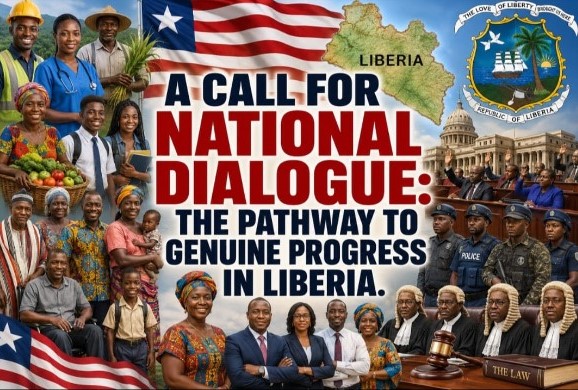
By Austin S. Fallah – A True Son of the Planet Earth Soil: fallahas@yahoo.com
President Boakai’s statements consistently emphasize that national progress depends on unity, peaceful engagement, and constructive dialogue rather than destructive confrontation.
His call to “recognize one another as Liberians first,” together with his appeal to choose “dialogue over division,” reinforces the principle that democracy is strengthened through respectful disagreement, constitutional processes, and national cohesion—not violence or destructive demonstrations.
The Executive Mansion.
President Joseph Nyuma Boakai, Sr.
“What unites us is bigger than what divides us.”
— Inaugural Address, January 22, 2024.
The Executive Mansion.
“I am therefore extending a hand of cooperation and peace to my political opponents, knowing the common bond between us is ‘Liberia.” Inaugural Address, January 22, 2024.
The Executive Mansion.
“As is said, ‘We must work together or fail separately.'”
— Inaugural Address, January 22, 2024.
The Executive Mansion.
“There is only one LIBERIA! We share a common CITIZENSHIP!
— Inaugural Address, January 22, 2024.
“We chose reconciliation over revenge. We chose dialogue over division. We chose hope over despair.”
— Keynote Address on Peace, 2026.
The Executive Mansion.
“Peace is not merely the absence of war. It is the presence of justice, opportunity, and dignity for all.”
— Keynote Address on Peace, 2026.
“National unity does not require uniformity of thought. It does not silence criticism or suppress debate. Rather, it demands that even in disagreement, we recognize one another as Liberians first.”
— New Year Message of National Unity, January 1, 2026.
The Executive Mansion.
“Disagreement must never descend into hostility.”
— New Year Message of National Unity, January 1, 2026.
Ellen Johnson Sirleaf (Former President of Liberia): “Democracy is the system of government that surpasses all others; grounded in rule of law, respect for individual and human rights, and for institutions, which can arbitrate between competing political interests on behalf of the people.”
“The peaceful and orderly transfer of political power… confirms our nation’s collective search for purposeful and responsive national leadership.” (From her 2006 inaugural address). United States Embassy.
George Manneh Weah (Former President of Liberia):
“We have had our bitter past… let our past remind us that we must do everything to maintain the peace. This is why we have to dialogue.”
The Executive Mansion.
“While I respect citizens’ constitutional right to assemble and protest, Liberia’s history teaches that such pursuits have historically been problematic. The best way to maintain the country’s peace is for Liberians to dialogue continuously.” The Executive Mansion.
In the landscape of political discourse in Liberia, there exists an urgent necessity for a national dialogue that transcends the superficiality of ill-informed national demonstrations.
Such protests, far from fostering meaningful dialogue, often dilute significant progress in national development and impede the upliftment of the lives of the Liberian people.
As Liberians stand at a critical juncture in their nation’s history, it is imperative that Liberians critically evaluate whom they follow and the credibility of the ideas being presented.
Following individuals who are nothing more than snallygosters, politicians with dubious motives and a lack of genuine concern for the greater good, will lead the nation further down a path of stagnation and despair.
At the heart of an effective national dialogue is the need for substantive engagement from all parties involved.
The call to abandon demonstrations that lack credible leadership is not merely a critique but an invitation to foster conversations that involve skilled individuals capable of articulating well-informed positions.
It is disheartening to witness countless demonstrations led by individuals who exhibit lathologica, the inability to articulate thoughts clearly, ensuring that the issues at hand remain unresolved and poorly understood.
Rather than serving the nation, these misguided protests often leave the public inflamed and divided, unable to comprehend the essential questions that must be tackled.
Pursuing dialogue instead of protest holds the promise of confronting the nation’s very real psychological conflicts, encapsulated in the concept of psychomachia, the struggle between good and evil within oneself.
To foster national growth, Liberians must engage in introspection and self-criticism.
This self-examination must include questioning the motives behind our leaders and the true intentions of those stoking societal unrest.
In many instances, they lack realistic plans or qualifications to govern effectively or represent their constituencies’ interests.
The tragedy of alhazagoraphobia, or the fear of being ignored, often drives individuals to seek loudness in their dissent rather than depth in their discourse.
This fear can lead to chaotic demonstrations aimed more at being heard than at fostering understanding or solutions.
Liberians must address their fears more constructively, opting for collaborative dialogue that encompasses the nation’s diverse perspectives rather than amplifying division and unrest.
Demonstrations, particularly those organized without a clear vision or direction, can often find themselves trapped in an ignominious cycle of shouting and agitation, yielding no tangible outcomes.
Such actions can lead to increased frustration, especially when constituents realize that their grievances are not being adequately addressed.
Genuine progress arises from the capacity to listen actively and engage in discourse that tackles fundamental societal issues.
A national dialogue rooted in authenticity can lift the nation above petty squabbles and facilitate critical discussions of policy and societal needs that have been historically neglected.
Furthermore, it is essential to understand the emotional and psychological toll of misguided protests on the fabric of Liberian society.
The strife that emerges from chaotic demonstrations harms not just political stability but also socio-economic progress.
To risk progress in favor of misguided actions is to harm the welfare of the Liberian people.
As compatriots, Liberians owe it to themselves to cultivate conversations that are inclusive and aimed at building a brighter future.
By focusing on a dialogue that prioritizes informed and responsible leadership, Liberians can shift their national narrative toward collective upliftment and empowerment.
Moreover, empowering young leaders with the tools to engage in this national dialogue is paramount.
Education and access to resources can equip future leaders with the skills necessary to navigate complex societal issues intelligently.
By nurturing an environment that values thoughtfulness over mere bravado, Liberia may one day foster a generation of public servants who prioritize the common good over self-interest.
Establishing a national platform for dialogue enables engaging discussions around critical national issues such as healthcare, education reform, national security, drugs and drug cartels, double-faced government officials, and economic stability, allowing participants to collaborate on innovative solutions rather than fostering a constant atmosphere of discord.
This commitment to mutual understanding and evidence-based policymaking could facilitate a re-examination of Liberia’s socio-political landscape.
It could build a framework in which all citizens feel their voices are heard and valued, leading to greater civic engagement and accountability.
Just as sesquipedalian language in political rhetoric can create confusion or mistrust, a shift towards transparent, relatable communication in the national dialogue is essential.
Politicians and activists must communicate more clearly to ensure their messages resonate with all cultural and socio-economic demographics in Liberia.
The burden is on all air-breathing Liberians, as citizens, to demand clarity from their influencers, hold them accountable, and encourage discourse that is both enlightening and constructive.
It is time for Liberia to take a hard look at the trajectory of its political landscape.
A call for national dialogue rather than fleeting demonstrations is not merely a reaction to current events; it embodies a proactive approach to fostering genuine understanding and constructive collaboration.
Liberians should resist the allure of following figures who display snallygoster tendencies and instead seek to engage with leaders who represent informed discourse and national pride.
Only through this paradigm shift can they hope to combat unity’s psychological struggles, reject the allure of misguided protests, and foster a society that values dialogue over discord.
The time has come to prioritize the nation’s interests over personal grievances, with a commitment to thoughtful conversations that empower each citizen and uplift the collective future.
In doing so, Liberia can emerge as a beacon of hope and progress, ensuring that it does not merely occupy a place on the world stage but commands a prosperous and vibrant narrative that inspires future generations.
Let all Liberians set aside their fears and biases, delve deeper into the conversation, and come together as one people working toward a shared vision of a better Liberia.