
A Reflection On Hypocrisy, Double Standards, And The Dishonesty Of Power
By Dr. J. Kerkula Foeday
Kerkula Foeday: Reflections & Impact, Issue 27, August 28, 2026
**********
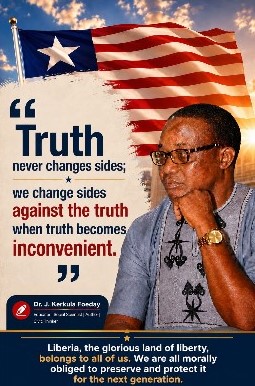
Truth never changes sides;
we change sides against the truth
when truth becomes inconvenient.
**********
Yesterday, the voice was fearless,
A thunderclap against the halls of power;
Yesterday, the critic was celebrated …
Hailed as courageous, principled,
A defender of the people
And a necessary voice against bad governance.
Today, the same voice speaks again,
But suddenly,
Truth has become treason.
What changed?
Did the facts become different overnight?
Did conscience change its language?
Or did yesterday’s applause belong not to truth,
But to the usefulness of truth against someone else?
This is where hypocrisy begins …
When principle becomes partisan,
When justice depends upon who stands accused,
When the same conduct is condemned in an opponent
And defended in an ally.
One constitution for the other man;
Another interpretation when power is ours.
We speak proudly of the rule of law
Until the law becomes inconvenient.
We invoke the constitution
Until constitutional principle collides with political interest.
We demand accountability from those before us
And plead for patience
When accountability
comes knocking at our own door.
But hypocrisy wears many faces.
It lives in the family,
Where fairness is preached,
But favoritism survives;
In communities, where loyalty outranks truth;
In churches, where righteousness is proclaimed
But sometimes practiced selectively;
In institutions, where credentials can outshine character
And silence is mistaken for wisdom.
Then comes intellectual dishonesty …
The quietest and perhaps most dangerous of all:
Choosing evidence that confirms our beliefs,
Discarding what challenges them,
Calling propaganda “analysis,”
Calling loyalty “objectivity,”
And calling disagreement ignorance
Because admitting another person may be right
Would wound our pride.
Moral dishonesty is even more intimate:
Knowing what is right
And deliberately choosing what is convenient;
Speaking of integrity in public
While bargaining with conscience in private.
We teach the young about honesty
While demonstrating, by our conduct,
That honesty has conditions.
And so Liberia stands before a mirror …
Not merely a nation asking
What is wrong with government,
But a people forced to ask
What is wrong within us?
For governments do not manufacture
Every hypocrisy we condemn;
Sometimes, they merely inherit
The habits we have normalized.
So let the question travel
From the Executive Mansion to the marketplace,
From the Legislature to the pulpit,
From the university to the home:
Would we still defend the principle
If our political opponent were replaced by our political friend?
If truth is worthy only when it hurts them,
But dangerous when it exposes us?
If justice is sacred only
When we are victims,
But negotiable when we hold power?
Then, perhaps,
The crisis is deeper than politics.
Perhaps the greatest danger to Liberia is not
That truth has changed sides,
But that we have learned
to change sides
Whenever truth
stands in our way.