
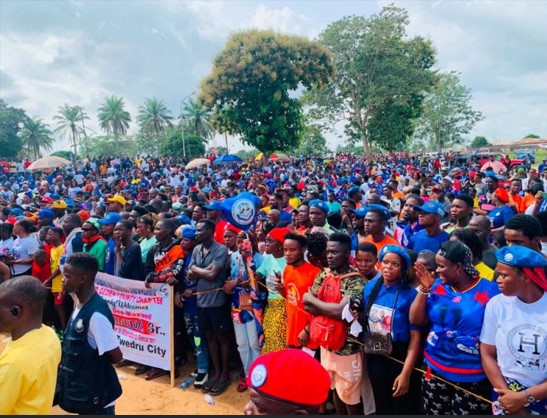
ZWEDRU, Grand Gedeh County – Beyond party colors, speeches, music, and anniversary festivities, the political symbolism emerging from Zwedru has generated fresh debate over whether the fragmented opposition in Liberia is beginning to lay the foundation for a united front capable of challenging the ruling Unity Party in the 2029 presidential election.
By Selma Lomax, selma.lomax@frontpageafricaonline.com
Unlike previous CDC anniversaries, this year’s event attracted an unusually broad cross-section of opposition political leaders, many of whom once contested fiercely against one another. The attendance of Alternative National Congress (ANC) Political Leader Alexander B. Cummings, Citizens Movement for Change (CMC) Political Leader Musa Hassan Bility, Movement for Progressive Change (MPC) Political Leader Simeon Freeman, former Associate Justice Kabineh Ja’neh, Senator Thomas Yaya Nimely, MOVEE Political Leader Dee-Maxwell Kemayah, alongside senior officials from several opposition institutions, transformed what could have remained a routine party anniversary into a national political statement.
While no coalition agreement was announced and no political alliance was formally unveiled, the gathering projected an unmistakable image of opposition solidarity. For many political observers, the significance was less about what was formally declared and more about what was quietly demonstrated: rival political leaders, many carrying their own presidential ambitions, willingly shared the same platform while directing much of their criticism toward President Joseph Boakai’s administration rather than toward one another.
That visual alone may become one of the defining political images of 2026. The importance of the Zwedru gathering becomes even more evident when viewed against the country’s political history. Opposition parties have repeatedly struggled to maintain unity despite recognizing that fragmentation often benefits the incumbent government.
Similar conversations emerged before both the 2017 and 2023 elections, yet disagreements over leadership, political strategy, and power-sharing ultimately prevented lasting coalitions. Those experiences continue to shape today’s political calculations.
This time, however, several developments appear different. Rather than competing for political attention, opposition leaders appeared determined to emphasize common concerns surrounding governance, accountability, the economy, judicial independence, and democratic institutions.
Throughout the anniversary, speakers repeatedly stressed that national interest should outweigh personal political ambitions, suggesting that lessons from previous failed alliances may now be influencing a more pragmatic approach.
Addressing supporters through a live statement from the United States, former President George Manneh Weah devoted considerable attention to the unprecedented attendance of opposition leaders.
“We are grateful to every opposition political party and every national stakeholder that honoured our invitation today. Your presence demonstrates that Liberians with different political backgrounds can still unite around the common interest of protecting our democracy and defending the future of our country.”
Weah argued that political cooperation among opposition parties should not be viewed as political convenience but as a democratic necessity.
“Our differences should never become obstacles to defending Liberia. Whenever democracy is threatened, whenever citizens are struggling, and whenever accountability becomes weakened, responsible opposition leaders have a duty to stand together regardless of party affiliation.”
The former President also used the occasion to urge opposition parties to begin preparing collectively for the future. “The road to 2029 begins today. This is not the season for division. This is the season for organization, mobilization, and unity. The Liberian people expect leadership that places country above personal ambition, and that responsibility belongs to all of us.”
Perhaps the strongest endorsement of opposition cooperation came from ANC Political Leader Alexander B. Cummings, whose keynote address extended far beyond congratulating the CDC.
Although Bility maintained his party’s independent identity, his participation nevertheless reinforced growing perceptions that opposition leaders increasingly recognize the value of maintaining open communication ahead of future elections. Political analysts note that attendance does not automatically translate into political alliance, but sustained engagement often creates opportunities for future negotiations.
Movement for Progressive Change Political Leader Simeon Freeman delivered one of the gathering’s most provocative interventions, criticizing the Unity Party leadership for failing to attend the CDC anniversary.
“A confident government should never fear democracy. Political maturity requires recognizing that our parties are competitors during elections but partners in protecting Liberia’s democracy.”
Freeman argued that participation in one another’s national events strengthens democratic culture rather than weakens political competition.
“If the Unity Party celebrates tomorrow, we should attend. If the CDC celebrates today, they should attend. Democracy grows stronger when political parties respect one another’s institutions.”
He further accused the ruling establishment of viewing every opposition gathering through the lens of political insecurity. “Unfortunately, some people see every opposition meeting as a threat instead of an opportunity to strengthen our democracy. Liberia deserves leaders who embrace political tolerance rather than fear it.”
Beyond the speeches themselves, perhaps the greatest significance of Zwedru lies in the political optics. Images showing former rivals sharing the same stage inevitably create public expectations that broader political cooperation may eventually follow. Such expectations could place additional pressure on opposition leaders to maintain dialogue instead of returning to familiar political rivalries.
Nevertheless, important challenges remain. Nearly every major opposition leader present is either considered a potential presidential candidate or leads a political institution with national ambitions. History demonstrates that agreeing on the principle of unity is considerably easier than agreeing on who should lead that unity. Liberia’s previous coalition experiences illustrate how disagreements over leadership selection can quickly overshadow broader political objectives.
The ruling Unity Party will likely view the Zwedru gathering with cautious interest rather than immediate concern. Until opposition parties formalize any coalition framework, announce a common platform, or agree upon a single presidential strategy, the government may reasonably conclude that symbolic unity alone cannot guarantee electoral success. Political photographs generate headlines, but elections are ultimately decided through organization, compromise, fundraising, grassroots mobilization, and disciplined political agreements.
Still, dismissing the significance of the Zwedru gathering would also overlook an important political reality. The event demonstrated that communication channels among opposition leaders remain open despite years of political disagreements. That alone marks a noticeable departure from the deep divisions that characterized much of Liberia’s post-2023 opposition politics.
Whether the anniversary ultimately becomes remembered as merely a symbolic display of opposition goodwill or the first chapter of a broader political realignment will depend upon what follows in the months and years ahead. If the conversations initiated in Grand Gedeh evolve into structured negotiations, common policy positions, and genuine political compromise, historians may eventually identify the CDC’s 22nd anniversary as the moment Liberia’s opposition began constructing a united front for 2029.
For now, however, Zwedru has accomplished something equally significant. It has shifted the national political conversation from whether opposition unity is possible to whether opposition leaders are finally prepared to pursue it.