
By Austin S Fallah – A True Son of the Planet Earth Soil: fallahas@yahoo.com
“Two heads are better than one head. This is a fallacy. It depends on the two heads. Two drug cartel heads are not better than one prudent national security head, because the two drug cartel heads will be caught and brought to justice.”
Aunty Success (Angel Michael Comedy), Young Nigerian Comedienne: “Motivational Speaker: It is people like you who are misleading youths on social media.”
Nigerian proverb: “The rain can wash away a house, but it can not wash truth from a clean conscience.
Proverbs 16:18: “Pride comes before a fall.”
Vint Cerf — Internet pioneer
Cerf, one of the principal architects of the Internet’s TCP/IP protocols, gave his famous Internet Society address under the title:
“The Internet is for Everyone.”
The principle was subsequently formalized in RFC 3271, which states that the Internet should be for everyone, while recognizing that making universal access a reality requires deliberate effort.
President Joseph Boakai: “In current day realities, nobody will demise the importance/usefulness of Internet connectivity.”
Former President George Manneh Weah: Similarly recognized both the transformative and potentially problematic dimensions of the Internet. He described the Internet as a platform that has “propelled and accelerated innovation in all facets of life” and said that it had “bridged communication gaps and made the world a smaller and better place in many ways.”
Bill Gates described the internet’s trajectory by stating, “The Internet is becoming the town square for the global village of tomorrow.”
Eric Schmidt noted the unprecedented scale of the medium, calling it “the first thing that humanity has built that humanity doesn’t understand, the largest experiment in anarchy that we have ever had.”
Mukesh Ambani highlighted mobile connectivity as “the single-most defining technology of this century for human development.”
Sir Tim Berners-Lee — Inventor of the World Wide Web: “The Web is humanity connected by technology.”
Mark Zuckerberg — Facebook/Meta founder
“We believe that the need to open up and connect is what makes us human.”
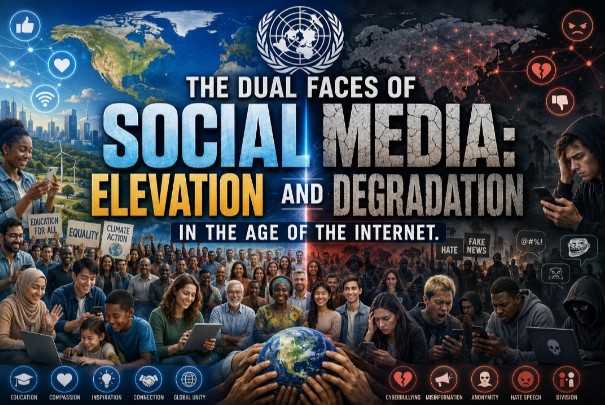
The advent of the internet has revolutionized the way we live, learn, and engage with one another.
In particular, social media platforms have created an environment where intelligence meets creativity, facilitating an unprecedented elevation of human potential in the 21st century, and hopefully beyond.
As a nefelibata, those who are head in the clouds, dreaming beyond the terrestrial confines of reality, many young individuals have harnessed the power of the internet to develop innovative solutions and foster dialogue about pressing social issues.
However, contrasting sharply with these aspirational figures are a group of contumacious individuals who misuse social media, perpetuating a cycle of ignorance and incompetence that undermines progress, particularly in countries like Liberia, where the socio-economic fabric is frayed.
On one hand, humanity jas the munificent spirits of young people across the globe who utilize social media not merely as a platform for communicating quotidian experiences, but as a powerful vehicle for intellectual discourse and social change.
This cohort of digital natives engages critically with the world around them, creating thoughtful ideas and discussions that aim not only to elevate their own understanding but also to fortify their nations.
They are the change-makers, the ones who think deeply and act with principle, thus reflecting the redoubtable nature of their convictions.
Their efforts often manifest in campaigns that advocate for education, environmental protection, innovations, creative thinking, and human rights, showcasing a perspicacious awareness of the multifaceted challenges facing society today.
In direct contrast, however, are the half-baked, self-styled politicians and so-called intellectuals, drug addicts, and those who think that going to school and sitting in classrooms means they are educated, drug cartels, and alcoholics who populate the darker corners of social media discourse.
These individuals often engage in rebarbative rhetoric, eschewing genuine dialogue in favor of empty slogans and unschooled diatribes.
This disconnect from reality, characterized by childish behaviors and a penchant for gossip, fosters an environment in which baseless narratives thrive.
In this unfortunate reality, the dialogues that catch fire are often those that contribute nothing of substance.
Their approach can be encapsulated by the term “chimerical,” as their claims and arguments lack a firm foundation in truth and are often merely fanciful distractions from the complexities of real-world issues.
Within the Liberian context, the repercussions of such behavior are pronounced.
While some youths harness the capabilities of the internet to address educational disparities and champion reformative initiatives, others engage in petty political squabbles and alcohol infused criticisms that detract from meaningful advancement.
The discourse they promote, much like liquor talk, is good for nothing but perpetuating a cycle of ignorance and disillusionment.
This regressive rhetoric erodes the foundational elements of Liberia’s educational system and limits opportunities for constructive engagement among the young population, oftentimes stifling the intellectual growth crucial for sustained national development.
Engaging critically with ideas is essential for growth, yet the presence of intransigent individuals, those unwilling to accept differing viewpoints or engage in meaningful discussion, further compounds the issue.
Their refusal to engage with academia and intellectualism, instead opting for sensationalism or ad hominem attacks, creates an atmosphere of hostility.
This toxic culture often discourages more thoughtful individuals from participating, leading to a landscape that favors the sensational over the significant.
It is imperative to understand that not all discourse is created equal; some conversations elevate while others hinder.
One must consider the implications of a society propelled by sesquipedalian discourse, where jargon and lengthy, complicated language replace clarity of thought.
This trend not only alienates those without advanced degrees but also complicates the basic ideas necessary for societal progress.
The irony lies in the fact that while some young people embrace the tools of social media to articulate their ideas eloquently, others drown in a sea of unnecessary verbosity that obscures rather than clarifies their messages.
As humanity confronts these dual realities- the elevation provided by the intelligent use of social media and the degradation imposed by baseless rhetoric- it is vital to cultivate a culture that encourages the former while challenging the latter.
The responsibility lies not just with the individuals producing these rebarbative statements, but with the wider community that consumes and amplifies them.
In engaging with content mindfully and critically, humanity begins to shift the narrative away from vacuous insults and intellect devoid of substance.
Education plays a pivotal role in this transformation.
By fostering a generation of individuals equipped with critical thinking skills, innovative skills, and a genuine interest in socially responsible behavior, humanity can create future leaders capable of influencing the political discourse positively.
Programs aimed at enhancing digital literacy are essential, teaching young people not only how to navigate social media but how to discern credible sources from disinformation.
In doing so, airbreathing intelligent Liberians empower them to reclaim the narrative and turn social media into a robust platform for informed discussion, rather than a stage for ignorance.
Moreover, the development of mentorship programs could bolster the capabilities of young Liberians by establishing a network of knowledgeable individuals who can provide guidance and support.
Influencers and recognized figures, when they choose to engage thoughtfully, can have a tremendous impact on shaping the discourse.
When prominent social media personalities use their platforms to champion educational initiatives and discuss social justice, they can galvanize audiences to elevate their thoughts and contributions similarly.
It is also crucial to confront the existing archaisms in society that allow such negativity to flourish on social media.
This is where the role of community engagement comes into play; constructive and positive grassroots organizations and national governments must work together to promote positive discourse.
Community forums, both online and offline, could serve as environments for thoughtful exchange, combating the existing trend toward ignorance with a collective effort to enlighten.
Likewise, media literacy campaigns that emphasize the value of informed engagement and critical analysis will help build a more discerning public that rejects gutter politics in favor of constructive dialogue.
As we navigate the era of social media, the choice between elevation and degradation lies largely within our grasp.
The challenges are significant, but so too are the opportunities for transformative change.
By engaging critically with ourselves and each other, we can create a culture that celebrates knowledge, inquiry, and open discourse.
Our collective aspirations should be to cultivate an environment where the nefelibata spirit thrives alongside reasoned debate, one that allows for innovation while also fostering accountability.
The dichotomy of social media reflects a broader struggle within society: the balance between creativity and ignorance, between hope and despair.
We must strive to amplify the voices of the youngest generations who seek to advance discourse while challenging those who propagate vacuous narratives.
Ultimately, the mark of a true intellectual society lies in its ability to filter out the noise and promote a dialogue that honors truth, creativity, and the shared democratic ideals that bind us.
As we face the future, let us be redoubtable in our efforts to elevate our discourse and ensure that the internet remains a bastion of creativity and intelligence, building a better world for all.