
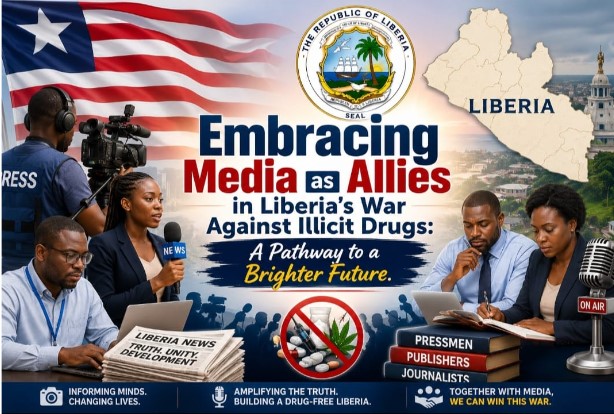
Rather than being perceived as adversaries, journalists, publishers, and media houses must be embraced as crucial partners in confronting these social and economic bandits.
By Austin S, Fallah – A True Son of the Planet Earth Soil: fallahas@yahoo.com
President Joseph Nyuma Boakai: “Has strongly condemned drug trafficking, emphasizing that while Liberia is open for business, it is not a haven for criminal networks. He has vowed that Liberia will not be a transit point or warehouse for drugs and that all involved, regardless of status, will be pursued. Furthermore, he has promised a relentless, non-selective fight against drugs.
President Ronald Reagan on Government and Media Cooperation. In a 1988 address to media executives, President Ronald Reagan acknowledged the typical need for media caution regarding joint government efforts. Still, he argued that the fight against drugs constituted a “matter of life and death,” allowing for “common purpose”. Reagan urged the media to continue “tough reporting,” emphasizing the need for comprehensive coverage on trends in drug use.
President Felipe Calderón (2010): Launching public appeals during Mexico’s military offensive against cartels, Calderón emphasized societal alignment, stating on national television that the anti-crime initiative was “a fight of all Mexicans because criminals hurt all of society and everyone’s participation is vital,” urging broad public and informational backing.
Committee to Protect Journalists (CPJ): Carlos Lauria, head of the CPJ Americas program, highlighted the extreme pressure exerted on local reporting, pointing out regions where violent cartels operate as the effective “editors of the press” through systemic intimidation and assassinations.
As Liberia stands at the threshold of entering its 180th anniversary, it has the potential to once again become a beacon of resilience, growth, and justice in the second half of the 21st century.
Yet, the threat of the illicit drug trade looms ominously over the nation, undermining its social fabric and stunting its economic growth.
In this complex battle against drug cartels and the cycle of addiction, the role of the media is often misconstrued.
Rather than being perceived as adversaries, journalists, publishers, and media houses must be embraced as crucial partners in confronting these social and economic bandits.
By supporting authentic media outlets, the Liberian government can turn the tide against the drug menace that preys upon the most vulnerable members of society, thus paving the way for a brighter, safer future.
The Role of the Media in Society:
Throughout history, the media has played a pivotal role in shaping public discourse, informing citizens, and advocating for social justice.
In the context of drug-related issues, the media serves as a critical watchdog, exposing corrupt practices, shedding light on the conditions that foster addiction, and highlighting the voices of those who have been affected by drug abuse.
When the media is granted the freedom to investigate and report on the drug trade, it can help illuminate the connections between organized crime, socio-economic deprivation, and governmental inefficiencies.
For instance, investigative journalism has often led to powerful revelations and significant reforms.
The exposure of the Mexican drug cartels’ operations by journalists like Jorge Ramos and the investigations surrounding “El Chapo” gave the world insights into the intricate networks of drug trafficking, while simultaneously highlighting the struggles of individuals caught in this web.
In Liberia, a similar approach could apply and serve to unveil the horrid realities of the drug crisis while also advocating for the rights and needs of individuals affected by substance abuse.
The Misconception of Media as Enemies:
Unfortunately, in Liberia, there remains a prevalent misconception that the media is part of the problem rather than a solution.
This mindset is particularly dangerous, as it can lead to censorship, harassment, and intimidation of journalists attempting to cover drug-related issues.
The belief that the media is antagonistic to the national interest ignores the essential role they play in promoting transparency and accountability in governance and society.
Instead of viewing the media (not social media) as enemies in the fight against drugs, the government must recognize them as allies.
By facilitating the media’s work, the government would align itself with those who are committed to revealing the truth.
This partnership can yield more effective anti-drug campaigns that simultaneously address the root causes of addiction, such as poverty, lack of education, and limited access to healthcare.
For example, in countries like Portugal, comprehensive drug policies that include harm reduction and media collaboration were implemented with marked success.
Media narratives focused on the human side of addiction and recovery rather than criminality, helping to reduce stigma and promote rehabilitation.
A similar approach could transform the landscape of drug policy in Liberia.
Supporting Authentic Media: A Call to Action:
To genuinely address the drug crisis, the Liberian government must actively support authentic media outlets and create an environment where investigative journalism can thrive.
This support can take the form of financial grants for investigative journalism, legal protections against harassment and threats, and building partnerships between law enforcement agencies and media representatives.
Additionally, the government can initiate training programs that empower journalists to cover drug issues effectively.
This includes understanding the legal ramifications surrounding drug reporting, ethical considerations, and methods for conducting thorough investigations with accuracy and fairness.
Such efforts would elevate journalistic standards while equipping media professionals with t
True cooperation between the government and media can also foster school programs that educate young people about the dangers of drug use while integrating discussions on responsible journalism.
By instilling these values early, future generations will appreciate the importance of media in society and the intricate relationship between governance and the media.
Facing the Consequences of Inaction:
The consequences of neglecting the role of media in the fight against drug-related issues are severe. Ignoring the media in their quest for the truth can lead to a perpetuation of cycles of addiction and criminality, impacting entire communities and exacerbating social inequities.
The burden of drug abuse falls disproportionately on the downtrodden, those lacking access to resources, education, and health services.
As these citizens become embroiled in the drug crisis, they transform into statistics rather than individuals deserving of empathy and support.
Moreover, failing to engage media efforts against drug cartels diminishes civil liberties and undermines democratic processes.
A society that suppresses the free press risks creating an environment of fear and impunity, where the true causes of societal issues could remain obscured.
As history has shown, disregarding the association between drugs, crime, and poverty can result in a deteriorating nation.
In Afghanistan, the lucrative opium trade has fueled decades of conflict, destabilizing society and forcing rural farmers into cycles of despair.
Similarly, in Latin America, drug trafficking has led to increased violence and social unrest, all fueled by a lack of transparency and accountability from governing bodies.
Case Studies of Successful Media Policy Collaboration:
Examining global examples where media has collaborated with governments and agencies might provide valuable insights for Liberia.
In the Philippines, under President Duterte’s anti-drug campaign, several media outlets bravely reported on the implications of extrajudicial killings associated with the war on drugs.
Even amidst threats, journalists used their platforms to amplify the voices of victims’ families.
This move not only raised awareness but also drew international attention to what many criticized as human rights violations.
Additionally, the approach taken in countries such as Norway, where drug use is decriminalized, presents an intriguing perspective.
Local media outlets have collaborated with health agencies to report on drug-related issues comprehensively and humanely, shifting the narrative from punitive measures to public health solutions.
This has fostered an environment where individuals feel safe seeking help, thus addressing the issue at its root.
Towards a Better Future for Liberia:
As Liberia approaches a new and transformative phase of entering its 180-year history, the time has come to reevaluate the role of the media in the nation’s journey toward a better future.
By embracing journalists, publishers, and media houses as partners in the fight against illicit drugs, the Liberian government can harness the power of informed discourse and transparent reporting.
This collaborative effort will not only shed light on the underlying issues surrounding drug addiction and trafficking but will empower individuals, communities, and the nation as a whole.
Drug cartels and the social challenges associated with substance abuse will not be eradicated overnight; however, with a robust network of support from the media, the path to justice and healing becomes clearer.
By fostering a new relationship built on trust and cooperation, Liberia has the potential to emerge not as a transit hub for illicit substances, but rather as a model of resilience, justice, and progress in the 21st century. Let us embrace our media as allies, granting them the freedom and resources to shine a light on the truth for a safer, brighter Liberia.