
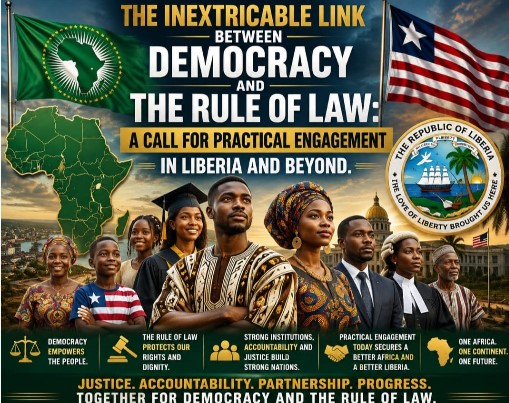
A Call For Practical Engagement In Liberia and Beyond
By Austin S Fallah – A True Son of the Planet Earth Soil: fallahas@yahoo.com
President Joseph Nyuma Boakai: From his inaugural address on January 22, 2024:
“We must restore respect for the rule of law, and respect for officers of the law across our three branches of government.”
Democracy Requires Practical Engagement: “To carry it through successfully there is need to combine practical common sense of the most hard-headed kind with a spirit of lofty idealism.” — Theodore Roosevelt, “A Charter for Democracy,” 21 February 1912. Teaching American History.
Reflection: Liberia’s democratic development requires more than inspiring speeches. It calls for practical engagement: strengthening institutions, respecting constitutional limits, improving public services, and ensuring that laws work in everyday life.
Equality Before the Law: “In its proper meaning equality before the law means the right to participate in the making of the laws by which one is governed, a constitution which guarantees democratic rights to all sections of the population, the right to approach the court for protection or relief in the case of the violation of rights guaranteed in the constitution, and the right to take part in the administration of justice.”
— Nelson Mandela, statement in the Pretoria Magistrate’s Court, 1962. United Nations.
Reflection: Liberia’s democratic promise becomes tangible when citizens can participate in governance, challenge abuses, and obtain justice without discrimination. The rule of law must protect the governed as well as regulate the government.
The inextricable link between democracy and the rule of law is not merely a constitutional ideal; it is a daily obligation to make justice, accountability, and public participation real for every Liberian.
In an era marked by political upheaval and rapid transformation across the globe, the relationship between democracy and the rule of law remains critically important.
It is often asserted that “the law is the law; democracy and law are identical twins, inseparable.”
This statement encapsulates the essence of a functional democratic society where laws serve as the backbone of governance, ensuring justice, equity, and social order.
Challenging this axiom invites chaos and undermines the foundations of civil society.
Some individuals and groups, under the guise of advocating for democracy, seek to undermine established legal frameworks by promoting agendas that erode the rule of law.
Such behaviors threaten not only the integrity of democratic practices but also the future of nations striving for progress and stability.
In this discourse, I argue that robust adherence to the rule of law is fundamental to maintaining and genuinely realizing democracy, particularly in Liberia and across the African continent.
The Foundations of Democracy and the Rule of Law:
To appreciate the relationship between democracy and the rule of law, it is essential to define both concepts clearly.
Democracy can be understood as a system of government in which power resides with the people, allowing them to exercise it directly or indirectly through elected representatives.
The rule of law, meanwhile, encompasses the principle that all individuals and institutions, regardless of their position or power, are accountable to the law.
In an ideal democratic setup, laws are crafted and enacted with the participation and consent of the citizenry.
Democracy without the rule of law is a façade, a mere shadow of governance. Without legal structures to guide behavior and ensure accountability, democracy risks descending into anarchy, where might supersedes right.
This is evident in numerous historical contexts, where the absence of a robust legal framework led to coups, civil unrest, and pervasive corruption.
In Liberia, a nation that has endured civil wars and political instability, commitment to the rule of law is imperative not only to heal past wounds but also to forge a peaceful future.
Ulterior Motives and Erosion of Democratic Principles:
While advocacy for democracy is often couched in emotional language and fervent slogans, it is crucial to interrogate the intentions behind such assertions.
Those with ulterior motives tend to exploit popular discontent, cloaking their agendas in the guise of democratic expression while simultaneously attacking the integrity of legal institutions.
Such actions can degrade the rule of law, as the populace is misled into believing that disdain for established laws serves some greater democratic purpose.
This trend undermines national stability and development.
Empty rhetoric, unsubstantiated claims, and character assassinations become tools for manipulation, leading to widespread disillusionment among the citizenry.
Instead of constructive dialogue and engagement with pressing socio-economic issues, these actors contribute to an atmosphere of suspicion and division.
When citizens become further entrenched in this toxic narrative, the potential for collaborative solutions diminishes, perpetuating cycles of discontent and instability.
Rejecting Naivety: A New Era for Africa:
The assertion that “those days when naivety and empty slogans with no meaningful solutions to national issues are over” speaks to a pivotal moment in the evolution of governance on the African continent.
With the rise of an educated and informed citizenry, there is growing recognition that real change is possible only through sound policies and practical development strategies, not mere emotional appeals for democracy.
The challenges facing African nations, including Liberia, are complex and multifaceted, demanding nuanced approaches rather than simplistic proclamations.
Fighting poverty, addressing corruption, promoting education, and building infrastructure require cooperation across all sectors of society, guided by laws that uphold rights and ensure justice.
Therefore, a commitment to the rule of law is essential not only for legal fidelity, but also for effective governance and societal advancement.
Practical Solutions and Robust Governance:
What, then, constitutes the practical application of the rule of law within a democratic framework?
One of the foremost measures is establishing transparent institutions that operate independently of political influence.
Judicial independence is crucial, as it assures the populace that justice is not subject to the whims of political elites.
Furthermore, expanding access to legal education and resources can empower citizens by equipping them with the knowledge needed to engage with the legal system and advocate for their rights.
In addition, promoting democratic engagement through grassroots movements can help bridge the divide between citizens and their government.
Individuals must feel that their voices are heard and valued, and they need channels to express concerns about governance and policy.
By fostering a culture of accountability, where leaders are held responsible for their actions before the law, the ingrained trust between government entities and the populace can be revitalized.
Moreover, it is essential to encourage and support non-governmental organizations (NGOs) and civil society actors that push for legal reforms and advocate for enforcing laws that promote equality, peace, and sustainable development.
In Liberia, this could mean bolstering organizations that work on human rights, access to justice, and anti-corruption initiatives.
A Call to Action for Liberia and the Continent:
In conclusion, the assertion that “a new day for Africa, and Liberia, has come” is not merely aspirational but a poised challenge to all stakeholders engaged in governance and civic participation.
It calls for a critical reevaluation of how democracy and the rule of law interact, emphasizing that one cannot exist meaningfully without the other.
As nations on the African continent strive for democratic ideals, it is imperative to recognize that mere slogans and rhetoric will not yield tangible change.
A return to respect for the rule of law must guide any democratic discourse and action.
The citizens of Liberia and the continent at large must actively demand accountability, seek tangible policies, and engage in meaningful conversations about their future.
By doing so, they protect their rights and work towards a society grounded in justice, equity, and sustainable development.
As the world, Africa, and particularly Liberia move further into the 21st century, let us steer away from empty propaganda and instead embrace rigorous, ethically sound approaches that can ensure the prosperity and dignity of every African nation and the world at large.
The collective responsibility rests on every citizen to not only uphold the rule of law but to embody the true essence of democracy.
Only then can we promise an equitable future, just and reflective of the people’s aspirations.