
It’s Been 3 Years Of Boakai’s Regime, 16 Years After TRC Report, 23 Years After Civil War Officially Ended Claiming About 250,000 Lives
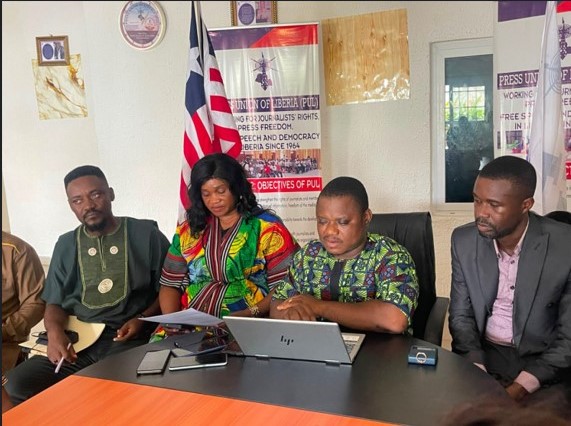
PHOTO: Executives of Liberian CSOs during the joint statement read by CENTAL’s Director at the PUL headquarter on 9th Street in Sinkor, Monrovia on Tuesday
By Frank Sainworla, Jr,. newspublictrust@gmail.com
August this year, 2026 made it exactly 23 years after this West African nation, Liberia officially ended one of Africa’s longest fratricidal civil wars which the United Nations says killed about 250,000 people. And that culminated into the signing of the Comprehensive Accra Peace Agreement.
That peace deal came a week after former President Charles Ghankay Taylor had agreed to peacefully resign and was evacuated into exile in Nigeria through an arrangement reached by ECOWAS and African leaders.
This year also makes it 16 years after the country’s Truth and Reconciliation Commission (TRCO presented its final report calling for prosecution and sanctions on war actors who bear the greatest responsibilities for war crimes and crimes against humanity, as well as economic crimes, while stressing the need for reparation for the many victims of the carnage.
Like in the case of the previous democratically regimes since then—Unity Party government of former President Ellen Johnson Sirleaf (2006-2018), the CDC government of ex-President George Manneh Weah (2018-2024)–three years into the current Unity Party government of President Joseph Nyume Boakai, no war and economic crimes court has been set up so far.
In its conclusion, the TRC report said, among other things that:
- “All factions to the Liberian conflict are responsible for abuses, including war crimes and crimes against humanity.
- “External state actors in Africa, North America and Europe participated, supported, aided, abetted, conspired and instigated violence, war and regime change for political, economic and foreign policy advantages and gains (Consolidated Final Report, Vol. II, p. 18).”
Recommendations
- The TRC advised for the establishment of an Extraordinary Criminal Tribunal for Liberia and named individuals, corporations and institutions recommended for prosecution or, in some cases, for further investigation.
- The TRC recommended that the Government of Liberia assumes its full responsibility under international law to provide reparations for all those individuals and communities victimized by the years of instability and war, especially women and children. The commission recommended a reparation program of approximately US$500m over 30 years. The commission recommended general amnesty for children, and amnesty for lesser crimes in an effort to foster national healing and reconciliation if individuals admit their wrongs and express remorse.”
Now, a group of Liberian Civil Society Organizations, including the Press Union of Liberia (PUL) on Tuesday, September 82026 raised serious concerns about another delay in accountability and Justice for Liberia’s war past.
The sixty-four-thousand-dollar question is: Will a war and economic crimes/anti-corruption court ever come to fruition in this post-war West African nation, usually referred to as a fragile state.
“Liberia’s election to the United Nations Security Council for the 2026–2027 term reflected international confidence in the country’s transition from conflict to peace and its growing role as a contributor to international peace and security,” the CSOs press statement said.
The list of CSOs raising the concerns are:
- Press Union of Liberia (PUL)
- Center for Transparency and Accountability (CENTAL)
- Women’s NGO Secretariat of Liberia (WONGOSOL)
- Association of Female Lawyers of Liberia (AFELL)
- National Muslim Council of Liberia (NMCL)
- Liberia Council of Churches (LCC)
FULL TEXT OF THE CSO’S JOINT PRESS STATEMENT BELOW:
Press Statement by National Civil Society Consortium for Transitional Justice
Expressing Concern Over Delays by the Joseph Boakai Administration in
Establishing the War and Economic Crimes Court and National Anti-
Corruption Court Ahead of Liberia’s December 2026 UN Security Council
Presidency
Title: Accountability Delayed — Liberia Must Match Global Leadership with
Domestic Accountability and Justice
Tuesday, September 8, 2026
(Monrovia, Liberia): The National Civil Society Consortium for Transitional Justice in Liberia expresses deep concern over the continuing delays by the Government of President Joseph Nyuma Boakai in enacting legislations to establish the War and Economic Crimes Court (WECC) and the Specialized National Anti-Corruption Court for Liberia (NACC), nearly 3 years (36 months) after assuming state power in January 2024. We applaud the 55th Legislature’s passage of a Joint Resolution in April 2024 to establish the War and Economic Crimes Court. Also, we acknowledge President Boakai’s creation of the Office for the Establishment of War and Economic Crimes Court for Liberia (OWECC) and subsequent submission of draft Bills to establish the above-mentioned Courts. While we applaud these initial actions, government must decisively act to complete the process – enact the enabling statutes to establish, adequately fund, and make fully operational the War and Economic Crimes Court and National Anti-corruption Court for Liberia.
Liberia’s election to the United Nations Security Council for the 2026–2027 term reflected international confidence in the country’s transition from conflict to peace and its growing role as a contributor to international peace and security. Importantly, Liberia campaigned for and got elected on the Council’s seat on explicit commitments to conflict prevention and peacebuilding; human rights protection, justice and accountability; and the agendas of Women, Peace and Security (WPS) as well as Youth. Therefore, the country must lead by example by demonstrating at home the same values and priorities it has undertaken to champion internationally. As Liberia prepares to assume the Presidency of the United Nations Security Council in December 2026, the nation stands at a critical juncture, in terms of matching the global leadership role with demonstrated commitment to justice, accountability, the rule of law, and inclusive and sustainable peace. Yet, at home, the absence of decisive government action to establish the War and Economic Crimes Court and National Anti-corruption Court risks undermining Liberia’s credibility and moral authority on the international stage.
The National Civil Society Consortium underscores that women, children, and other victims and survivors of Liberia’s civil wars have waited far too long for justice. The lack of a War and Economic Crimes Court perpetuates impunity, denies closure, and weakens reconciliation – more than two decades after Liberia’s violent armed conflicts, which subjected women and girls to grave violations, including conflictrelated sexual and gender-based violence, displacement, loss of livelihoods, and other serious human rights abuses. Therefore, establishment of the WECC is integral to Liberia’s implementation of the Women, Peace and Security agenda, enabled by the United Nations Security Council’s Resolution 1325 (UNSCR 1325). The broader Women, Peace and Security (WPS) framework recognizes that sustainable peace requires not only women’s meaningful participation, but also protection, accountability, access to justice, and measures that prevent reoccurrence. A credible, victim-centered and gender-responsive War and Economic Crimes Court (WECC) would therefore help translate Liberia’s Women, Peace and Security (WPS) commitments into concrete justice for survivors, while ensuring that women, children and other victims are not treated only as symbols of Liberia’s peace story, but as rights-holders entitled to truth, justice, remedy and guarantees of nonreoccurrence.
Similarly, entrenched impunity for corruption and abuse of public resources continue to undermine democratic governance, breed distrust in government, deepen poverty and inequality, and violate human rights, in part through limiting citizens’ access to adequate, inclusive and gender responsive health, education, electricity and other basic social services. When established, adequately funded, and fully functional, the Specialized National Anti-Corruption Court will therefore play an indispensable role in fostering accountability by ending impunity for corruption, safeguarding public resources and assets and fostering inclusive and sustainable economic development.
We wish to remind the government of Liberia and the public that establishment of the War and Economic Crimes Court (WECC) and National Anti-Corruption Court (NACC) are non-negotiable, as they respond to Liberia’s wider obligations and commitments under international human rights law, international humanitarian law, the rule-of-law framework of the United Nations, and the principles of accountability and effective remedy for serious human rights violations. Hence, the courts must be designed and operated consistent with international standards, including judicial independence, equality before the law, due process and fair-trial guarantees, protection of victims and witnesses, and meaningful victim participation. Combined, both courts will strengthen the rule of law, increase public confidence in state institutions; advance economic and social justice justice and healing for victims and survivors; help to deter future corruption and other abuses; reinforce reconciliation and demonstrate that no person is above the law; and strengthen Liberia’s standing as a credible voice on anti-corruption reforms, peacebuilding, Women, Peace and Security (WPS), and human rights protection and accountability. Furthermore, it will place Liberia in a stronger position to mobilize the needed international technical, diplomatic and financial partnerships and resources to operationalize credible and sustainable justice institutions.
Despite repeated commitments, we are concerned that the Boakai Administration has not secured the swift passage of the necessary enabling legislations, which are expected to meet constitutional requirements and international human rights standards. Continued delay risks undermining Liberians’ aspirations for justice and creating a damaging gap between the principles Liberia champions at the UN Security Council and other international platforms and the actions it takes at home.
In conclusion, we wish to emphasize that Liberia’s leadership on the UN Security Council must be matched by concrete domestic reforms. The country cannot credibly advocate for the protection of civilians, women’s participation in peace and security, credible sanctions against corruption, accountability for serious human rights violations, respect for international law, and stronger institutions abroad, while leaving critical justice and accountability reforms unfinished at home.
The National Civil Society Consortium therefore makes the following recommendations:
- President Boakai should urgently act by engaging with the leaderships and members of the Senate and House of Representatives to ensure timely passage of the War and Economic Crimes Court and National Anti-Corruption Court Bills and eventual establishment of both courts. Also, the President must ensure that the 2027 National Budget contains allocations for both courts, as a sign of leadership in ensuring their financial sustainability, while seeking to mobilize support from international partners.
- The leaderships and members of the Legislature must urgently deliberate on and pass the Bills to establish the indicated Courts without further delay. We are reminded about previous delay tactics by past legislatures in the name of constituency engagement on the 2009 Findings and Recommendations of the erstwhile Truth and Reconciliation Commission’s (TRC) Report. Therefore, while we recognize the value in constituency engagement by lawmakers, we caution against its use as an excuse for delayed action on both instruments.
- The President and Legislature must ensure that both courts are adequately resourced, financially and operationally independent, impartial, transparent, victim-centered, gender-responsive, and compliant with constitutional and international human rights and fair-trial standards.
- Government must align Liberia’s domestic justice and anti-corruption agenda with its international commitments on human rights, peace and security, transitional justice, and Women, Peace and Security, including the principles reflected in UN Security Council Resolution 1325 and subsequent WPS resolutions.
- The Liberian government must use the country’s December 2026 Presidency of the UN Security Council to demonstrate leadership by example: advancing accountability and Women, Peace, and Security (WPS) internationally while taking concrete actions to institutionalize justice and accountability at home.
- The United Nations, European Union (EU), US Government and other international partners should continue to support Liberians’ drive for accountability and demand for their government to establish the War and Economic Crimes Court and National Anti-Corruption Court for Liberia and provide for their adequate financing and operationalization.
- Finally, we call on the Office for the Establishment of War and Economic Crimes Court to strengthen collaboration with all stakeholders to constructively engage with the Office of the President of Liberia, relevant agents of the Executive, Legislature, Judiciary and other partners to achieve this milestone.
The Civil Society Consortium for Transitional Justice reaffirms its readiness to collaborate with national institutions and international partners to ensure that the War and Economic Crimes Court and National Anti-Corruption Court are timely established and sustained, to advance Liberia’s transitional justice, anti-corruption reforms and other good governance agendas.
Justice delayed is justice denied. And justice denied is a recipe for human rights violations, impunity, violence, poverty and underdevelopment. The Boakai administration must act now!
Signed:
- Press Union of Liberia (PUL)
- Center for Transparency and Accountability (CENTAL)
- Women’s NGO Secretariat of Liberia (WONGOSOL)
- Association of Female Lawyers of Liberia (AFELL)
- National Muslim Council of Liberia (NMCL)
- Liberia Council of Churches (LCC)