
By Austin S Fallah – A True Son of the Planet Earth Soil: fallahas@yahoo.com
There are plenty of sincere and great prelates among Liberians in the diaspora, in Liberia, and across Planet Earth.
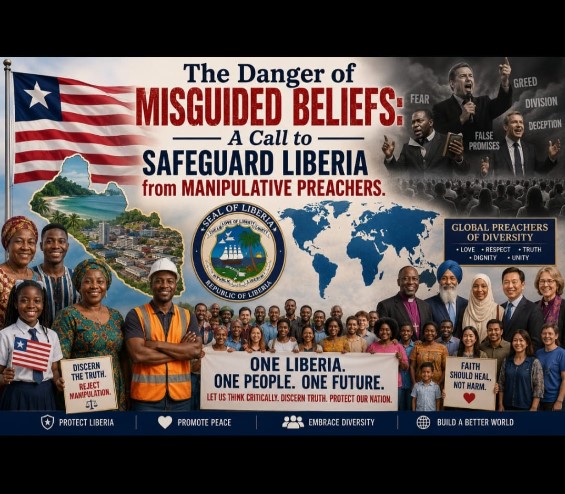
Misguided beliefs and manipulative preachers pose severe threats to Liberia’s peace and moral integrity. Addressing this manipulation requires spiritual discernment and civic accountability.
Liberians and global voices emphasized the urgent call to protect the nation from falsehoods and protect the public from religious exploitation.
President Joseph Nyuma Boakai: “Faith must shape conduct. Prayer must shape decisions. Patriotism must shape sacrifice. We can not seek divine favor while tolerating division, corruption, dishonesty, and indifference.”
President Boakai: “A praying nation must also be a responsible nation. A faithful people must also be a disciplined people. While governments make plans, institutions carry responsibilities, and citizens work daily to build a better country, we must never lose sight of the divine hand that guides nations.”
Former President George Weah: “When someone tells you it is not possible and uses God’s name to cause emergency or alarm, and your hopes are still tied there, that is where we go wrong. The only way to isolate false prophets is by walking away from their presence so they know that when you lie to a congregation, God isolates you.”
Clergy & International Prelates:
“If a minister is not well disciplined and humble enough to only preach the Gospel of Christ, they will be highly tempted to manipulate, lie, and forge miracles just to be relevant.”
“Many of these present-day prophets are religious rascals. When the anointing of God is upon you, you don’t collect money from politicians and give false prophecies in their favor.”
“Beware of false prophets, who come to you in sheep’s clothing, but inwardly are ravenous wolves.” (Matthew 7:15).
Politicians & Public Leaders:
“While we believe prophecy is biblical, we must remember that in the last days, deception and false teaching will lure people away from the truth. Liberia must not return to a scandalous reign where manipulative men act as lords in a banana republic.”
“No servant of God should peddle a lazy gospel to please a patron or promote false prophecies claiming false powers. We must discern and protect our nation’s destiny from those who exploit faith for power and money.”
Universal Citizens & Social Observers:
“The idea that people believe that God will magically send down money, gold, or diamonds from heaven is ridiculous. African Christians must change the script and match their faith with hard work, accountability, and responsibility.”
“When citizens gravitate towards supporting a religious endeavor, it doesn’t mean they are blind to the truth. Too many people are suffering at the hands of false prophets who use the name of God to deceive for selfish gain.”
In the face of growing global interconnectedness, it is increasingly evident that vulnerable communities are susceptible to exploitation by individuals and organizations that masquerade as bearers of divine wisdom.
Chief among these exploiters are the so-called “abecedarian neophytes,” “fledgling preachers,” and “self-proclaimed men of God,” who infiltrate societies lacking strong religious and educational foundations.
In Liberia, these individuals have taken root, spreading confusion, manipulation, and often harmful ideologies that threaten the very fabric of society.
It is imperative for Liberians to recognize the dangers these preachers pose and for the government to take a proactive stance to expel those who do not embody the true essence of spirituality and ethical leadership.
These neophyte preachers, often depicted as “tyros” or “greenhorns” in the religious domain, typically lack comprehensive theological training.
They present themselves as genuine clergy while simultaneously fashioning their ministries into lucrative businesses.
This business-minded approach to religion fosters an atmosphere ripe for manipulation, as these preachers exploit the faith and hopes of individuals seeking solace and direction in their lives.
It is not uncommon to witness these self-styled prophets peddling fear and superstition under the guise of divine messages.
Their machinations align more closely with the practices of charlatans than with the teachings of Christ or any other legitimate spiritual guide.
It is crucial to acknowledge that the influx of these preachers into Liberia, often referred to as “tenderfoots” or “novices,” is facilitated by a welcoming spirit among the Liberian populace.
In their quest for spiritual fulfillment, many Liberians have unwittingly opened their arms to figures whose chief motivations are not altruistic but instead are hinged on personal gain.
The explosion of these pseudo-churches, commonly replete with ostentatious claims of miraculous healing and prophetic insight, serves as a stark reminder of our collective responsibility to vet those we allow to lead us spiritually.
The growing prominence of these dubious institutions has engendered a tragic consequence: the manipulation of the vulnerable and the encouragement of divisive, fear-based ideologies that can destabilize society.
One of the most troubling aspects of this phenomenon is that these preachers often resort to fear-based rhetoric, issuing dire prophecies of impending doom if their followers do not adhere to their teachings.
Remarks about the overthrow of governments or societal collapse are not only incendiary but also inherently undemocratic.
In any civilized society, including Liberia, free speech, while a fundamental right, has boundaries that should not encompass hate speech or the incitement of violence.
By cloaking their intimidating messages in religious language, these preachers are leveraging the very faith that provides hope to so many.
As such, allowing them to operate unchecked undermines Liberia’s stability and perpetuates a cycle of fear and unrest.
The most egregious impacts of this trend manifest in the way these preachers distort the tenets of Christianity, making their teachings more about profit than about the nurturing of spirit and community.
They offer salvation and blessings in exchange for financial contributions, thereby commercializing faith in ways that are ethically dubious and morally corrupt.
This transactional approach to spirituality not only disenfranchises the faithful but also dilutes the true messages of compassion, love, and service that are at the heart of genuine religious teachings.
Moreover, the presence of these manipulators sends a stark message to the broader international community about Liberia’s vulnerability.
In a world that increasingly values integrity, wisdom, and spiritual depth, the prominence of unscrupulous individuals who spread false narratives damages Liberia’s reputation and undermines efforts to foster international partnerships.
This burgeoning cycle of negative representation feeds into the broader discourse regarding religious freedom, where instead of being seen as a nation rich in faith and diversity, Liberia risks becoming branded as a market for exploitation and deceit.
What becomes clear in this discourse is the urgent need for Liberians to take action.
The community must engage in collective introspection to recognize that those who profess to speak on behalf of the divine must be held accountable by both the people they serve and the governing bodies sworn to protect them.
A crucial step in this movement is the expulsion of those who exhibit harmful behavior and rhetoric masquerading as religion.
It is time for the Liberian government to bolster regulatory frameworks to ensure transparency and accountability among religious organizations, creating an environment where true spirituality can flourish, free from opportunistic behavior.
Furthermore, Liberians should strive to educate themselves about the diverse interpretations of faith and the ethical implications of leadership within religious spaces.
Encouraging critical engagement with spiritual teachings will empower individuals to discern genuine spiritual leaders qualified by their character and actions rather than their flashy presentations or persuasive rhetoric.
In embracing a culture of skepticism and inquiry, Liberians can better protect themselves and their communities from manipulation.
It is also essential for existing religious organizations and community leaders to step up and provide a strong, ethical alternative to the deception proliferated by these self-appointed preachers.
By reinforcing a commitment to teaching the true values of faith, compassion, and community service, legitimate leaders can offer a sense of hope built not on fear but on empowerment.
This counter-narrative will play an instrumental role in reclaiming the narrative around spirituality in Liberia and ensuring that the communities can find solace in genuine expressions of faith that uplift rather than exploit.
The increasing prevalence of manipulative preachers in Liberia is a critical issue that requires immediate attention.
The tendency of vulnerable individuals to open their arms to these individuals only perpetuates a culture of exploitation, fear, and division.
Liberians need to recognize the importance of safeguarding their spiritual well-being against harmful ideologies that masquerade as faith.
The expulsion of these so-called preachers, coupled with a commitment to nurturing genuine spiritual leadership, is paramount to fostering a society based on authenticity and integrity.
In doing so, Liberia can reclaim its spiritual identity and embrace a future where faith strengthens, rather than divides.
It is time for Liberians to stand united against the forces of manipulation and, in the process, protect the true essence of their shared beliefs.