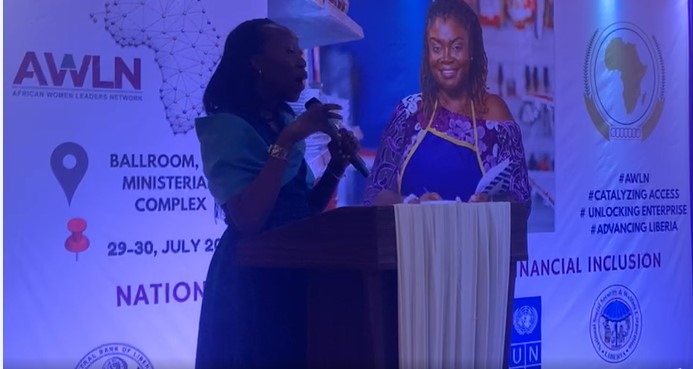
PHOTO; Madam Georgia Wallen, World Bank Group County Manager
World Bank Liberia Country Manager, Georgia Wallen has stressed the urgent need to boost financial inclusion and economic empowerment of Liberian women, who she said are “a key driver of economic growth, job creation, and poverty reduction”,
Madam Wallen was speaking this week at the National Conference on Women’s Financial Inclusion in Monrovia,
“In Liberia, women produce 93% of the country’s food yet own just 27% of businesses and significantly lag men in account ownership. Estimates suggest that achieving gender parity in Liberia could raise women’s contribution to economic activity to 53% and increase Liberia’s GDP by up to 30%.”
BELOW IS FULL TEXT OF THE WORLD BANK LIBERIA COUNTRY MANAGER’S REMARKS:
Remarks Delivered by World Bank Group Country Manager for Liberia Georgia Wallen at the National Conference on Women’s Financial Inclusion
National Conference on Women’s Financial Inclusion today, July 29, 2026. Kindly use it as a public service as seen below:
Good morning, Honorable Officials of the Government of Liberia, distinguished guests, development partners, and colleagues.
On behalf of the WBG, thank you for the opportunity to join you for this week’s national conference on women’s financial inclusion. We strongly share your conviction to women’s financial inclusion as a driver of economic growth, job creation, and poverty reduction in Liberia. Women are the backbone of Liberia’s economy. In Liberia, women produce 93% of the country’s food yet own just 27% of businesses and significantly lag men in account ownership. Estimates suggest that achieving gender parity in Liberia could raise women’s contribution to economic activity to 53% and increase Liberia’s GDP by up to 30%.
Financial inclusion and economic empowerment of Liberian women are keys for delivery on Liberia’s ARREST Agenda for Inclusive Development and Vision 2030.
The World Bank Group is committed to supporting this vital agenda, which is at the heart of our new Country Partnership Framework focused on building foundations for new and better jobs. We are supporting reforms and investments that expand access to finance, strengthen financial inclusion, and create opportunities for women entrepreneurs in both the formal and informal sectors. Leveraging digital technologies is also key, including for connecting women in remote communities to financial services and markets.
I’d like to highlight two examples that are yielding promising early results and demonstrate the promise and potential of Liberian women nationwide.
- Many women face barriers to accessing formal loans – such as lack collateral or credit history – yet they need start-up capital and working capital to launch or expand businesses. Over the past three years, the Liberia’s Women Empowerment Project (LWEP) has supported hundreds of women entrepreneurs across over 450 communities while tackling barriers like gender-based violence. Implemented by the Ministry of Gender, Children, and Social Protection, LWEP demonstrates how even modest access to finance —when paired with training and business planning— can unlock significant economic activity that impacts women, families, and communities for the better. Engaging with eligible village savings and loan associations (VSLAs), LWEP is boosting financial inclusion while also investing in community resilience and connecting rural women to mobile money platforms. Women who once operated cash-only roadside stands now accept digital payments, maintain bank accounts, and access markets beyond their communities. This digital bridge is helping women to formalize their businesses, build credit, and lay the foundation for sustainable growth. The LWEP demonstrates once again that when women thrive, they become engines of inclusive growth – boosting job creation, strengthening local supply chains, and building more resilient communities.
- The World Bank’s Liberia Investment, Finance and Trade (LIFT) Project also actively drives women’s financial inclusion by expanding low-cost loans and modernizing digital payment systems for small and medium enterprises (SMEs). Led by the Ministry of Commerce and Industry and the Central Bank of Liberia, the LIFT project is already having positive demonstration effects. Some 130 out of over 200 supported SMEs (roughly 60% of total beneficiaries) are female-owned or female-managed businesses spanning trade, agriculture, manufacturing, health services, and more.
Expanding women’s financial inclusion is integral to Liberia’s economic transformation and long-term prosperity. When Liberian women are positioned to save, borrow, invest, and grow businesses, Liberia’s economy will grow faster and more inclusively.
Kudos for this timely and meaningful event. The World Bank Group is proud to partner with the Government of Liberia and other stakeholders to advance this agenda.
Thank you.