
But Fighting Against Liberia’s Narcotic Drugs Fight Far Outweighs Possible Environmental Pollution
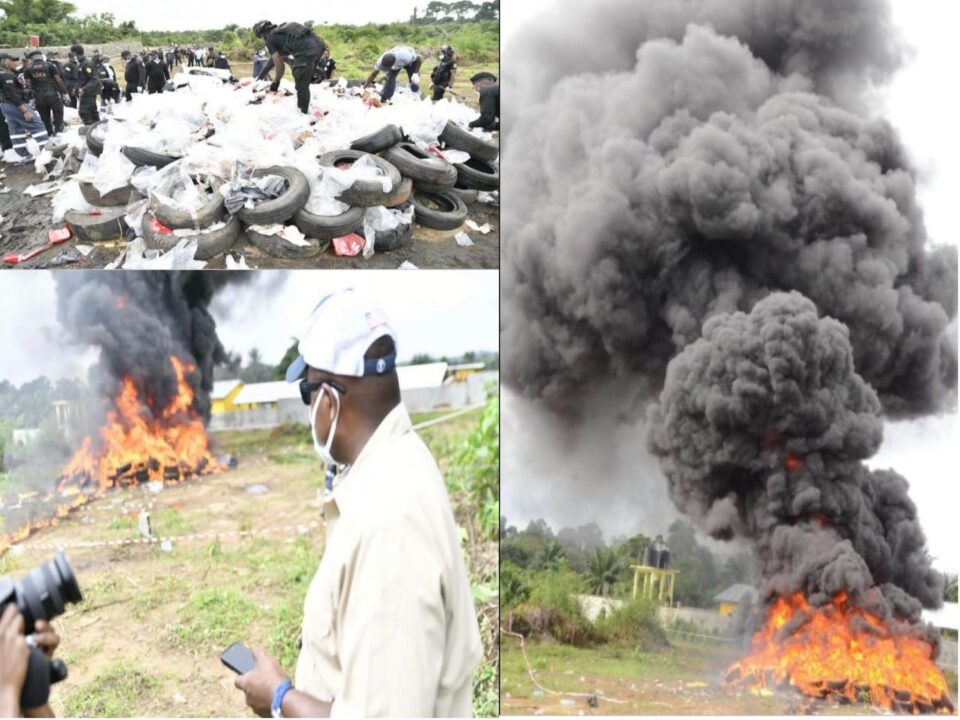
PHOTO: This week’s burning of US$19.2 million and US$317 million cocaine seized by Liberia Joint Security Taskforce outside Monrovia
By Emmanuel Tobey
It is no doubt that a vast majority of Liberians appear to be on edge and want to see all efforts by state authorities to decisively crack down on the growing rise in narcotic drugs trafficking, use and abuse in this post-war West African country. Thus, beating this drug menace means more to this nation than any temporary environmental pollution resulting from burning of these highly dangerous narcotic substances.
But just out of curiosity, this writer has been reflection on possible environmental pollution resulting from the burning of such a huge quantity of the recently seized US$19.2 million cocaine seized at the Roberts International Airport in June and the US$317 million cocaine seized from a private residence on the Robersfield highway on the outskirts of the capital, Monrovia.
Burning 3,971 kg (about 4 metric tons) plus 237.6 kg of processed cocaine would mean destroying a total of 4,208.6 kg (about 4.21 metric tons) of material, research shows.
The exact amount of pollution cannot be calculated without knowing:
- The chemical composition and purity of the cocaine.\
- What adulterants or cutting agents are present (such as levamisole, caffeine, sugars, local anesthetics, etc.).
- The type of incinerator or whether it is burned in the open.
- The combustion temperature and emission controls.
However, experts say several general conclusions can be made:
Burning over 4.2 metric tons of any processed drug can release carbon dioxide (CO₂), carbon monoxide (CO), fine particulate matter (PM2.5 and PM10), and volatile organic compounds (VOCs) if combustion is incomplete.
Depending on the additives, it may also emit nitrogen oxides (NOₓ) and other potentially hazardous gases.
Open-air burning poses a much greater risk to nearby communities than destruction in a high-temperature hazardous-waste incinerator equipped with pollution-control systems, according to environmental scientists.
Advice for Liberia Environmental Protection Agency (EPA)
The Environmental Protection Agency should recommend that:
The drugs be destroyed only in a licensed high-temperature hazardous-waste incinerator with modern emission-control equipment.
Open-air burning should be avoided.
Air quality should be monitored before, during, and after the destruction, measuring pollutants such as PM2.5, PM10, CO, NOₓ, and VOCs.
Residents near the destruction site should be informed in advance, and a safety perimeter should be established.
The destruction process should comply with national environmental laws and international best practices for hazardous waste disposal.
An environmental monitoring report should be prepared and made available to the public after the operation to demonstrate compliance with air-quality standards.
If the destruction is carried out in a properly designed hazardous-waste incinerator with effective pollution controls, the environmental impact can be greatly reduced compared with open burning.
Conversely, if the drugs are burned in the open or in an uncontrolled facility, the resulting smoke and air pollution could pose health risks to workers and nearby communities.