
By Austin S Fallah – A True Son of the Planet Earth Soil: fallahas@yahoo.com
A few days ago, I sat with some friends and discussed current events in our motherland, Liberia, which inspired this article. Rather than narrowing the article to Liberia, I decided to give it a more holistic perspective.
“Is it wisdom—or political amnesia—to represent in court the very person who once joined forces to impeach you and ban you from public office? Machiavelli’s political philosophy reminds us that interests, alliances, and changing circumstances drive power. An enemy who is now in trouble may suddenly need the person they once tried to destroy. But remember: their crisis does not erase their history. Help if you choose, but never let compassion make you forget who stood against you when they had the power to hurt you.”
“Machiavelli understood a hard truth of politics: when circumstances change, yesterday’s enemy may become today’s dependent. So, when someone who once helped impeach you, worked to remove you from public office, and stood against your political survival later finds themselves in a legal battle—ask yourself: Is this an opportunity to demonstrate statesmanship, or a test of political memory? The wise politician can forgive an enemy without forgetting the lesson the enemy taught them.”
“Politics has a long memory, even when politicians pretend to have none. When the person who once stood in a coalition to impeach you and restrict your right to public service later finds themselves trapped in a legal battle, their circumstances may change—but history does not. Machiavelli’s realism reminds us that political alliances are often built on interests, not permanent friendships. The question is not whether you can help an old adversary; the question is whether helping them serves principle, justice, and your own political integrity. Forgiveness can be strength—but forgetting can be a political weakness.”
“An enemy who once helped close the doors of public office against you may eventually knock on your door seeking representation when trouble finds them. That moment reveals more than their predicament—it reveals your character. Machiavelli’s philosophy teaches us to understand the shifting nature of power: yesterday’s adversary can become tomorrow’s petitioner. But wisdom requires distinguishing between mercy and political naïveté. You may choose to rescue someone from the storm without forgetting who once helped create the storm you endured.”
Machiavelli’s philosophy reminds us that an enemy who falls into trouble may become dependent upon the very person they once opposed. But before extending a helping hand, ask: What has changed—their circumstances or their character? If they once joined a campaign to impeach you and deny you public office, representing them in their hour of legal difficulty may demonstrate magnanimity, political calculation, or misplaced loyalty. In politics, forgiveness is a choice; forgetting is a risk.”
In the convoluted world of politics, where loyalty can shift like the sands of time, the question of whether to aid those who have actively sought to undermine or discredit us is both profound and perplexing.
This dilemma takes on several dimensions when considering an attorney’s role in assisting political opponents, particularly in criminal matters.
The inquiry at hand is not merely about legal ethics; it also delves into compassion, political strategy, and societal norms.
Should we, as a collective society, extend our hands to those who have declared us enemies?
This aims to explore this ethical conundrum through various lenses, providing a nuanced view on the moral implications of assisting former adversaries.
At the heart of this issue is the decision to support or decline assistance to those involved in our downfall, often through impeachment or public condemnation.
What compels one to help a former enemy? Several factors may influence this decision, including compassion, monetary gain, political amnesia, or retribution disguised as civil duty.
The sentiment of compassion suggests an innate human tendency to empathize with others, regardless of their past actions.
As followers of the Christian faith might argue, compassion aligns with the biblical admonition: “Love your enemies and do good to those who hate you” (Luke 6:27).
This perspective posits that offering help, even to those who have wronged us, serves a higher moral purpose that transcends personal grievances.
Conversely, one cannot ignore the potential pitfalls of helping political adversaries.
Money, perhaps the most tangible motivator in this discourse, raises questions about the sincerity of one’s actions.
Are we aiding our opponents out of a genuine sense of duty, or are we responding to financial incentives that may lead to compromises of integrity?
In a political arena that often blurs the lines between altruism and self-interest, the decision to help a former adversary may be scrutinized through a lens of skepticism.
Political amnesia also plays a perplexing role in this conversation.
In politics, memories of past conflicts can seem to dissipate, allowing for renewed alliances when convenient.
Yet, should we resort to amnesia rather than confronting past injustices? Or is it wise to acknowledge differences while rising above them for the sake of the greater good?
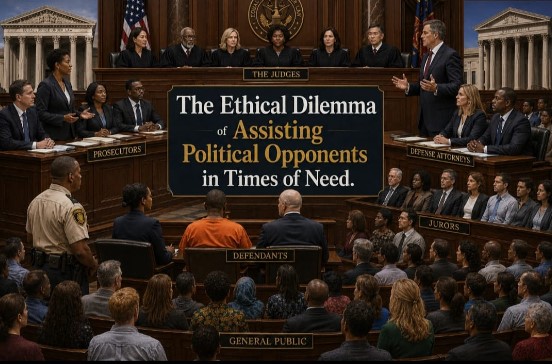
In a complex society, the public becomes judge, jury, prosecutor, defendant, defense lawyer, and ultimate arbiter of ethical decisions.
With this multi-faceted role, public sentiment guides the decision-making process.
When asked to assist a political opponent in their time of need, the public’s perception is paramount.
People often reflect upon their values and collective norms when determining whether to support a former enemy.
This situation can spark complex societal debates, where constituents may either rally in support of helping those in need or argue that former adversaries should bear the consequences of their actions independently, without aid.
Consider, for example, the historical precedents in which public figures have chosen to support their opponents.
After the fall of her presidency, former Secretary of State Hillary Clinton publicly extended her support to President George W. Bush during a humanitarian initiative to combat AIDS.
While their political ideologies starkly opposed one another, this act exemplified an understanding of shared humanity that transcends partisan differences.
Such actions can alter the public narrative, showing that even in the face of conflict, cooperation can lead to meaningful outcomes.
However, in understanding the dynamics of political enmity, one should not overlook the deep-seated sentiment that arises from betrayal.
When individuals seek to prosecute us politically, declare us unfit for office, and label us as enemies, distrust naturally develops.
The bitter taste of political rivalry often leads individuals to question the motives behind the aid provided to former enemies.
Furthermore, resentment and anger can cloud one’s judgment, making it difficult to navigate these treacherous waters of moral obligation.
One significant factor in resolving this ethical dilemma is education.
A more educated society is often better equipped to foster empathy and understanding for others’ plight, regardless of past grievances.
By promoting civil discourse and educating the public on political processes and the intricacies of justice, we can prepare a foundation for compassion that thrives in times of strife.
Education not only clarifies the complexities of the law but also highlights the importance of reform, understanding, and mutual respect.
It allows the public to engage with conflicting ideologies respectfully and constructively, minimizing the divisiveness that permeates political discussions.
While education remains a powerful tool in addressing this ethical domain, forgiveness and reconciliation also play key roles.
By reframing what it means to support a former enemy, we can acknowledge that the decision to offer help can vary widely by context.
For instance, extending legal assistance to someone facing persecution for a crime against the nation, such as drug trafficking, may advance a more equitable system and serve the public interest.
In this case, aiding a former opponent becomes a matter of principle over personal history.
Furthermore, it is paramount to acknowledge that aiding a political adversary in times of need does not equate to endorsing their past actions.
Supporting a former enemy should be rooted in the belief that everyone, irrespective of their political history, deserves access to fair legal representation.
This aligns closely with the ethical standards of the legal profession that prioritize justice.
Lawyers, as advocates for the law, must rise above personal vendettas and strive to uphold the principles of the legal system that prioritize help and advocacy for those in need.
Ultimately, the question of whether to assist those who have once sought to devour us politically is complex and layered.
As citizens of a semblance of democracy, we face a momentous opportunity to reveal our true values.
Will we choose to stigmatize our adversaries, or will we rise above our enmities to embody a sense of compassion?
The teachings of various faiths highlight the importance of forgiveness, reconciliation, and empathy.
May we choose to heed these timeless lessons not merely as abstract ideals, but as cornerstones of a shared moral foundation that elevates us as a society.
Therefore, as we navigate the waters of political rivalry and adversity, let the public become the ethical compass guiding these decisions, weighing the potential repercussions against the principles that underpin a just society.
In the end, the call to support those in need, irrespective of past actions, should catalyze collective healing, understanding, and progress toward the common good.
The question is not necessarily whether we help those who have sought our downfall, but rather what kind of society we envision when we exercise our power to extend compassion, fostering a world where even political enemies can contribute to a greater cause.