
By Austin S Fallah – A True Son of the Planet Earth Soil: fallahas@yahoo.com
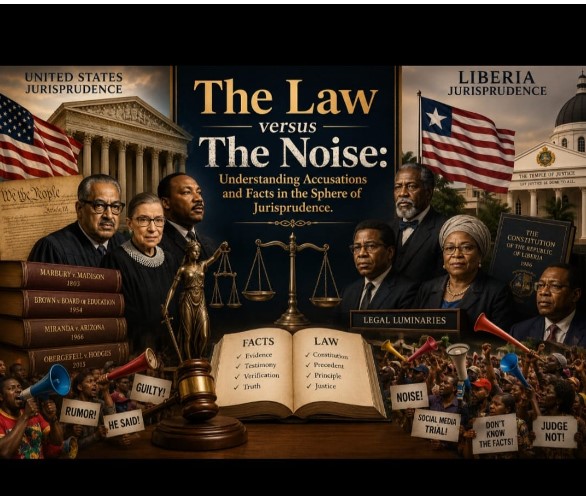
Navigating the tension between the “law” and the “noise” requires balancing objective legal realities with the clamor of public accusations, political rhetoric, social media noise, and societal grief.
Across jurisprudence, history, and African governance, leaders and thinkers have frequently emphasized that the letter of the law must always prevail over emotional mobs and political theater.

Photo: (L-R) The Temple of Justice and the Author
President Joseph N. Boakai: “We are a country governed by laws, not by mobs or self-serving ambition. Those who undermine peace, violate the law, or seek to disrupt national harmony will face the full force of the law and justice.”
Cllr. Tiawan Saye Gongloe (Liberian Human Rights Lawyer): “Justice and the rule of law are inseparable. A functioning democracy depends on the ability to distinguish what the law requires for proof and judgment, from what an angry public assumes about guilt.”
Musa Bility (Lawmaker and Liberian Politician): “It has been affirmed that law, not noise, must guide us. Now, it is up to the rest of us, especially politicians, to follow that example. We must remove ethnicity and religion from the battlefield of politics.”
Nelson Mandela (Former President of South Africa): “I have fought against white domination, and I have fought against black domination. I have cherished the ideal of a democratic and free society in which all persons live together in harmony and with equal opportunities.”
Peter Obi (Nigerian Politician): “Africa should look inward and tackle the leadership challenges contending with its development… true leadership emerges through accountable governance and respect for the rule of law.”
Ellen Johnson Sirleaf (Former President of Liberia): “True reconciliation is not just about the truth; it is about building a society where the rule of law replaces impunity and where justice belongs to all.”
Accusations, Facts, and the “Noise” Carl Sandburg (American Writer/Historian): “If the law and the facts are against you, pound the table and yell like hell.” (Note: This popular legal adage points directly to the phenomenon of using loud, baseless arguments—the “noise”—when neither the facts nor the law support an accusation).
John Inazu (American Legal Scholar): “Many disagreements stem from collapsing these categories—treating moral outrage as if it settles factual uncertainty or treating factual uncertainty as if it silences moral judgment.”
William L. Prosser (Renowned Legal Scholar on Torts): “There is perhaps no more impenetrable jungle in the entire law than that which surrounds the word ‘nuisance,'” (often used metaphorically to describe the chaotic “noise” of endless, ungrounded legal accusations).
On Truth and Cross-Examination Proverbs 18:17 (Biblical Wisdom often cited in jurisprudence): “The first to speak in court sounds right—until the cross-examination begins.” (This passage remains a foundational axiom for understanding the difference between early, unverified accusations and the actual facts uncovered in a fair legal process).
“Understanding accusations versus facts requires staying tethered to the Executive Mansion and official judicial records rather than the volume of public debate.
To explore how governments are actively pursuing accountability to bridge the gap between historical impunity and the rule of law, you can track Executive Mansion Press Releases.”
In the modern era, the distinction between legal accusations and facts often blurs amid the cacophony of public opinion and social media discourse.
This phenomenon is particularly evident in jurisdictions steeped in rich legal traditions, such as the United States and Liberia.
As graduate students (former and current), doctor of jurisprudence(former and current), and future practitioners of the law, it is essential to navigate this landscape with an analytical lens, recognizing that accusations remain mere claims until they are substantiated beyond a reasonable doubt or established with a preponderance of the evidence.
This personal analytical korero explores the critical differences between allegations and facts within legal proceedings, the role of public opinion in shaping perceptions of guilt, and the urgent need for a more informed citizenry equipped to understand the complexities of law.
At the core of any judicial system lies the principle of the presumption of innocence.
This enduring tenet holds that an individual is innocent until proven guilty in a court of competent jurisdiction.
This foundational concept is enshrined in both the American legal framework and the emerging jurisprudence of nations like Liberia.
Academic discourse further reinforces this principle, as law professors teach their students (us at the current or former Graduate or JD levels) the distinction between accusation and fact, emphasizing the British-led common law tradition that seeks to protect the rights of the accused.
Accusations are, by their very nature, statements that assert an individual committed a wrongful act.
However, merely voicing an accusation does not equate to demonstrating its truth.
In a court of law, the burden of proof lies with the accuser.
In the United States, criminal cases generally require the prosecution to establish guilt beyond a reasonable doubt.
In contrast, civil cases require a lower standard of proof, known as the preponderance of the evidence.
This bifurcation highlights not only the variability in the judicial process but also underscores the importance of scrutinizing the evidence supporting any allegations.
In Liberia, the same standards applied, but the legal system, influenced by its historical context and societal challenges, similarly grapples with the intricacies of accusations versus facts.
The legacy of civil unrest, compounded by the complexities of a transitioning society, requires a robust understanding of legal principles among its populace.
The ability of citizens to distinguish between facts and accusations is crucial to reinforcing the rule of law and fostering a culture of accountability.
Yet at times, Liberians may find themselves overwhelmed by the noise of opinions from individuals who lack the legal expertise to navigate such issues.
Public opinion can profoundly shape perceptions of guilt, especially in cases that receive significant media attention.
In today’s digital age, social media amplifies voices and disseminates information (and misinformation) rapidly, contributing to an often skewed public narrative.
Individuals without legal backgrounds may hastily form opinions based on sensationalized narratives, failing to appreciate the complexities of legal procedure.
This tendency can create a hostile environment for the accused, particularly in jurisdictions where public sentiment may influence judicial outcomes.
The legal reasoning we(legal minds) employ is cultivated through rigorous study and an understanding of legal texts, landmark cases, and prevailing doctrines.
Our(legal minds) intellect is honed through the analysis of case law, statutory interpretation, and the application of legal principles to varied scenarios.
Consequently, we come to understand that what may appear as definitive truths in a public context may lack the substantiation required for legal adjudication.
The responsibility we bear as budding legal practitioners is tremendous, as we must advocate for a clear understanding of legal parameters and the profound importance of basing judgments on facts rather than hearsay.
This intellectual journey extends beyond academic confines; it requires a commitment to imparting legal knowledge to the wider community.
There exists a pressing need for public engagement that emphasizes the significance of maintaining an informed citizenry.
We must advocate for and participate in educational initiatives that enlighten individuals about their rights, the judicial process, and the implications of accusations, both for the accused and the accusers.
To foster a culture that respects legal principles is to cultivate a society that values justice over chaos, facts over opinions.
It is vital to reiterate that ill-informed opinions, sensationalized stories, and rampant gossip can have damaging effects on ongoing legal matters.
A cloud of intrigue can overshadow an individual’s fundamental right to a fair trial.
The potential for injustice escalates when societal pressures distort evidence and impinge on courts’ deliberative processes.
This reality is one of the reasons many legal systems incorporate safeguards, such as jury selection and instructions, to diminish the influence of external noise on judicial determinations.
Furthermore, when legal accusations lack a factual basis, they can perpetuate a cycle of mistrust and discord within communities.
Clients and defendants alike begin to lose faith in the criminal justice system when they perceive that judgments are being passed on irrational grounds rather than on a careful consideration of the facts.
For the system to function effectively, it must command public confidence.
Therefore, the culmination of legal education and public understanding becomes indispensable for fostering an environment in which the administration of justice prevails, unmarred by distraction.
Essentially, achieving justice hinges on our collective ability to demystify the legal process and the basic tenets that underpin it.
It is incumbent upon law students, legal scholars, and practitioners to ensure that the legal intricacies are communicated effectively to those not versed in the law.
Although legal jargon can be daunting, we must strive to bridge the gap between the legal community and the general public.
By empowering individuals with knowledge about their rights and the justice system, we contribute to a culture that not only reveres the rule of law but also actively participates in its reinforcement.
As we look toward the future, we must remain committed to the principle that all accusations must be met with the rigor of legal analysis and evidence-based examination.
Liberians, like their American counterparts, must rise to an intellectual level that allows them to discern the relationship between accusation and factual evidence, rejecting the vices of gossip, innuendo, and unfounded claims that threaten the integrity of the judicial process.
The dialogue surrounding accusations and facts within the legal framework demands rigorous scrutiny and critical engagement.
The principle of the presumption of innocence underpins a just society, and as legal scholars and practitioners, it is our mandate to champion that tenet vigorously.
We must resist the allure of noise and focus instead on fostering enlightened discourse rooted in the rule of law.
Only through a shared commitment to intellectual clarity and social responsibility can we hope to nurture a legal culture in which justice prevails above all else.
We hope for one Liberia, where the noble pursuit of justice and truth empowers every citizen to rise above prejudice and engage thoughtfully with the law.