
By Austin S Fallah – A True Son of the Planet Earth Soil: fallahas@yahoo.com
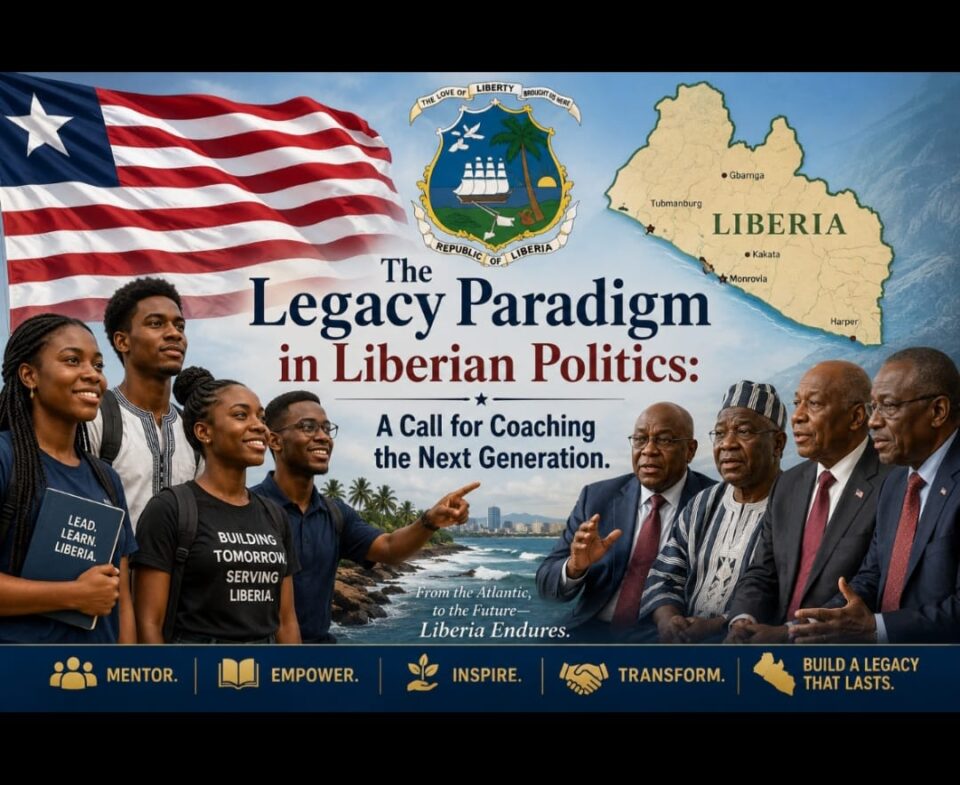
The Legacy Paradigm in Liberian Politics centers on transitioning authority from the older generation of political heavyweights to the youth, emphasizing structured coaching and mentorship rather than political exclusion.
The Legacy Paradigm is not about older leaders stepping away abruptly. It is about transforming the political pipeline from “gatekeeping” to “coaching,” ensuring the next generation is technically prepared and ethically anchored to govern.
President Joseph Nyuma Boakai: “I fear not the next election; I am raising the next generation and building a legacy to lay the foundation for a greater Liberia.”
President Boakai: “Learning is liberation, learning is legacy, and learning is the lever that thrusts us into the future… investing in young people is not a choice; it is the foundation of our success.”
Dr. Amos Claudius Sawyer (Interim President & Scholar): “The strength of democracy lies not only in the institutions that uphold it but in the active participation of its people, particularly the youth who carry the torch of change.”
Dr. Sawyer: “If we build a capable state, it can administer to the people sufficiently that they will be happy, and the divisions will be minimized once the state is delivering.”
Dr. Henry Boima Fahnbulleh Jr. (Statesman, Progressive Politician, Scholar & Diplomat): “Any education that is not placed at the service of the masses is useless.”
Dr. Fahnbulleh:” Extending this to the legacy paradigm, Fahnbulleh’s doctrine insists that veteran leaders must pass down their knowledge to intellectually radicalize, well-meaning youth to alter the historic narrative of societal inequality.”
Dr. Togba-Nah Tipoteh (Economist, Scholar, Statesman & Progressive Politician): Dr. Tipoteh’s lifelong advocacy via MOJA (Movement for Justice in Africa) emphasizes “mentorship through grassroots integration.” He frequently warns that older politicians cannot expect an uncoached generation to sustain democracy.”
Dr. Tipoteh: “True preparation for leadership happens in the fields of service to the people, where the old must actively guide the young away from the greed of the past.”
Prof. Alaric Tokpa: “We can’t be taking pleasure from the poverty-stricken condition and abject misery of our people, then we say the struggle must end. We can’t be in haste to get rich and pretend that the struggle is coming to an end. On our side, the struggle is just beginning.”
Prof. AlaricTokpa: “We have the power. Be not deceived. We have the power to change Liberia. We must know that we have that power. We must claim that power. We must utilize that power in a progressive democratic manner.”
Prof. Alaric Tokpa: ” Liberia’s history has often been fragmented and shaped by exclusion and selective memory.”
D Karn Carlor (Veteran Liberian Progressive Activist): “Education and Politics,” the “masses” must be politically educated, so corrupt political actors cannot easily manipulate them. He argues that true political transformation comes only when the public moves past superficial political rhetoric and receives a civic education rooted in the country’s real socio-economic conditions.
Nelson Mandela (Former President of South Africa): “The youth of today should be the scriptwriters of their own destiny and features. Empower them, inspire them, and they will change the world.”
Ellen Johnson Sirleaf (Former President of Liberia): “If your dreams do not scare you, they are not big enough. We must clear the path so our young daughters and sons can run faster and further than we ever did.”
Thomas Sankara (Former President of Burkina): “We must produce more because it is the young person who produces. A youth that does not create is a youth that decays.”
United Nations (UN): “You are never too young to lead, and you should never doubt your capacity to triumph where previous generations have failed.”
Lee Kuan Yew (Singapore): “If you do not choose your successors early and coach them through the crucible of governance, everything you built will turn to ashes within a generation.”
Confucius (China): “If your plan is for one year, plant rice. If your plan is for ten years, plant trees. If your plan is for a hundred years, educate and nurture the children.”
Sheikh Mohammed bin Rashid Al Maktoum (UAE): “A place that does not nurture and mentor its youth to take over the reins of tomorrow is a place that has chosen its own stagnation.”
Chinua Achebe (Novelist, Things Fall Apart): “While we do not think that continuous change is always good, we must accept that a generation that fails to mentor its successors abandons its own history.”
Wole Soyinka (Poet & Playwright): “The hand that passes the torch must not shake, and the hand that receives it must be steady. That steadiness is only achieved through the deliberate patience of mentorship.”
Bob Marley (Musician): “Emancipate yourselves from mental slavery. Pass it on to the children, tell them the truth about where we come from so they can build where we are going.”
By: Austin S Fallah – A True Son of the Planet Earth Soil: fallahas@yahoo.com
In the ever-evolving landscape of global politics, revered political figures, those who have left an indelible mark on their nations, often re-emerge not merely as symbols of bygone eras but as active participants in shaping the future.
These political legends do not vanish from the stage; instead, they return as coaches to guide the next generation of leaders, reminiscent of sports legends who come back to inspire future champions.
In Liberia, there is a compelling need for seasoned politicians to broaden their horizons and expand their consciousness.
The political realities of today require a deliberate rethinking of strategy and engagement, particularly in light of the challenges that beset the nation.
Liberia stands at a critical juncture, grappling with socio-economic inequalities that have entangled generations.
To usher in a new era of governance, it is essential for political leaders to not only reflect on their past experiences but also reframe their worldview and local views.
This transformation necessitates a generational mindset—one that prioritizes community.
Political legends must cultivate a legacy mindset that prioritizes meaningful engagement and sustainable change rather than temporary solutions and empty promises.
A significant aspect of this legacy mindset involves future-proofing one’s thinking.
In a world that is rapidly changing due to technological advancements, demographic shifts, and globalization, politicians must be proactive in evolving their perspectives.
The complexities of modern governance demand a shift in paradigms that addresses both immediate concerns and long-term aspirations.
In Liberia, where endemic poverty and underdevelopment persist, this evolution of thought is more urgent than ever.
Political leaders must recognize the need to prepare the next generation of politicians who embody intellectual rigor, critical thinking, and innovative approaches to governance.
These future leaders should not merely aim to occupy positions of power; they should aspire to lift the masses from the dungeons of poverty and despair, where many have been trapped for far too long.
This requires listening to the voices of youth engaged in grassroots movements and fostering environments conducive to growth, aspiration, and creativity.
Regrettably, the current political discourse in Liberia often falls prey to a cycle of unproductive demonstrations and empty rhetoric.
These actions, branded as patriotic but lacking genuine substance, do little to advance the needs of the populace.
Instead of creating pathways for constructive dialogue and progressive action, they exacerbate tensions and foster an uneasy, unsafe environment.
Political legends must therefore move beyond such futile gestures and engage in meaningful coaching that inspires resilience and the capacity to address real issues faced by citizens.
The responsibility of political coaching extends beyond merely imparting knowledge or offering advice.
It entails a commitment to fostering a spirit of collaboration and mentorship.
For instance, established politicians could initiate mentorship programs that pair experienced leaders with aspiring politicians, particularly from underrepresented communities.
This would facilitate the sharing of insights gleaned through decades of experience, providing a rich foundation for the next generation to build upon.
Moreover, it is pivotal to instill a sense of community ownership in political processes.
Politicians must become facilitators of change rather than mere agents of individual ambition.
Embracing a community-first approach involves engaging citizens in decision-making processes, advocating for their needs, and prioritizing policies that foster economic growth and social equity.
By adopting such an approach, political legends can ensure that their legacy is not merely a remembrance of their past triumphs but a living testament to their investment in future generations.
In teaching the next generation of Liberian leaders, it is essential to emphasize critical thinking and innovation.
As the nation grapples with multifaceted challenges, economic stagnation, environmental degradation, and social discord, innovative solutions are paramount.
Political legends, with their wealth of experience, should encourage young politicians to think creatively, challenge the status quo, and harness the power of technology to effect positive change.
By fostering a culture of innovation, they can help create a political landscape where new ideas thrive, and youth voices contribute meaningfully to national discourse.
Additionally, political leaders need to actively participate in shaping educational policies that empower the younger generation.
Education is a powerful tool for emancipation, and politicians must advocate for a robust educational framework that fosters critical thinking, civic engagement, and social responsibility.
By championing initiatives that prioritize quality education, they are investing in a generation of leaders with the awareness needed to transform Liberia into a prosperous and inclusive society.
Furthermore, political leaders must adopt a holistic understanding of socio-economic issues affecting Liberia.
From healthcare access and economic opportunities to gender equality and environmental sustainability, these interconnected challenges require comprehensive solutions.
Political coaches must guide emerging leaders to recognize the intersections of these issues and advocate for policies that promote systemic change rather than quick fixes.
This approach will not only uplift the masses but will also foster a culture of resilience and adaptability that can withstand future crises.
Lastly, the importance of ethical leadership cannot be overstated.
As seasoned politicians return to play a mentoring role, they must model integrity, transparency, and accountability.
The youth-young people must witness principled leadership in action, as this serves as a powerful lesson in ethics and governance.
When political legends prioritize ethical considerations, they establish a standard that future leaders will aspire to uphold as they navigate the complexities of governance.
The role of political legends in Liberia extends far beyond their time in office.
By embracing the mantle of coaching the next generation of leaders, they can cultivate a legacy that transcends mere political achievements.
This requires a profound commitment to broadening horizons, elevating consciousness, and evolving perspectives.
The future of Liberia rests in the hands of its young leaders, and it is the responsibility of those who came before them to prepare them for the challenges that lie ahead.
By adopting a community-first approach and fostering critical thinking, innovation, and ethical leadership, political legends can inspire a new generation dedicated to uplifting their nation and fostering true emancipation.
Through this deliberate effort, Liberia can transform its political landscape into one defined by progress, hope, and unity.