
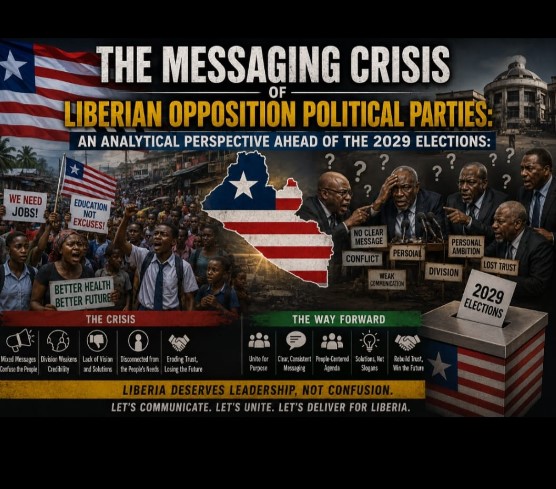
An Analytical Perspective Ahead of the 2029 Elections
By Austin S. Fallah – A True Son of the Planet Earth Soil: fallahas@yahoo.com
President Joseph Nyuma Boakai: “As long as the next election remains the most important priority of the opposition, there is no need to pay attention to the opposition because they have absolutely nothing to offer. Opposition must never become an obstruction to the national good or a desire for harm to befall our country.” – “I see protesters on their placards saying, ‘Boakai can’t lie.’ But let me tell them — they can lie. And while they do, we are moving this country forward.”
“Weah and Boakai were given state power and did nothing meaningful with it. All people see today is more hardship and suffering.” – Sensee Kaidii, Director of Communications for the Alternative National Congress (ANC).
“I can assure you 2029 CDC will win the elections democratically by a landslide margin… 2029 will be an electoral tsunami, not like the Unity Party that won with a margin of error.” – Attorney Janga Kowo, Chairman of the Coalition for Democratic Change (CDC).
“What you left in this mansion, do you want to come back? What you left there, do you want to come back? Liberian people, we say NO. The message they have, we understand the message.” – Deputy Speaker Thomas Fallah.
Dr. Togba-Nah Tipoteh: The Liberian opposition’s messaging crisis ahead of the 2029 elections stems from a fundamental disconnect with everyday citizens, often characterized as a cycle of incoherent tirades and empty platitudes rather than realistic policy advocacy.
Dr. Togba-Nah Tipoteh (Economist and Veteran Politician): On message clarity: Dr. Tipoteh has long championed the view that political parties must bridge the gap between their messaging and the grassroots realities of the Liberian people. He emphasizes that the poor and vulnerable are often left behind by vague, elitist rhetoric.
Dr. Amos Claudius Sawyer (Former Interim President): Addressing the disparity between the ruling elite and the impoverished electorate: “Socially, Liberia constitutes two worlds: the one of the haves is characterized by affluence. Existing side by side with this luxury group are the poor people of Liberia parched by the wretchedness of poverty.”
Dr. Togba-Nah Tipoteh: Critiquing the lack of substance and the transformation of servants into masters.
President Joseph Nyuma Boakai: Urging that opposition should not become a destructive force against national progress.”
Former President Ellen Johnson Sirleaf: Defining leadership as a commitment to service rather than a quest for status.”
Former President Charles Taylor: Reflecting on the historical, fear-driven dynamics of political messaging in Liberia.
Former President Samuel K. Doe: Emphasizing the urgent need for national unity and the rejection of class hatred.
Dr. Henry Boima Fahnbulleh: Historically maintained that for the opposition to succeed, it must champion the “ideological” liberation of the masses over opportunistic power grabs.
Cllr. Winston Tubman: During past election cycles, Tubman emphasized national stability over rhetoric, noting: “What Liberia needs now is stability, not war. We, as leaders of a leading opposition political party, will work closely with the ruling party to maintain the peace of our beloved country.”
Gabriel Kpolleh and Jackson F. Doe: As foundational opposition figures during the 1980s multi-party transitions, they pushed the narrative that “opposition is opposition if the interest of the state is paramount” over partisan compliance.
Alexander B. Cummings (Opposition Leader / Alternative National Congress): On the state of the opposition: Mr. Cummings has frequently criticized traditional opposition parties for failing to present a unified, transformative agenda, arguing that merely waiting to capitalize on the failures of the ruling party is an ineffective strategy for leading the country.
Dr. Edward B. Kesselly (Political Scholar): On political communication, Dr. Kesselly has analyzed the persistent shortcomings in Liberian opposition messaging, noting that historical factionalism and a lack of issue-based campaigns often prevent opposition parties from securing the electorate’s trust.
Benoni Urey (Political Figure): On party vision: Urey has advocated changing the fundamental nature of Liberian politics, asserting that politicians should focus on tangible results, such as building transparent institutions, rather than empty promises.
Former President William R. Tolbert Jr.: Focusing on conquering the “Enemies of the State, Ignorance, Disease, and Poverty.”
William V.S. Tubman (Former President): Advocating for economic security, equal justice, and national independence.
Current Opposition Figures & Media Analysts, and Activists: Note a failure in current strategies, with opposition parties often trapped in a cycle of “noise” and unsubstantial criticism rather than presenting realistic alternatives for youth.
As Liberia approaches the 2029 Presidential and General Elections, its political landscape is increasingly characterized by a cacophony of empty rhetoric and unfulfilled promises.
The opposition political parties, which should serve as beacons of hope for change and improvement, lack concise messages that resonate with the immediate concerns of the Liberian populace.
The absence of compelling and clear communication marks a significant departure from effective political engagement, particularly when addressing the needs of the most vulnerable groups, including students, youth, and the broader population struggling with poverty.
I will explore, from a personal perspective, the current state of political messaging among Liberian opposition parties, the implications of their failure to connect with the people, and potential strategies to realign them with the country’s aspirations.
At first glance, one might expect political opposition to have a unified, compelling narrative designed to challenge the ruling party’s policies and to redirect public sentiments toward change. However, in Liberia, the reality is starkly different.
The opposition is mired in vacuous slogans and baseless criticisms rather than explicit, actionable policy propositions.
This situation alienates the constituents and perpetuates a sense of hopelessness among those seeking meaningful improvement.
The deficiencies in messaging are particularly apparent in discussions centered on the everyday struggles faced by citizens, highlighting how disconnection from the populace has become a crucial flaw in the opposition’s strategy.
The current opposition parties seem caught in a cycle of “noise” rather than education and advocacy.
Many of their proclamations resemble political platitudes—high-sounding words devoid of substance that fail to address the pressing issues.
Liberia’s students and young people, who represent a significant demographic and a potential electorate, often find themselves the most neglected by this empty discourse.
They crave discussions that address their educational needs, job opportunities, and the infrastructure that supports their development, yet the opposition remains silent on these vital topics.
Instead of rallying the youth around dreams of a better future through policy proposals, opposition parties resort to incoherent tirades that criticize the government without offering realistic alternatives.
Furthermore, the absence of proposed solutions from opposition parties exacerbates voter disenchantment.
The political culture in Liberia has been marred by a tendency to point fingers at incumbent administrations rather than engage in constructive dialogue to advance progress.
This lack of proposals creates a void in which people perceive the opposition as mere naysayers with ulterior motives rather than as legitimate advocates for change.
For instance, a political party might declare, “We oppose the government’s failure,” yet fail to articulate a plan for educational reform that would engage students, a demographic crucial to societal advancement.
This disconnect between criticism and action creates an insurmountable chasm, leaving a public that not only questions the opposition’s efficacy but also feels trapped in apathy.
The implications of this messaging crisis are far-reaching.
Despite being among society’s most vocal members, young people and students have increasingly begun to internalize a sense of futility regarding their political involvement.
The opportunity for active civic engagement is supplanted by a growing belief that political discourse is ineffectual in addressing their realities.
As a result, the possible impact of youthful engagement is lost, and young voices remain in the shadows of the political arena.
A lack of political awareness and engagement often leads to the underrepresentation of the youth/young people’s perspective in policy formulation, perpetuating cycles of poverty and hopelessness.
Moreover, the environment of abject poverty in which many Liberians exist demands immediate and innovative responses from their political leaders.
The opposition parties must go beyond criticizing the prevailing governance model and instead offer concrete proposals demonstrating an understanding of the people’s issues.
This includes crafting messages highlighting how their policies would alleviate poverty, improve access to education, create jobs, and foster sustainable economic development.
The crux lies in opposition leaders’ ability to listen to people’s daily problems and translate those into actionable legislative agendas.
One significant aspect of effective political messaging involves a deep understanding of constituents’ values and aspirations.
Opposition parties must engage with the population, particularly the youth/young people and students, in meaningful and relatable ways.
Town hall meetings, educational workshops, and outreach programs could provide platforms for direct engagement, allowing leaders to gather insights regarding the concerns of everyday Liberians, many of whom may feel unheard, as seen with the MCSS students’ recent advocacy for the betterment of their teachers’ and instructors’ salaries/wages/pay.
Such communication channels would empower the constituency and enrich opposition parties with the grassroots intelligence necessary to construct relevant and impactful messages.
Additionally, establishing a narrative grounded in authenticity and relatability has become imperative.
Political slogans that evoke emotional responses often fall flat when disconnected from citizens’ experiences.
Instead, a messaging approach that draws on the realities of daily life could yield a more profound resonance. It would acknowledge citizens’ plight while presenting a compelling vision for a better Liberia.
By doing so, opposition parties could create a platform that fosters collaboration and unity among the populace, bringing diverse groups together around a common goal.
The potential success of such strategies hinges on opposition leaders’ commitment to reshaping their approach to governance as one rooted in the people’s needs.
Transparency and accountability must not be mere catchphrases but found elements of their engagement with the citizenry.
By pledging to uphold democratic principles and valuing active citizen participation, Liberia’s opposition parties can diminish their perception of themselves as antagonists and foster an environment more conducive to collective progress.
As the clock moves steadily towards the 2029 elections, the opposition political parties in Liberia must confront the reality of their messaging failures head-on.
While they continue generating noise with empty slogans, they risk alienating the populace they seek to engage.
Addressing the needs and aspirations of the Liberian people, particularly the students and youths, should take precedence over self-serving political warfare.
Only by championing substantive causes early on and crafting precise, actionable proposals can the opposition position itself as a viable alternative capable of addressing Liberia’s myriad challenges.
This monumental shift toward embracing the real issues and creating responsible solutions challenges the present political leadership and revitalizes hope in the populace’s hearts.
It can foster more informed, active engagement in the democratic process that resonates long after the 2029 elections.
Ultimately, the liberation of Liberia from cycles of poverty, disillusionment, and despair lies in the hands of those who dare to listen, who dare to act, and who dare to craft a narrative that transcends empty slogans, recognizing the shared humanity of a nation in search of better days.