
By Austin S. Fallah – A True Son of the Planet Earth Soil: fallahas@yahoo.com
The political exploitation of struggle involves using systemic injustices and personal hardships as tools for gaining power, often through empty promises and divisiveness rather than authentic reform.
This manipulation turns genuine suffering into political currency, requiring a shift toward ethical leadership, accountability, and a “call for authenticity.”
“I used to say that African politicians were thieves, but when I went to Uganda, I was told they are not thieves but looters, and when I went to Liberia, I was told they are not just looters, they are looters on an industrial scale.” Prof. P. L.O. Lumumba.
“When you want to help people, you tell them the truth. When you want to help yourself, you tell them what they want to hear.” — Thomas Sowell.
“A politician who can only secure election by pitting one group of Americans against another is a dangerous leader.” — Thomas Sowell.
“The poor person does not exist as an inescapable fact of destiny… The poor are a by-product of the system in which we live.” — Gustavo Gutiérrez.
On Political Deceit and “Fake” Authenticity
“People always have been the foolish victims of deception and self-deception in politics, and they always will be, until they have learned to seek out the interests of some class or other behind all moral, religious, political, and social phrases, declarations, and promises.” — Lenin.
“In a media-centered democracy, nothing is more important for a politician than being regarded as authentic, genuine, and real.” — Gunn Enli.
“The heroism of war is a lie. It’s not the bravest who fight but those who have no other choice.” — Jean-Paul Sartre.
A Call for Authenticity and Independent Thought: “The moment loyalty replaces accountability, you stop being a citizen and start being a follower.” — Samburu Development Forum.
“Above all, always be capable of feeling deeply any injustice committed against anyone, anywhere in the world.” — Che Guevara.
“We learn more from people who challenge our thought process than those who affirm our conclusions.” — Adam M. Grant.
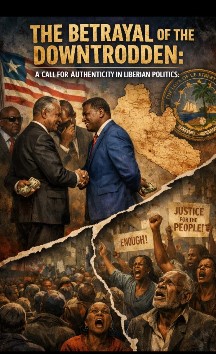
In the contemporary Liberian political landscape, a troubling trend has emerged. Many politicians, cloistered in the comforts of wealth and privilege, have taken to appropriating the struggles of the downtrodden for their own political gain.
This phenomenon compels an urgent examination of how the very fabric of socio-political integrity is being frayed by disingenuous actors who, while living in relative comfort, claim to be champions of the marginalized and the impoverished.
Within this context, it becomes imperative to highlight the ethical violation inherent in such political manipulation, a form of “stolen valor,” in which the struggles of the masses are commodified for personal advancement, leaving behind the very people they purport to represent.
The Utopian Disconnect
At the heart of this issue lies a profound disconnect between politicians and the realities faced by ordinary Liberians.
Many political leaders live in a utopian existence, shielded from the hardships that characterize their constituents’ lives.
These figures often engage in grandiose rhetoric that positions them as the saviors of the disenfranchised, even when their lives stand in stark contrast to those of the struggling working class.
Such duplicity raises an ethical quandary: how can one genuinely advocate for the marginalized when one is detached from their realities?
The metaphor of “stolen valor” aptly describes the actions of these politicians.
Traditionally associated with military service, the term implies that those who claim to have experienced hardship without having done so are engaging in deceit.
By equating their political struggles to the lived experiences of people with low incomes, politicians engage in a disingenuous display that ultimately undermines the very essence of advocacy.
This manipulation is an affront to those who endure systemic poverty and daily injustices, as it not only misrepresents their struggles but also co-opts their narratives to serve the ambitions of the privileged few.
The Stakes of Political Manipulation
The consequences of such political manipulation are dire. The appropriation of the masses’ struggles leads to a dangerous cycle of exploitation, one that confines people to the depths of social, political, and economic poverty.
Politicians who claim to represent the interests of the downtrodden often prioritize their own agendas, entwining their success with the very suffering they seek to address.
When the struggles of the working class are used as a backdrop to bolster a politician’s image, genuine advocacy becomes a commodity, sold to voters without any real commitment to enacting meaningful change.
This political opportunism subjugates the very people who are already marginalized.
For those experiencing poverty, the cycle is all too familiar: the promise of change and improvement remains unfulfilled as the politicians they trust disregard the realities of their lives.
While these leaders may rise in power and influence, the everyday struggles of ordinary citizens persist, unmitigated by the hollow promises of those who have detached themselves from the issues at hand.
This creates a skewed political landscape in which the voices of true advocates for people experiencing poverty become lost amidst the clamor of self-serving rhetoric.
The Utopian Life and the Downfall of Meaningful Change:
One must ask: why do politicians continue to engage in this harmful practice? Part of the answer may lie in the allure of power.
Politicians often seek to secure their positions by portraying themselves as relatable leaders who understand the people’s plight.
However, without a true investment in their constituents’ well-being, their promises ring hollow.
The result is a political environment rife with disillusionment. When the experiences of those who live in poverty are merely co-opted for political advantage, meaningful change becomes a distant dream.
Moreover, the rapid rise of corporate interests, exemplified by entities such as Bea Mountain, exacerbates this phenomenon.
While such corporations flourish, the working class remains marginalized, often exploited in the very systems that are supposed to support them.
Bea Mountain continues to keep the illusion of creating substandard jobs for Liberians, while importing aliens to occupy the well-paying positions with the help of some unnationalist and unprincipled-minded Liberian government officials.
Contracts are not set in stone; even stones can be broken. ” Moses did break the law, according to the Holy Bible, can attest”, so the need for a revision of the Bea Mountain contract is paramount at this juncture, ensuring that Liberians get the “Lion’s” share of what shall be embedded in the renegotiated agreement-contract.
In this context, politicians may find it expedient to align themselves with corrupt corporate practices, creating a façade of support for the impoverished while actively engaging in practices that perpetuate their subjugation.
The cycle repeats as these politicians cultivate a narrative that presents them as the gatekeepers of progress.
They maintain an illusion of intent to uplift people experiencing poverty, all while the wealth gap continues to expand.
This dynamic not only disempowers communities but also prevents genuine advocates, those who would engage authentically with the needs of the masses, from rising to positions of influence.
Consequently, the discourse surrounding poverty and inequality remains dominated by those who lack a genuine understanding of the issues, further entrenching the very structures of oppression they claim to stand against.
An Ethical Imperative for Political Accountability
It is crucial, therefore, to advocate for a shift in the political paradigm, a call for authentic representation and accountability.
The struggles of the downtrodden must be channeled through genuinely committed advocates who embody the fight for social, political, and economic justice.
Political leaders must embrace a sense of responsibility to those they represent, eschewing opportunism in favor of solidarity with the working class.
The words of Martin Luther King Jr. resonate profoundly in this context: “Don’t let anybody treat you like you are a nobody.” This assertion serves as a reminder that the voices of the marginalized deserve visibility and respect, and that it is the duty of politicians to amplify them rather than appropriate them for personal gain.
Equally, citizens themselves must be vigilant in holding their leaders accountable.
It is essential to scrutinize the actions of those who claim to represent the populace, demanding transparency and authenticity in their promises.
By fostering a politically literate and engaged citizenry, the likelihood of electing leaders who genuinely understand and advocate for the people’s needs increases exponentially.
This shift can reshape the political narrative, steering it away from empty promises towards actionable change that uplifts the downtrodden rather than exploits them.
Finally, collective action must also play a role in this reformation of political representation.
Constructive, forward-thinking grassroots movements, unhooliganist community organizations, and patriotic unions can work together to elevate the voices of those who have been systematically marginalized.