
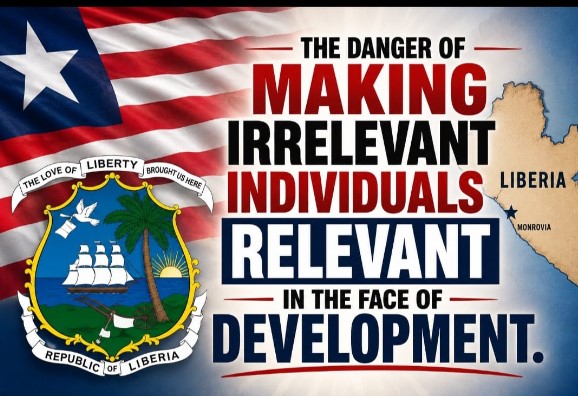
By Austin S. Fallah – A True Son of the Planet Earth Soil: fallahas@yahoo.com
President Joseph Nyuma Boakai: On corruption and development:
“Corruption in all its manifestations brings about underdevelopment and deprivation, and that is what African leaders should fight against.”
On leadership: “The perennial problem of this country is mainly triggered by the lack of sound and honest leadership.”
On human potential: “I firmly believe that every person, regardless of the situation or circumstances, has something to offer humanity.”
On national progress: “We must rise to build a society that values knowledge over ignorance, unity over discord, and progress over stagnation.”
On service rather than praise: “I didn’t come to this presidency to be praised. I came to improve the lives of our people.” The Liberian Investigator.
Societies undermine development when they grant influence, recognition, or authority to individuals who neither contribute constructively nor uphold integrity, competence, or the common good.
Sustainable development depends on elevating merit, service, knowledge, and accountability, not empty prominence.
This interpretation aligns with President Boakai’s emphasis on honest leadership, fighting corruption, valuing knowledge, and improving people’s lives, even though he has not publicly used this exact wording.
Ellen Johnson Sirleaf (Former President of Liberia): One of her best-known statements on leadership is: “The size of your success is measured by the strength of your desire, the size of your dream, and how you handle disappointment along the way.” Although this quote is authentic, it is about perseverance rather than elevating unproductive individuals.
Former South African Nelson Mandela: “What counts in life is not the mere fact that we have lived. It is what difference we have made to the lives of others.” This emphasizes contribution over status.
Former US President John F. Kennedy: “Ask not what your country can do for you, ask what you can do for your country.” This highlights civic contribution rather than personal recognition.
Former US President Theodore Roosevelt: “Far and away the best prize that life has to offer is the chance to work hard at work worth doing.” This stresses meaningful contribution over prominence.
Civil Rights Advocate Martin Luther King Jr.: “Everybody can be great because everybody can serve.” This suggests that true relevance comes through service.
In the intricate tapestry of governance and leadership, relevance is crucial.
Particularly in nations like Liberia, where socio-economic development is both a pressing need and a formidable challenge, the focus must rest on entities and individuals capable of making meaningful contributions to national progress.
Unfortunately, there is a tendency for governments, driven by a plethora of motives, to lend political attention to those I shall boldly refer to as “snallygosters”—individuals who are more concerned with their self-interests than with the welfare of their communities or their country.
This disquisition argues that the government must prioritize genuine innovation and critical thinking over irrelevant individuals who threaten to derail Liberia’s development journey.
The Irrelevance of the Snallygoster:
“Snallygoster,” a term often referred to in American political discourse, denotes a politician who is more motivated by personal gain than by the general good.
When snallygosters garner political attention, they distract from serious issues that warrant critical thought and innovation.
These individuals often lack the intellectual rigor to engage with Liberia’s pressing challenges, including poverty alleviation, educational reforms, and infrastructure development.
By awarding them relevance, governments undersell the potential of those who possess the skills and vision to spur meaningful change.
This dynamic creates a cycle of apathy in which governance becomes more about optics than substance.
Citizens begin to lose faith in their leaders when they see incompetent figures elevated to positions of influence simply because they fit a political agenda or uphold an unchallenged status quo.
As Liberia seeks to liberate itself from the oppressive grip of poverty, allowing irrelevancies to dominate discourse is antithetical to progress.
It is akin to plucking low-hanging fruit while ignoring the tree’s deep-rooted health.
The Weight of Alhazagoraphobia:
In essence, engaging with snallygosters can instigate a condition known as alhazagoraphobia, the fear of being in a situation where you are unable to speak.
Such fear is palpable in contexts where citizens may feel their opinions and concerns are ignored in favor of more trivial or superficial matters.
Alhazagoraphobia signals a societal malaise; it is the apprehension individuals experience when they sense that their engagement with the political process is limited.
This could stem from observing that prominent figures in society lack the intellectual qualities needed to address complex issues.
Liberia’s advancement necessitates a populace that is vocal, informed, and empowered.
Individuals should be encouraged to contribute to discussions that shape their future, free from the fear that their voices will be drowned out by those whose relevance is merely a construct of political expediency.
The government must cultivate environments that favor healthy discourse, where the most pressing social and economic challenges can be tackled in earnest, led by those with the capacity for critical engagement.
The Consequences of Ignoring Intellectual Contributions:
Addressing the issue of snallygosters inevitably leads to a discussion about the consequences of ignoring genuine intellectual contributions.
It borders on lathologica, the pathological inability to speak coherently on demand, an affliction that can diminish a nation’s ability to progress.
When political platforms prioritize charm over substance, they set an alarming precedent for society at large, favoring style over sound reasoning.
Education systems that prioritize charisma over critical thinking risk producing generations ill-equipped to engage with the complex world of governance and problem-solving.
If Liberia’s future leaders are cultivated on the premise of superficiality, innovation will remain an elusive goal, relegating the country’s socio-economic development to an indefinite stall.
Education, then, must be twofold: it should aim to build critical thinking skills, empower students to challenge the status quo, and provide opportunities to engage in comprehensive discussions that matter.
These individuals who graduate with the capacity to participate in and influence national policy will need to be embedded within governmental frameworks.
The Dichotomy of Psychomachia:
Moreover, the issue of relevance in political discourse can lead to a larger internal conflict, akin to psychomachia, the struggle between the moral and immoral aspects of the self.
This struggle can manifest in both leaders and citizens.
For leaders, it may involve the temptation to prioritize superficial popularity over genuine progress.
This morally ambiguous terrain only serves to complicate the already convoluted governance landscape and to slow down necessary reforms.
On the other hand, citizens may experience their own version of psychomachia when they confront the need to choose between supporting unaccountable leaders for the sake of political loyalty or demanding accountability and enlightenment.
This moral friction reflects a society grappling with its identity, values, and aspirations versus those thrust upon it by irrelevant figures acting as political puppets.
The spirit of progress must grapple with such moral ambiguities, pushing forward despite resistance from those who would prefer to maintain the status quo.
If Liberia is to embrace a path that leads to socioeconomic development, both voters and elected officials must strive for clarity in this struggle and shift their allegiance to purpose-driven leaders who reflect the values and intellect necessary for revitalization.
The Call for Action:
In light of these considerations, the government, civil society, and regular citizens must adopt a proactive stance to dismantle the tentacles of irrelevance that are invading the discourse.
This involves scrutinizing the figures who receive political attention and probing their qualifications for leadership roles.
Societal efforts should align with developing infrastructures that inherently promise innovation, accountability, and evidence-based solutions to pressing challenges.
By encouraging political platforms to elevate individuals with track records of innovation and critical engagement, Liberia can pivot not only toward eradicating poverty but also toward enriching the nation’s collective social fabric.
Ultimately, a robust civil society willing to challenge snallygosters and question the motives underlying their ascent will be required to safeguard this vision.
As Liberia lumberingly ascends from its tumultuous past, the government must agilely recognize that making irrelevant individuals relevant will do nothing but impede the nation’s social and economic progress.
By understanding the implications of allowing snallygosters to take the political forefront, citizens and leaders alike can demand more of one another.
Embracing critical thinkers, rejecting the fear of alhazagoraphobia, moving beyond lathologica, and confronting psychomachia will yield a society where genuine engagement fuels development.
This ambitious undertaking is not merely desirable; it is essential for moving Liberia toward a brighter, more progressive future.