
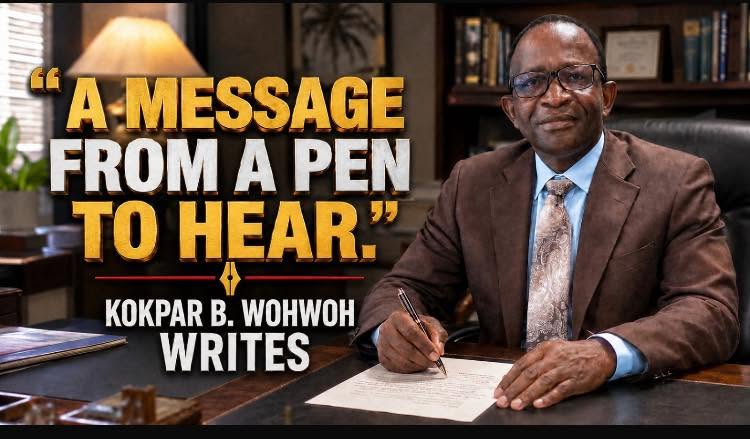
PHOTO: The Author
Bu Kokpar B. Wohwoh
Alumnus, 2007
ID #19587
Zoo/Chem
Thomas J. R. Faulkner
College of Science and Technology, University of Liberia
As an alumnus who learned under similar difficult circumstances at the University of Liberia, I feel more hurt than ever before after reading the Official Statement issued on July 21, 2026, by President Dr. Layli Maparyan.
What the President Said
In her statement, the President responded to recent resolutions from the University of Liberia Faculty Association (ULFA) and the Staff Association (ULSA). She acknowledged that their concerns regarding welfare and infrastructure are legitimate, longstanding, and affect the University community daily. She noted that her administration is engaging the Board of Trustees and the Government of Liberia through Cabinet and Board meetings, but admitted that progress has been slow and has not met expectations. She then appealed for continued dialogue and cautioned that disengagement from academic work would not serve the students’ interests.
The Gaps in the Statement
While the acknowledgment is welcomed, the statement contains gaps that cannot be overlooked. As an official presidential communication, it bears a personal Gmail address on its official letterhead and carries a future date, which weakens its administrative weight.
More importantly, it lacks substance. It offers no timeline, no budgetary commitment, and no measurable plan to resolve the issues raised by ULFA and ULSA. For staff members who have endured years of difficult conditions, a promise of more meetings is not reassuring.
The Philosophical Betrayal
This situation can be understood through two philosophical lenses. First, John Dewey argued that education is the foundation of democracy and that a nation that fails to invest in its public university undermines its own democratic future. When the state neglects UL, it neglects not only buildings but democracy itself. Second, Paulo Freire warned that when the oppressed are asked to be patient while the privileged maintain their advantages, dialogue becomes false generosity. Asking faculty to keep sacrificing while the privileged protect their benefits is not genuine dialogue.
Fat Salaries Abroad, Hunger at Home
This is where the pain becomes personal and the anger deepens. Members of the political class collect over $15,000 monthly in salaries, benefits, gas slips, scratch cards, and sitting fees, and they use that money to send their own children abroad for better education, while thousands of vulnerable Liberian children linger in the streets of Monrovia.
Many are forced to become petite traders to survive, while others fall among drug users and into the growing addiction crisis. At the same time, members of the University faculty and staff associations, who hold advanced degrees and carry the future of the nation on their shoulders, go to bed hungry because their salaries are low, delayed, and cannot sustain their families.
The political class does not feel the ruin of our public education system because its families are insulated from it. Its members push for their own salaries and benefits while they neglect the very institution that educates the poor.
The Rescue Must Be Now
The truth must be stated plainly: our state-owned institution is in ruins and needs immediate rescue under the Government of President Joseph Boakai. The Government and the Board of Trustees must move beyond statements to concrete budgetary support. The UL Administration must present a clear, time-bound action plan jointly developed with ULFA and ULSA. ULFA and ULSA must remain engaged while firmly demanding accountability.
The University of Liberia deserves more than words; it deserves investment, respect, and political will.
Kokpar B. Wohwoh
Alumnus, 2007
ID #19587
Zoo/Chem
Thomas J. R. Faulkner
College of Science and Technology, University of Liberia