
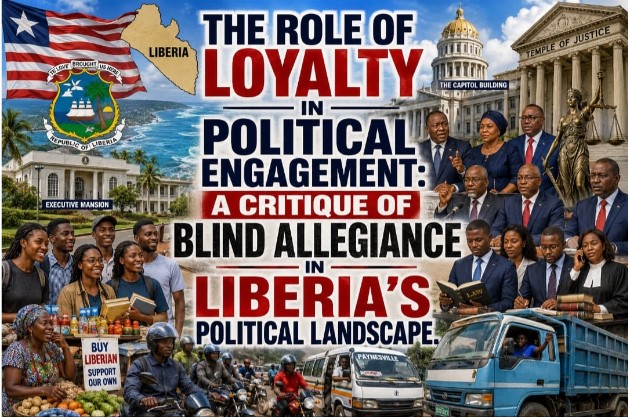
By Austin S Fallah – A True Son of the Planet Earth Soil: fallahas@yahoo.com
The role of loyalty in Liberia’s political history often centers on unconditional patronage versus institutional accountability, though direct, verbatim archival statements isolating “blind allegiance” as a standalone philosophical critique vary by specific historical figure.
President Joseph Nyuma Boakai: Emphasized collective responsibility over unthinking compliance, noting in governance addresses that public servants must remain committed to national integrity rather than convenience: “We stand on the shoulders of giants… [and] we are Liberians first.”
Former President Ellen Johnson Sirleaf: Addressed the dangers of complicity and sycophancy in governance, stating famously in public reflections on accountability: “The truth is that there will always be consequences when we act with courage to do the right things or falter in dereliction by pretending blindness in the face of an obvious wrong.”
Former President George Weah: Framed political alignment around patriotism superseding partisan factionalism during transitional moments, stating: “This is a time for graciousness in defeat, a time to place our country above party, and patriotism above personal interest.”
Former President Samuel K. Doe: Historically demanded absolute personal and military-style loyalty under the regime’s security decrees, frequently equating dissent with opposition to the state. However, formal philosophical treatises critiquing blind allegiance were suppressed under his military council.
(Capt. Thomas Samkara)-Dr. Henry Boima Fahnbulleh Jr. at the TRC: A soldier without a political education is a potential bandit.
Dr. Henry Boima Fahnbulleh Jr.: “A leader must be a strategist and identify where ideas and interests converge.”
Dr. Henry Boima Fahnbulleh Jr.: “The Principle of International Politics: No permanent friends but permanent interests.”
Dr. Henry Boima Fahnbulleh Jr.:”Politics is not a Sunday School Party.”
https://www.facebook.com/share/v/1F7ijHvjfS/
Dr. H. Boima Fahnbulleh Jr, Dr. Togba-Nah Tipoteh, Dr. Edward B Kesselle, & Dr. Amos Sawyer: Progressive academic and political critics of the Liberian state apparatus have long argued that ethnic and personal clientelism destroys civic consciousness. Their historical lectures and essays critique how blind adherence to patrimonial leaders stunts the growth of functional democratic institutions.
Contemporary Political Voices (Benoni Urey, Alexander B. Cummings, and Cllr. Tiawan Saye Gongloe): Debates across modern Liberian party lines frequently caution against “file-and-rank” sycophancy, with opposition and independent figures arguing that unquestioning party loyalty prevents the electorate from demanding transparent infrastructure, education, and anti-corruption measures.
Loyalty to a political institution has long been seen as a virtue.
It breeds unity, collective identity, and the potential for sustained progress.
However, as political landscapes evolve and the stakes of governance heighten, it becomes clearer that unwavering loyalty, particularly when divorced from critical thinking and common sense, does more harm than good.
This is particularly evident in Liberia, a nation that has faced numerous challenges stemming from political mismanagement and corruption.
The phrase “A New Dawn for Liberia: Progress Through Freedom and Leadership” reflects an aspirational vision for the country, a vision that is undermined by the political enslavement of its citizens through blind loyalty.
These phalanges pin to a keyboard will explore the pitfalls of uncritical allegiance to political parties or leaders, the importance of critical thinking and innovation, and the empowerment of the youth as we chart a pathway toward a brighter future for Liberia.
Blind Loyalty to Political Institutions:
Political loyalty, particularly in Liberia’s context, often manifests as an unyielding attachment to certain political parties or leaders, regardless of their performance.
This loyalty is reminiscent of the age-old adage, “the devil you know is better than the angle you don’t.”
Voters may lock this vision behind ideologies or political figures, clinging to the hope that past unquestioning alliances will yield results.
However, this dependency leads to stagnation and mediocrity.
Consider the phrase, “Progress Through Freedom and Leadership.”
While it invokes notions of liberation and progressive governance, the reality for many Liberians is a continuation of their struggles in poverty and disenfranchisement.
Political loyalty has, in many instances, persisted even in the face of policies and leadership styles that have failed to uplift the people.
By maintaining such loyalty, citizens forgo their agency and the ability to demand accountability of their leaders.
This followership phenomenon plunges the nation deeper into a cycle of democratic failure and socio-economic decline.
The Liberian expression “u b muh-muh” aptly captures the foolishness of remaining mute, and loyal to institutions or leaders that have consistently failed to deliver.
This term underscores a critical point: loyalty should not be mistaken for intelligence or common sense.
When allegiance is rooted in tradition or sentiment rather than critical evaluation of policies and outcomes, voters risk perpetuating their suffering and undermining their futures.
The Danger of Political Enslavement:
Political enslavement occurs when citizens willingly subjugate their decision-making to party lines, often at the cost of their well-being.
In Liberia, this phenomenon has become alarmingly pervasive, as citizens rally behind candidates who promise change but consistently deliver disappointment.
The zeal to support ‘one of our own,’ often based on ethnicity or political lineage, has overshadowed the need for a thorough examination of leadership capabilities and policies.
Moreover, empty promises and political slogans have become the bread and butter of political campaigns, seducing voters into complacence.
This manipulation of political allegiance deprives citizens of their agency and limits their ability to challenge the status quo.
Leaders often exploit cultural loyalty by reinforcing the idea that questioning their authority equates to disloyalty.
As a result, critical voices are silenced, and a culture of conformity prevails, stifling innovation and ideas that could usher in real change.
Additionally, the failure to engage with contemporary global issues further entrenches political enslavement.
While the youth of many nations are mobilizing through critical thinking and innovative ventures, the Liberia youth remain ensnared in outdated political frameworks.
This is not a complacent national tragedy; it is an affront to the potential of a generation eager to forge its path forward.
A Call for Critical Thinking and Engagement:
If Liberia is to transcend the chokehold of blind political loyalty, it must cultivate a culture of critical thinking.
Engaging with the complexities of governance, economics, and social justice should not be the responsibility of a select few, every citizen must participate.
Critical thinking empowers individuals to weigh evidence, question authority, and confront uncomfortable truths.
Instead of echoing tired slogans devoid of substance, citizens should ask Liberians questions that challenge the status quo: How can governance be improved? What initiatives can combat poverty and uplift living standards? How can the nation harness the potential of its young people?
By engaging with these questions, voters activate a collective consciousness that prioritizes progress over loyalty and rhetoric over empty promises.
Moreover, contemporary issues facing Liberia, such as unemployment, educational deficits, and economic instability, demand innovative solutions.
The youth, equipped with the tools of critical thinking and entrepreneurial spirit, can spearhead innovative initiatives that not only address these challenges but also inspire others to reimagine their roles within the political sphere.
The global landscape is replete with young people who have initiated change in their communities through entrepreneurship and social innovation.
Whether starting tech companies that drive economic advancement or engaging in grassroots activism that champions human rights, young leaders are actively shaping the futures of their countries.
Liberia must not lag behind but rather embrace these same ideals, fostering environments where young people can thrive and contribute to the national dialogue.
Empowering the Youth for a Brighter Liberia:
The crux of positive change lies within the youth, a demographic that not only represents the future but also embodies the spirit of potential and innovation.
Liberia’s young population is poised to take on leadership roles and drive the nation towards a new political and social contract, one rooted in accountability and progress.
However, this shift requires more than mere participation, it necessitates empowerment through education, advocacy, and access to resources.
Educational institutions must prioritize curricula that encourage critical thinking, civic engagement, and awareness of contemporary issues.
By equipping students with the skills necessary to analyze policies and question leaders, Liberia can break the cycle of political enslavement.
Additionally, fostering environments where young people can collaborate on projects that address socio-economic challenges will help kickstart a new era of innovation and enterprise, effectively transforming the political narrative.
Moreover, grassroots movements led by young Liberians can serve as catalysts for change.
Engaging communities in dialogue that reassesses political loyalties and encourages collective action can shift the political landscape.
Young people advocating for transparency in governance and demanding accountability invite broader participation across the socio-economic spectrum.
While loyalty to a political institution can manifest as a source of strength and unity, it becomes a liability when it devolves into blind adherence.
Liberia stands at a crossroads: a choice between maintaining the status quo or embracing a future rooted in critical thinking, innovation, and collective empowerment.
Political loyalty, if unchecked, can lead to a form of enslavement that stifles progress and perpetuates cycles of poverty.
The vision of a brighter Liberia lies not in the perpetuation of political myths or slogans but in the awakening of critical consciousness among its citizens.
As voters cast aside detrimental allegiances and embrace a collaborative, questioning spirit, they can transform the nation into one of freedom, opportunity, and leadership, one that truly reflects the will and potential of its people.
It is time for Liberia to engage with the 21st century, time for its citizens, especially the youth, to demand more than mere loyalty; they must insist on a future that embodies dignity, prosperity, and progressive change.