
By Austin S. Fallah – A True Son of the Planet Earth Soil: fallahas@yahoo.com
“Don’t let the 7 days of wahala and public opinion bury this $19 million drug bust like Liberians have seen before in Liberia. The government has to act decisively this time.” A marketer at Redlight Market.
“If Liberians want to free their youths from violence and despair, and turn Liberia’s young people into a force that builds up humanity rather than destroys it, swift and serious action is needed.” A student at the University of Liberia.
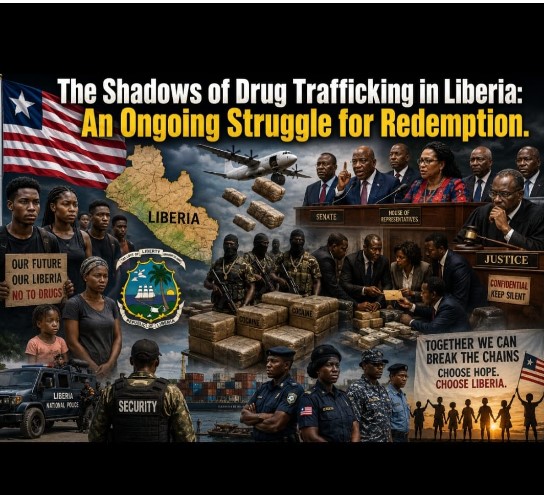
The fight against illicit drugs and trafficking in Liberia has been described as a critical battle for redemption, with leaders and organizations characterizing the issue as a “national emergency” and a threat that is robbing the country of its future and youthful potential.
President Joseph Boakai (On national strategy): “Liberia will not be used as a safe haven, transit point, warehouse, financial center, or operational base by criminal networks engaged in narcotics trafficking. This national emergency demands more than words — it demands bold, sustained, and irreversible actions.”
President Joseph Boakai (On the youth): “We cannot allow the spread of illicit drugs to turn our children into victims, our communities into ghettos, and our neighborhoods into shelters for criminal elements. Liberia will not lose another generation to drugs. Not on my watch.”
Former President George Weah: “I see it to be very much disappointing, the way in which the young people of the country are engaging in drugs at an early age. The fight against illicit drug and substance abuse is not for the government alone; it requires all Liberians in and out of the country to join the fight.”
Former President Ellen Johnson Sirleaf: “The issue of drugs is indeed serious because it victimizes some of our vulnerable young people. The government will go after drug traffickers because they are the culprits and not the young people who consume the drugs.”
Hon. Musa Bility (Nimba County Lawmaker): “How many thousands of our children have lost their way because of drugs. This is no longer just a law enforcement issue. It is a national emergency.”
Former Representative Yekeh Kolubah (On government accountability): “A government serious about fighting drugs acts swiftly and transparently. We need timelines, arrests, and evidence that no one is above the law.”
Disadvantaged Youths (Voices from the “Say No to Drugs” campaign in Monrovia): “These children are Liberia’s pride and future. We are tired of the ghettos. We need rehabilitation and skills to start life, not more drugs and suffering.”
The International Community & The World, The United Nations (UNODC on regional drug trends): “West Africa remains a key transit point for drug trafficking, with expanding local markets severely threatening public health, stability, and the socio-economic development of vulnerable youth populations.”
Former United States Ambassador to Liberia, Michael McCarthy, expressed severe concern regarding the regional threat of cartels, noting that wcombatingement and acquittals in major drug cases could attract international drug syndicates to use West Africa as a safe passage.”
The World Health Organization (WHO on substance abuse): “The escalating use of illicit narcotics in recovering societies is a public health crisis, destroying family units, straining healthcare capacities, and ultimately undermining the foundation of the local workforce.”
President Joseph Boakai: “The fight against narcotics is not merely a law-enforcement exercise; it is a national duty to rescue our youth, safeguard communities, and ensure that no individual, regardless of status, is above the law.”
President of National Resources Joseph Nyuma Boakai: “Let it be known that no status, no title, no uniform, and no connection will protect anyone involved in drugs. Whether a street peddler or a high-ranking official, the law will reach and teach you. Liberia will not lose another generation to drugs. Not on my watch.”
President Boakai: “Those who seek to profit from the suffering of our people or undermine the security of our nation will find no refuge in Liberia. Together, with reso,lve, unity, and determination, we will win this fight.”
“Innately, greed, insensitivity to the poor, the international drug epidemic, money laundering, dynamics of climate change, and the impact of social media must compel a rethinking of our approach to global peace and security.” — United Nations (citing remarks by Liberia at the 79th UN General Assembly).
“Illicit drug trafficking remains a threat to human rights, institutional stability, and development, fueling transnational organized crime and undermining the rule of law across West Africa.” — UN and Global Security Experts, Liberian Politicians & Government Officials.
“Those who traffic drugs that damage lives and kill our youth should have no place in our society—an eye for an eye.” — Rep. Prince Toles.
“Liberia did not survive a civil war, two epidemics, and decades of struggle to lose this generation to a drug peddled for a few hundred Liberian dollars on a street corner. To those who profit from poisoning our youth, hear this as a warning: the Republic of Liberia is coming for you.” — Cllr: N. Oswald Tweh, Sr. (Minister of Justice).
“Many young people are not criminals; they are victims of unemployment, frustration, and hopelessness. Arresting youths alone will not save Liberia. Jobs will. Accountability will. Action will.” — Alexander B. Cummings (Politician and former Presidential candidate).
For nearly two centuries, Liberia has been a country shaped by its rich history, diverse culture, and the perennial struggles of its people.
Yet, as the nation’s fabric continues to fray under the weight of corruption, the specter of drug trafficking looms large.
The recent seizure of over USD $19 million worth of narcotics raises questions not only about the effectiveness of governmental oversight but also about the resilience and hope of its citizens.
As the drug kingpins and their cartels test the mettle of the Liberian government, it is essential to examine the implications of these narcotics on society and how a lack of patriotism and nationalism in governance can devastate the lives of the youth, women, and children.
In 2022, the Liberian government faced a monumental challenge with the seizure of USD $100 million worth of drugs.
At that time, the arrests made headlines, and promises were made to the citizens that a crackdown on drug trafficking would ensue.
Yet, almost four years later, the question remains: What truly happened to the hundreds of tons of narcotics that were confiscated? Were they, in fact, destroyed, or is it possible that they were recycled into the market in smaller, more manageable quantities?
The recent discovery of another tranche of drugs worth USD $19 million stirs the pot of speculation, leading many to wonder if the ghosts of the past are once again haunting the nation’s people.
The ongoing investigation into the latest drug bust represents more than a mere criminal query; it signifies a pivotal moment in which the Liberian government can choose to demonstrate its commitment to combating drug trafficking.
The citizens of Liberia remain steadfast, waiting, listening, and watching to see if their leaders will rise to the occasion.
It serves as a litmus test for governmental integrity: Will the ruling authorities pursue justice and transparency, or will the cries for accountability fade into the shadows of bureaucracy?
Unfortunately, the reality of drug trafficking in Liberia is not merely a problem for law enforcement; it casts a long shadow over the entire society, severely impacting its most vulnerable members.
Youth, young people, women, and children suffer the consequences of mismanagement and neglect of national resources, facing a future riddled with uncertainty.
The youth are particularly susceptible; with limited access to education and employment opportunities, many find themselves entangled in the web of the drug trade.
As they witness the allure of quick riches in their communities, the temptation becomes overwhelming.
When a governmental leadership fails to instill a sense of patriotism and commitment to national service, its most valuable assets, its people, pay the price.
The lack of national unity and pride breeds disenfranchisement, particularly among the youth, who are left without role models or pathways toward success.
This environment fosters an apathy that is all too inviting for drug traffickers, who exploit the vulnerabilities of a disillusioned populace.
When the governments failed to provide essential services, such as quality education, healthcare, and safe environments, they sacrificed the well-being of their citizens on the altar of inaction.
In a country like Liberia, which has endured civil strife, economic turmoil, and a stagnant political landscape, drug trafficking has emerged as a pervasive issue that exacerbates existing problems.
As drug kingpins continue to challenge the authority of the Liberian government, the nation is left in a vicious cycle where the very survival of its people is compromised.
Women and children become part of the statistics. Young girls may be lured into trafficking schemes with promises of a better life, only to find themselves trapped in a nightmarish reality of exploitation and abuse, as Liberians are witnessing at the Temple of Justice in the current trafficking case.
The tale of missed opportunities and broken promises reverberates through the corridors of Liberia’s history.
The USD $100 million worth of drugs that echoed with the sounds of people were arrested and investigated, now resound with questions that remain unanswered. Where was the accountability? Where was the leadership that was to stand firm against the threats from drug cartels?
The faith of the Liberian people, already frayed and worn, hangs in the balance with each passing day as the harsh realities of drug trafficking persist.
With the public eye now fixated on the government’s investigation into the recent drug seizure, the citizens must voice their expectations for change.
They must demand transparent processes that will not only address the current situation but also prevent future incidents of drug trafficking.
Each pledge made by the government must be scrutinized; there can be no room for complacency.
Instead, citizens must hold their leaders accountable for creating a safe and prosperous environment for future generations.
Through advocacy and community engagement, the people of Liberia can begin to reclaim their narrative.
It is within this context of resistance that the seeds of nationalism and patriotism can flourish, fostering a renewed sense of belonging and purpose.
When citizens take pride in their country, they are less likely to tolerate corruption and injustice.
Empowerment must be at the forefront of national discourse; educating the youth and providing them with tangible opportunities to lead successful lives will, in turn, diminish the allure of drugs.
Positive, free of hooliganism, grassroots initiatives can play a transformative role in changing perspectives and pathways within the nation.
By prioritizing youth development programs that instill values of hard work and integrity, Liberia can create an alternate narrative to the one offered by drug trafficking.
The Ministries of Education, Youth and Sports, and Labor, and communities must come together, forming support networks aimed at steering young people away from the perils of drugs and towards careers that enhance their skills and capabilities.
Emphasizing education, vocational training, and investment in social welfare programs will help break the cycle of despair.
Moreover, women’s empowerment is crucial in this endeavor.
In Liberia’s societal framework, women often serve as the backbone of families and communities.
By equipping women with resources, education, and self-sufficiency skills, society can undermine the patterns of drug trafficking that exploit their vulnerabilities.
Women need to advocate positively for policy changes, engage in civic discussions that influence government action, and avoid wearing t-shirts or carrying placards of questionable individuals in Liberian society.
In confronting the scourge of drug trafficking, the Liberian government must also lean on international partnerships.
Collaborating with global institutions and organizations that specialize in combating the drug trade can provide valuable insights and resources.
By combining local knowledge with international best practices, the government can craft comprehensive strategies that engage law enforcement, community leaders, and civil society in the fight against drugs.
Liberia stands at a crossroads, faced with the haunting specter of drug trafficking that threatens to derail progress and devour its most vulnerable citizens.
The government must rise to the occasion, demonstrating its commitment to combating the drug trade with integrity and action.
As the people of Liberia wait, listen, and watch, they are reminded that their voices matter and that change is possible.
By fostering a renewed sense of patriotism and community engagement and by prioritizing the needs of the youth, women, and children, Liberia can reclaim its narrative and forge a path towards a drug-free future.
As history has shown, the fate of the seized drugs, be it USD $100 million or the current USD $19 million, reflects the past and the potential for the future.
Only time will tell whether the USD $81 million difference will surface as a symbol of renewed hope or a reminder of lost opportunities.
Liberians deserve a government that has the fortitude to transform promises into action, to restore faith within the hearts of its people, and to finally put an end to the cycle of drug trafficking plaguing their beloved nation.
As Liberians gaze toward the horizon, let it be one of resilience, unity, and the belief that through collective effort, Liberia can rise above the shadows that seek to diminish it.