
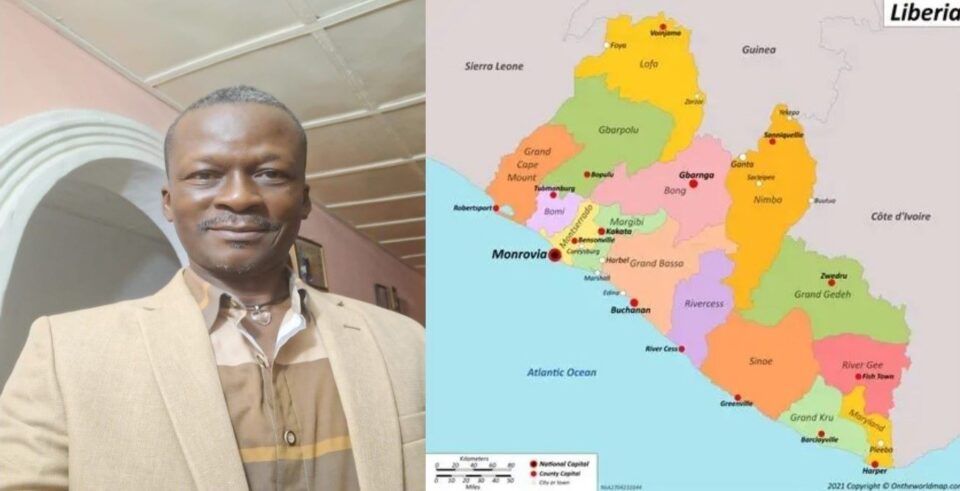
PHOTO: The Author with the map of Liberia
By Peter Quaqua
Liberia’s escalating drug war feels like a badly scripted movie, with competing narratives fighting for public attention. But beneath the noise, arrests, seizures, accusations and political drama—lies a deeper and more troubling question: What happens when drug networks begin to influence or penetrate the very institutions fighting them?
That is the question Liberians must confront as the country fights on two fronts.
On one front, the government is pursuing traffickers, intercepting consignments and bringing suspects to justice. The most dramatic development has been the capture and imprisonment of former Vice President Jewel Taylor.
The second front is less visible but no less consequential: the battle over the narrative. Who decides whether an arrest represents legitimate law enforcement or political persecution? Is the government really confronting the drug trade, or is it another example of what critics call “selective justice”?
When the fight against drugs becomes a fight over competing narratives, public trust—and the credibility of institutions on the frontline can become collateral damage – rightly or wrongly.
Beyond the Arrests and Seizures
Liberia cannot afford to become a transit point or haven for international drug networks. The social and economic consequences of a growing drug problem are far too serious to be treated casually. But once high-profile arrests become intertwined with politics, the temperature rises.
Every statement is scrutinized. Every arrest is interpreted through a political lens. Every suspect’s affiliation becomes part of the conversation. People weigh government announcements against perceived political interests. And criticism of an investigation can itself be portrayed as an attempt to undermine the drug fight.
This is where the drug war becomes a war of narratives.
The government’s narrative is that it is trying to dismantle the drug network. The opposition argues that the machinery of justice is being selectively deployed against political opponents—that people close to government are treated differently. Civil society calls for credible and independent investigations. The media becomes the arena where these competing narratives collide. Somewhere in the middle is the public, trying to determine what to believe.
The Politics of “Selective Justice”
Few phrases are more politically potent than “selective justice.” It exposes genuine double standards. But it can also become a convenient shield against legitimate law enforcement.
If a person is arrested and prosecuted because credible evidence links that individual to drug trafficking, political affiliation should provide no protection. But political affiliation should also never become evidence of guilt. The same principle must apply in all directions.
The government cannot credibly claim to be fighting drugs “without fear or favor” while the public sees people with political connections receiving different treatment. The growing public concern over alleged cherry-picking should not simply be dismissed.
At the same time, opposition politicians shouldn’t reasonably dismiss every investigation involving allies or supporters as political persecution. Legitimate concerns about double standards should certainly be raised. The central question must remain: What is the evidence? Not which political party he or she belongs to?
Justice becomes dangerous when politics determines guilt. But justice also becomes ineffective when political controversy obstructs legitimate investigations.
The Media
This is where the media have an especially difficult responsibility. Journalists are not simply ordinary observers. They are supposed to help citizens navigate complex issues. Yet drug investigations create an environment in which information is often incomplete, sensitive and highly contested.
Journalists and campaigners are credited for bringing many legitimate issues to public attention, particularly where law-enforcement authorities have been reluctant to identify individuals—including people within their own ranks. One can understand why the Police Inspector General responded to media reports with a broad allegation of bribery against the media. That response appeared more diversionary than revealing.
Without the press, some allegations might never have received public attention. That role is essential. But the media must remain independent of everyone involved.
It should scrutinize government and law enforcement. It should investigate allegations. But it must also guard against becoming a vehicle for narratives designed either to shield authorities from accountability or to discredit legitimate investigations.
Liberians do not need more outrage. They need facts. They need journalism that asks uncomfortable questions of everyone: Questions that help separate accountability from political theater.
The information environment surrounding the drug war is already highly contested. Every official statement, anonymous source, leaked document, political accusation and social-media campaign presents a different version of events.
The danger is that journalists can unknowingly [or knowingly] become part of someone else’s strategy. A carefully crafted propaganda narrative can make a legitimate investigation appear politically motivated. A government statement can present an allegation as though it were already fact. A politician’s accusation can become a headline before anyone asks whether evidence supports it. A social-media influencer can create a public verdict long before a courtroom examines the facts. This is how narratives become accepted as truth.
Exploiting the Confusion?
Criminal networks survive on exploiting weaknesses in institutions. They exploit corruption. They exploit division. They exploit weaknesses in law enforcement. And can exploit a polarized media environment. Where the public becomes uncertain about whom to believe, that confusion can also become an asset.
A sophisticated drug chain may only need to create enough uncertainty to make effective enforcement more difficult. They question motives, turn cases into partisan political disputes, create competing narratives, undermine the courts and compromise law enforcement. In other words, they only need the public to lose confidence in the institutions fighting.
That is why allegations that law-enforcement structures may have been penetrated or compromised must be taken seriously and investigated carefully. They should neither be dismissed because they are uncomfortable nor accepted simply because they make a compelling political story.
Government Has the Greatest Responsibility
The government cannot control every narrative. Nor should it try to. But it can control how it communicates – transparency, consistency and evidence matter.
When the state makes sweeping declarations about suspects before cases are tested in court, it risks undermining the very justice system it is trying to strengthen. When information is withheld without explanation, suspicion fills the vacuum. And when some cases receive enormous publicity and institutional energy while others disappear quietly, allegations of selective enforcement become almost inevitable.
If the government says there will be “no sacred cows,” the public should see that principle applied. Government sympathizers, opposition figures and ordinary citizens should face the same scrutiny. The credibility of the drug war depends not on what government says about fairness, but on whether the public can see fairness in practice.
Opposition Has a Responsibility Too
The opposition also has a role to play. Questioning government action is not obstruction. But there is a difference between raising legitimate concerns about due process and automatically declaring every prosecution political.
If every investigation involving an opposition figure is described as a witch hunt, the accusation eventually loses its force. That should not prevent the opposition from raising the alarm when there is evidence of a double standard.
But the demand should be for evidence, transparency and equal treatment—not immunity for political allies.
Losing the Public
The most important casualty of a badly managed drug war is public trust. Citizens need to believe that the fight against drugs is real. They need to believe that the institutions on the frontline are acting professionally. They need to believe that powerful people cannot simply buy their way out of trouble. But they must also believe that nobody will be punished simply because of political affiliation, personal rivalry or public pressure.
Once citizens conclude that justice is merely politics by another name, cooperation with law enforcement may decline. And legitimate investigations can become casualties of political polarization. That is dangerous not only for justice, but for the fight against drugs itself.
The Real Test
The drug fight should not be judged simply by the number of arrests, seizures or press conferences. The deeper test is whether Liberia can build a system in which evidence matters more than influence, institutions matter more than personalities, and justice matters more than politics.
Let the government pursue drug cases. Let the public scrutinize how those cases are pursued. Let the media investigate all sides. And let the courts determine guilt or innocence.
But none of these institutions should be weaponized for political purposes. The fight against drugs is difficult enough without turning it into a permanent political battlefield.
Liberia needs stronger law enforcement, rigorous journalism, independent scrutiny and a government confident enough in the strength of its evidence to withstand scrutiny. Because when the drug war becomes a war of narratives, the greatest casualty is not a particular suspect or institution—it is the public’s right to know the truth.