
By Austin S. Fallah – A True Son of the Planet Earth Soil: fallahas@yahoo.com
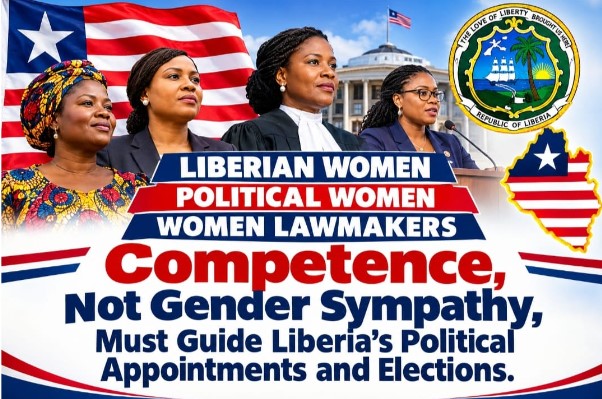
“Liberia must judge political leaders by competence, integrity, and results—not by gender-based sympathy.”
“Gender should never be a substitute for competence; Liberia deserves leaders chosen for their ability to serve, not merely for who they are.”
“True equality in Liberia means creating equal opportunities while allowing competence, character, and performance to determine who earns public trust.”
“Political appointments and elections should not be acts of sympathy; they should be deliberate choices based on merit, capacity, experience, and integrity.”
“Liberia cannot afford to compromise competence for political correctness; the nation’s future depends on choosing the most capable leaders, regardless of gender.”
Liberia stands at a critical moment in its democratic development.
After years of conflict, political instability, economic hardship, and institutional weakness, the country cannot afford to treat public office as a reward for sentiment, symbolism, personal loyalty, or gender sympathy.
Political appointments and elections must be based primarily on competence, qualifications, integrity, a demonstrated ability to deliver results, and a commitment to national development.
Gender equality is important, and women deserve full access to political leadership.
However, supporting women’s political participation should never mean lowering standards, ignoring performance, or assuming that a candidate is qualified merely because she is a woman.
Likewise, male candidates should not be preferred simply because they are men.
Liberia needs capable leaders, not symbolic leaders.
The issue is especially important because Liberia has already experienced a historic period of female national leadership.
The election of Ellen Johnson Sirleaf as Africa’s first elected female president was celebrated worldwide as a major milestone for democracy and women’s advancement.
Her presidency challenged the assumption that women could not lead African nations and opened important discussions about female participation in government.
Yet symbolism alone could not solve Liberia’s deep social, economic, and institutional problems.
A woman’s presidency for twelve years did not automatically translate into safety, prosperity, or dignity for all Liberian women.
Many Liberian women continued to face poverty, unemployment, poor access to health care, domestic violence, sexual abuse, limited educational opportunities, and exclusion from meaningful economic power.
This reality shows a basic political truth: a leader’s gender does not guarantee the quality of leadership.
A female president may be competent or incompetent, just as a male president may be competent or incompetent.
A woman in office may promote policies that benefit women and children, but she may also fail to confront corruption, strengthen institutions, improve justice, or protect vulnerable citizens.
Similarly, a male leader may ignore women’s needs, or he may become a strong advocate for women’s rights and social welfare.
Therefore, Liberians should reject the belief that gender alone is a sufficient reason to appoint or elect someone to political office.
Public service must be judged by performance, not by personal identity.
During the twelve years of female-led government, Liberia made some gains in international recognition, peace consolidation, and democratic continuity.
These achievements should be acknowledged fairly.
However, it is equally necessary to recognize the concerns many citizens raised about the daily conditions ordinary people faced. faced
In many communities, women and girls continued to experience severe hardship.
Reports and public discussions about sexual exploitation, child prostitution, rape, domestic abuse, and the vulnerability of girls remained troubling.
Poverty made many families desperate, and desperation often placed women and children at greater risk of exploitation.
A female president did not remove these dangers from Liberian society.
It would be inaccurate to suggest that one president alone caused every social problem Liberia experienced.
Liberia’s challenges are rooted in a long history of civil war, weak institutions, inequality, unemployment, corruption, and limited public services.
Nevertheless, political leaders must be held accountable for what they do or fail to do while they are in office.
If women and girls remain unsafe, if perpetrators of abuse are not consistently punished, if survivors cannot access justice, and if families remain trapped in extreme poverty, then a government can not claim complete success merely because it has placed women in visible positions.
Representation matters, but representation without results is insufficient.
The lesson for Liberia is not that women should be excluded from politics.
Such a conclusion would be unfair, unreasonable, and harmful.
Women have long contributed to Liberia’s peace, families, businesses, civil society, education, health care, and community development.
Women should keep running for office, serving in government, leading institutions, and participating fully in national decision-making.
The real lesson is that every candidate, female or male, must meet high standards.
Liberia should support qualified women because they are qualified, not because they are women.
The country should support qualified men because they are qualified, not because they are men.
Equal opportunity should mean equal access to compete and equal accountability once in office.
Political appointments matter especially in this regard.
Ministers, deputy ministers, assistant ministers, managing directors, county officials, ambassadors, commissioners, and heads of public institutions wield enormous influence over citizens’ lives.
When appointments are based on friendship, family ties, political loyalty, ethnic favoritism, regional calculations, or gender sympathy, the state becomes weaker.
Unqualified officials may occupy positions they do not understand, misuse public resources, delay projects, frustrate professional civil servants, and undermine public confidence in government.
The consequence is not merely administrative failure; it is human suffering.
A poorly managed health ministry affects mothers and children.
A weak education administration affects students and teachers.
Ineffective justice institutions leave victims of abuse without protection.
Corruption in infrastructure agencies leaves communities without roads, clean water, and electricity.
For this reason, the Unity Party Alliance government must make competence its central standard in appointments.
The government should appoint people with relevant education, professional experience, proven management ability, moral credibility, and a record of public service.
A minister responsible for health should understand health systems, public administration, and emergency planning.
A finance official should possess expertise in economics, budgeting, accountability, and financial management.
A justice official should demonstrate knowledge of the law and a commitment to due process.
A county superintendent should understand local needs, community relations, and development planning.
These standards should apply consistently, regardless of whether the candidate is a woman or a man.
Competence also includes the ability to deliver measurable results.
Liberia has had enough speeches, promises, ceremonies, and public relations campaigns.
Citizens need roads that are built and maintained, schools that educate, ho should review appointmentsspitals that function, courts that protect the innocent, and public institutions that respond to ordinary people.
Government officials should be evaluated according to clear goals.
Did they reduce corruption in their agencies?
Did they improve access to services?
Did they complete projects on time and within budget?
Did they treat citizens with dignity?
Did they create opportunities for young people? Did they protect women and children?
Did they submit transparent reports on how they used public funds?
These questions should matter more than whether an official satisfies a political quota or appeals to a particular group.
At the same time, Liberia should not confuse merit with exclusion.
Some people misuse the language of “competence” to protect old networks that have historically excluded women, youth, people with disabilities, rural citizens, and minority communities.
True meritocracy requires equal access to education, training, employment, party structures, and leadership opportunities.
If women have been denied opportunities to gain experience, then the solution is not to appoint unqualified people out of sympathy.
The solution is to invest in women’s education, mentorship, professional development, political training, and economic empowerment so that more women can compete successfully based on demonstrated excellence.
Liberia should build a pipeline of qualified female leaders in law, economics, public administration, engineering, health, security, agriculture, and diplomacy.
A strong democracy also requires voters to examine candidates carefully during elections.
Too often, elections are shaped by tribal loyalty, party slogans, emotional appeals, handouts, celebrity status, or candidates’ perceived identity.
These factors may be politically powerful, but they do not build a functioning country.
Liberian voters should ask candidates serious questions: What have you accomplished before seeking office?
What policies will you implement?
How will you finance your promises?
What is your record on corruption? How will you create jobs?
How will you improve the lives of women, children, and young people?
How will you promote justice and national unity?
A candidate who cannot answer these questions clearly should not be entrusted with public power.
The emphasis on competence is especially urgent because Liberia needs leaders with human-relations skills who can unite citizens.
The country has often been divided by political competition, regional identity, social class, generational differences, and memories of conflict.
A leader may have impressive academic qualifications but still fail if they can not listen, communicate, negotiate, and build trust.
National development requires more than technical expertise; it requires emotional intelligence, humility, patience, and respect for diverse communities.
Liberia needs public officials who can engage market women, students, traditional leaders, professionals, farmers, religious groups, civil society organizations, diaspora communities, and people living in remote areas.
A government that listens to its citizens is more likely to make wise decisions.
The Unity Party Alliance government therefore has an opportunity to establish a new political culture.
Instead of appointing people merely to reward campaign loyalty or satisfy calls for gender based favoritism, it should create transparent selection processes.
Job descriptions for major public positions should be clear.
Candidates should be vetted for qualifications, integrity, conflicts of interest, and past performance.
Where appropriate, appointments should be reviewed by professional bodies, legislative committees, and independent oversight institutions.
Officials who fail consistently should be replaced, regardless of their gender, party affiliation, or personal connections. Accountability should not be selective.
Furthermore, the government should make women’s safety and economic empowerment central measures of its success.
It is not enough to appoint women to office if poor women cannot feed their children, access medical care, obtain justice after abuse, or earn a decent living.
Liberia needs stronger enforcement against rape, trafficking, child exploitation, domestic violence, and all forms of sexual abuse.
Police officers, prosecutors, judges, social workers, and health providers must be adequately trained and resourced to respond to survivors.
Girls must be protected in schools and communities. Women must have access to land, credit, vocational education, and employment.
These are practical policies that improve women’s lives more deeply than political symbolism alone.
Liberia should embrace women’s full political participation while firmly rejecting gender sympathy as the principal basis for appointments and elections.
The twelve-year period of female presidency showed the world that a woman can lead a nation, but it also showed that the election of a woman, by itself, does not automatically eliminate poverty, abuse, exploitation, or inequality.
Liberians should learn from that experience without turning it into prejudice against women.
The standard must be the same for everyone: competence, qualifications, integrity, the ability to deliver, and dedication to national unity.
The future of Liberia depends on leaders who can move beyond symbolism and produce results.
The Unity Party government should appoint the best available Liberians, women and men alike, based on merit and a proven commitment to service.
The country needs leaders who can strengthen institutions, protect vulnerable citizens, create economic opportunity, fight corruption, and bring Liberians together.
Gender can be part of a broader commitment to inclusion, but it must never replace competence. Liberia deserves a government built not on sympathy, but on service, performance, and national development.