
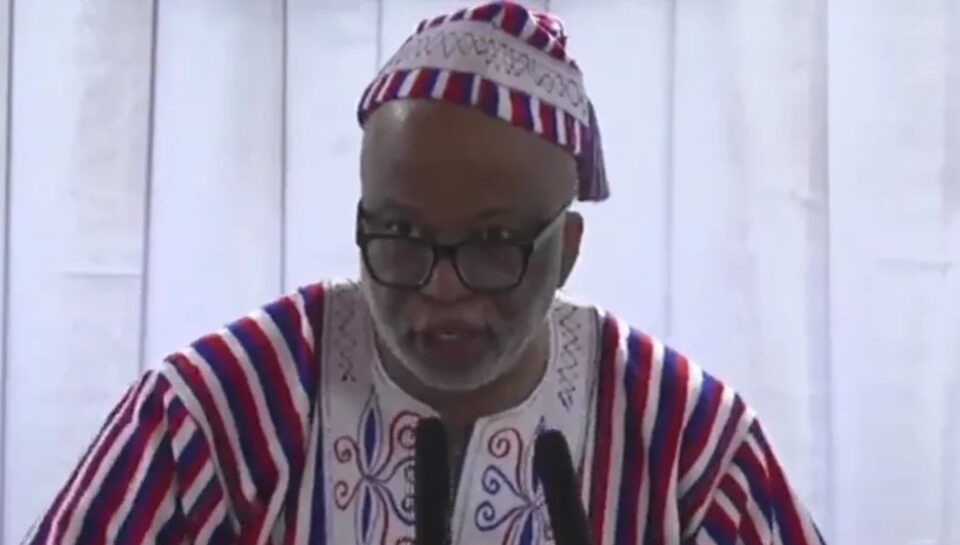
“My argument is simple,” Brewer declared. “Liberian history is one of our greatest national assets. And when it comes to understanding our collective past, the great challenge facing us is not simply that too many Liberians do not know their history. Our great challenge is that too many have come to believe their history has little value.”
SOURCE: Daily Observer newspaper
As Liberia commemorated its 179th Independence Day in Buchanan, Grand Bassa County, National Orator Dr. Herbert C. Brewer delivered a sweeping and thought-provoking address calling on Liberians to reclaim confidence in their history, arguing that the country’s greatest national asset is not its natural resources but its collective historical inheritance.
Speaking before President Joseph Nyuma Boakai, Vice President Jeremiah Kpan Koung, members of the Legislature, the Judiciary, and the Cabinet, diplomats, traditional and religious leaders, members of the Armed Forces, diplomats and hundreds of citizens , Dr. Brewer challenged what he described as a growing tendency among Liberians to dismiss their nation’s past as one defined only by failure.
“My argument is simple,” Brewer declared. “Liberian history is one of our greatest national assets. And when it comes to understanding our collective past, the great challenge facing us is not simply that too many Liberians do not know their history. Our great challenge is that too many have come to believe their history has little value.”
He warned that a nation that loses confidence in its history ultimately loses confidence in itself.
“History is not merely a record of yesterday’s events. History is the source of our identity, our memory, our wisdom, and our sense of national purpose,” he said. “A people who lose confidence in their history eventually lose confidence in themselves.”
Delivering one of the most comprehensive historical reflections ever presented during Liberia’s Independence Day celebrations, Brewer urged Liberians to rethink how they understand the country’s origins, emphasizing that Liberia’s story did not begin with independence in 1847 or even with the arrival of freed African Americans in 1822.
“To reclaim Liberia’s history, we must first understand that Liberian history did not begin in 1847. Nor did it begin in 1822. The republic whose independence we celebrate today rests upon foundations laid over many centuries.”
Tracing Liberia’s roots back centuries before European contact, Brewer highlighted archaeological evidence, oral traditions, and linguistic studies showing that generations of African societies built thriving communities long before the establishment of the modern republic.
He said Liberia’s ethnic groups evolved through centuries of migration, trade, intermarriage, conflict, and cooperation rather than existing as fixed identities.
“Our ancestors were not born into the identities that we know today,” he explained. “Indeed, our ancestors created those identities.”
According to Brewer, understanding this historical evolution should strengthen rather than divide modern Liberians.
“Liberia did not create its people; rather, its many people over countless generations created the Liberia we have inherited.”
The National Orator paid tribute to the sophisticated African societies that existed before the republic, noting they possessed functioning governments, judicial systems, diplomatic relations, commerce, and technologies adapted to their environment.
“The desire for self-government did not begin in 1847,” Brewer said. “What independence did was to give that older aspiration a new and modern constitutional form.”
Brewer also devoted considerable attention to the devastating impact of the transatlantic slave trade, describing it as one of humanity’s greatest tragedies that tore apart families, fueled wars, and interrupted Africa’s political development.
“No community in what is now Liberia escaped its effects,” he noted.
Yet he argued that centuries of resistance against enslavement also cultivated among Liberia’s ancestors an enduring commitment to liberty and sovereignty that later shaped the republic.
He recounted how local African rulers resisted European domination long before Liberia became independent, citing the refusal of Cape Mesurado’s ruler, Peter, in 1822 to permit Europeans to establish a fort on the Cape.
“That decision speaks across the centuries. It reminds us that long before the modern republic, the peoples of this coast understood the value of sovereignty.”
Brewer challenged long-held narratives suggesting Liberia’s founding began solely with the American Colonization Society (ACS), insisting instead that the republic emerged from a much broader historical movement involving Africans on both sides of the Atlantic.
He praised early Black leaders such as Paul Cuffe and Reverend Lott Carey, emphasizing that many returned to Africa through their own initiative rather than under the sponsorship of the ACS.
Quoting Carey, Brewer said, “‘I am an African. I feel bound to labor for my suffering race.'”
He argued that Liberia represented “one of the most remarkable meetings in history,” where returning descendants of enslaved Africans joined forces with indigenous African communities already established on the ground.
“Returning descendants of Africa brought the hard-earned lessons of survival, education, faith, resistance, and determination,” he said. “Africans who had remained on the continent brought generations of political experience, commercial knowledge, diplomatic skill, and cultural continuity.”
Brewer specifically recognized indigenous Liberian figures William Campbell, David Noah, and William Davis, whom he credited with introducing the American Colonization Society to Cape Mesurado and helping build trust between settlers and local rulers.
“The founding of the Liberian Republic was made possible not only by the vision of the returning descendants of Africa but also by the African people themselves already on the ground.”
Turning to Liberia’s Declaration of Independence, Brewer stressed that July 26 should be understood as the birth of the republic rather than the beginning of Liberian history.
“The Republic has a founding date. The history of its people does not.”
He argued that July 26 remains globally significant because it represented the first successful assertion that Black people could govern themselves through a constitutional republic during an era dominated by slavery and colonialism.
“No nation is born perfect,” Brewer observed. “July 26 matters because a free Black people declared to the world that they possessed the right and the capacity to govern themselves.”
Recalling Liberia’s first President Joseph Jenkins Roberts, Brewer quoted his explanation that independence was intended “to vindicate the race from scandal” by proving people of African descent were fully capable of sustaining modern government.
Against the backdrop of slavery and expanding European empires, Brewer said Liberia offered a radically different vision.
“Liberia declared that African people could govern themselves, that Black liberty could sustain republican government, and that an African nation could take its place among the family of nations.”
He acknowledged, however, that Liberia’s early republic was small and possessed limited authority beyond its coastal settlements, emphasizing that modern Liberia emerged gradually through decades of negotiations, alliances, and cooperation with numerous independent African societies rather than through simple territorial expansion.
Brewer praised indigenous leaders who chose cooperation with Monrovia during the colonial “Scramble for Africa,” arguing their decisions helped preserve Liberia’s sovereignty when European powers sought to divide the continent.
“Our national boundaries were not simply drawn up in Berlin,” he declared. “They were also forged through the decisions of African communities determined to preserve as much of their independence as possible.”
The National Orator also reflected on Liberia’s twentieth-century challenges, including the Firestone concession agreement of 1926, increasing economic dependence, political centralization, military intervention, and civil war.
He said history should not be reduced to those painful chapters alone.
“No nation should be judged solely by its darkest hours. The true measure of a people is not whether they experience hardship. It is whether they find the courage to rebuild.”
Celebrating Liberia’s survival after nearly two centuries, Brewer remarked, “Today, nearly two centuries after independence, our Republic endures. Imperfect, still unfinished, still striving, but enduring. That is no small achievement.”
In the closing moments of his address, Brewer delivered a passionate appeal to Liberia’s younger generation to embrace rather than reject their national inheritance.
“Do not inherit only this country’s territory. Inherit its memory.”
He urged young Liberians to preserve not only the national flag and Constitution but also the sacrifices made by previous generations to secure freedom.
“Do not allow anybody to persuade you that your history is something to be ashamed of,” Brewer said to sustained applause.
“It is your inheritance to reclaim it. All of it—the triumphs, the disappointments, the victories, the mistakes, the moments that inspire us, and the moments that humble us. All of it belongs to us.”
Brewer concluded by reminding Liberians that every generation inherits a republic it did not create and bears responsibility for strengthening it for future generations.
“The question is not whether we inherited a perfect republic—we did not. The question is whether we will leave our children a republic stronger than the one we received.”
Calling that responsibility “the true meaning of citizenship” and “the enduring meaning of July 26,” Brewer ended his historic address with a final appeal for national unity through historical understanding.
“A nation inherits many things—its rivers, its forests, its towns and villages, the Constitution, and the flag. But none is more valuable than the memory of how it became a people. That memory is our inheritance. Let us preserve it. Let us enlarge it. Let us honor it. Let us fight for it because it is worth fighting for. And let us pass it on stronger, richer, and wiser than we received it.”
He concluded, “May God continue to bless the Republic of Liberia, and may God bless the Liberian people.”