
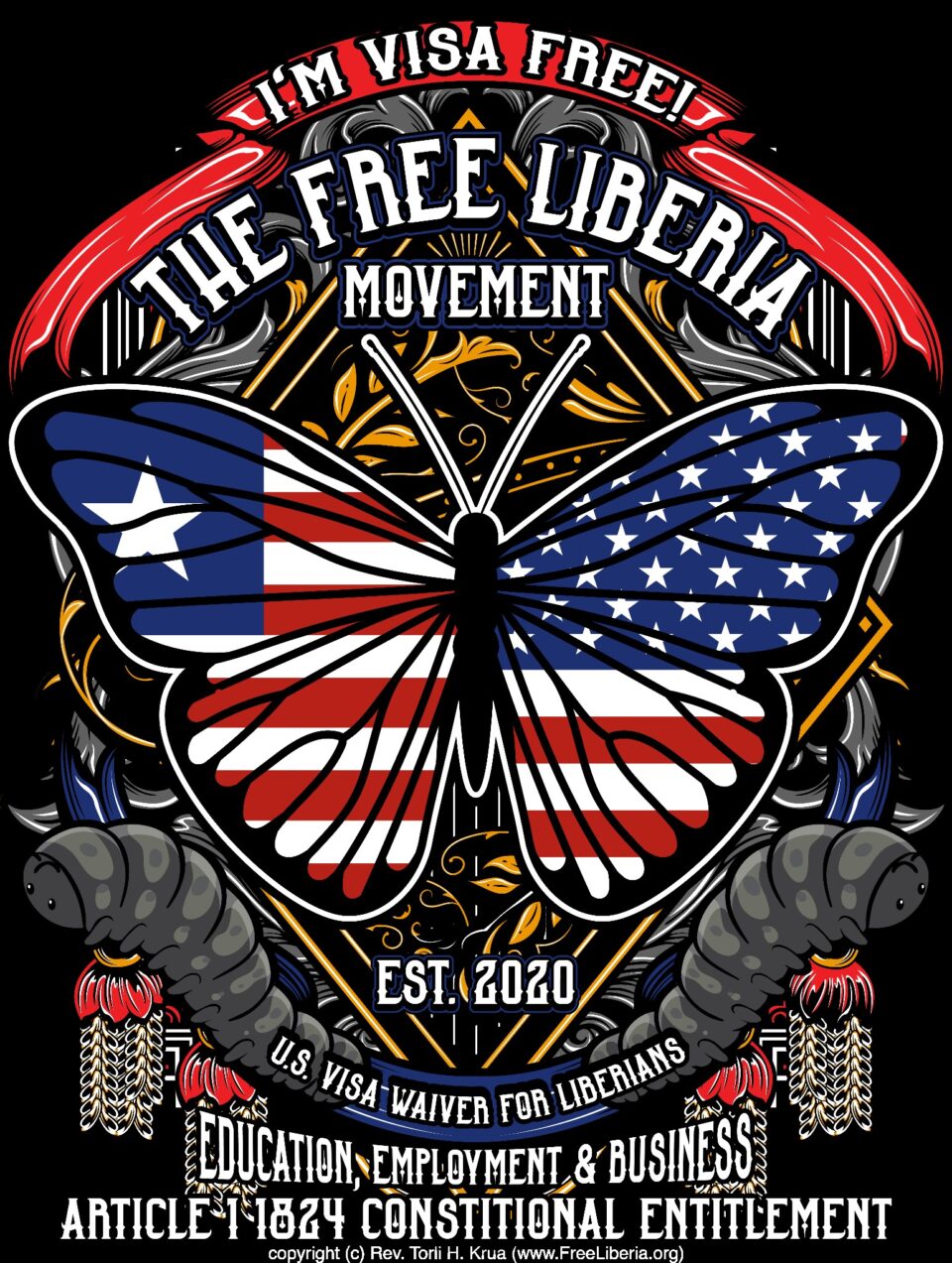
And A Sovereign Citizens Convention
Martin Luther King Jr. Day: No Reparations, No Freedom
For Immediate Release
January 12, 2026
PRESS STATEMENT
Boston, Massachusetts | Monrovia, Liberia — January 2026–On Martin Luther King Jr. Day, we honor a man who warned that “justice too long delayed is justice denied.” Today, all persons born in Liberia—descendants of U.S. citizens forcibly exiled under American colonization—declare that the delay must end.
Through the 1790 Naturalization Act and the 1819 Slave Trade Act, the Federal Government unconstitutionally removed Black American citizens and used Liberia as a site of racial exile under the false promise of freedom, equality, and self-government. That promise was broken.
On January 26, 2026, the Free Liberia Movement and allied citizens will present a Fourth & Final Remonstrance at the U.S. Embassy in Monrovia, demanding the immediate restoration of birthright U.S. citizenship for all persons born in Liberia and a decisive break from more than two centuries of colonial deception.
Liberia was not founded by immigrants. It was created by the United States—through federal laws, taxpayer funding, and U.S. naval force—to remove Black American citizens after they were legally recognized as free and equal under Massachusetts law. Those citizens were never foreigners. They were never immigrants. They were exiled.
Today, Liberia remains one of the poorest nations on Earth while its judges, lawmakers, ministers, politicians, and presidents routinely hold U.S. green cards and U.S. passports. Ordinary Liberians, meanwhile, face one of the highest U.S. visa refusal rates in the world—nearly 80 percent. This is not independence. It is unfinished colonization.
Our Demands Are Clear
- Immediate restoration of birthright U.S. citizenship for all persons born in Liberia, pending lawful resolution of sovereignty.
- A Sovereign Citizens Convention, convened by the people—without the permission or approval of political elites or political parties—to draft Liberia’s first truly democratic Constitution, grounded in:
- Participatory democracy
- Participatory budgeting
- The direct power of citizens to determine the salaries and benefits of their public servants
- Reparations before independence, under what we call the Mum Bett Rule:
No reparations. No freedom.
Just as slavery in Massachusetts ended only when freedom was legally recognized and compensated, Liberia’s colonial injury must be repaired before any legitimate independence can exist.
This is not only a Liberian issue. It is a moral and legal reckoning for the United States as it approaches 250 years of independence. The precedent set in Liberia will echo across the entire African continent, where colonial borders and constitutions were imposed without the consent of the governed and where political “independence” was granted without returning wealth stolen over centuries.
Martin Luther King Jr. taught that peace is not the absence of tension, but the presence of justice. On January 26, 2026, Liberians will peacefully—but firmly—demand that justice finally be present.
No reparations. No freedom.
This is our Mum Bett moment.
— Rev. Torli H. Krua
Founder, The Free Liberia Movement
Boston, Massachusetts
STATEMENT OF LEGAL AND HISTORICAL FACTS AND PRINCIPLES
I. Congressional Finding: The American Colonization Society Lacked Legal Authority
On May 4, 1844, the United States House Committee on Foreign Affairs investigated the legal status and authority of the American Colonization Society (“ACS”) and issued House Report No. 469 (1844).¹
The Committee declared that the charters granted to the ACS by the State of Maryland in 1831 and 1837 were “null and void,” because:
*The State of Maryland lacked constitutional power to establish a colony outside the United States and therefore could not delegate or grant such power to the American Colonization Society.*²
This conclusion reflects the foundational common-law doctrine:
Nemo dat quod non habet — one cannot give what one does not possess.³
Because Maryland had no sovereign authority to establish a foreign colony, it could not lawfully confer such authority upon the ACS. The ACS therefore never possessed lawful power to colonize Liberia.
II. ACS Admission of Lack of Authority (1844)
Following the congressional investigation, the ACS receded from its prior claims, acknowledging in 1844 that it lacked authority to colonize Liberia or to grant sovereignty or constitutional powers to the so-called Commonwealth of Liberia.⁴
Accordingly:
- The ACS was not a sovereign entity
- The ACS was not a lawful colonial authority
- The ACS could not convey political sovereignty
- The ACS could not grant constitutional authority
III. Failure of Title: ACS Could Not Own or Transfer Land
Because the ACS was neither sovereign nor a lawful government, it could not:
- hold valid title to land in Liberia;
- transfer title deeds to settlers or institutions; or
- confer ownership or territorial jurisdiction.
Under nemo dat quod non habet, any land titles or governmental authority purportedly derived from the ACS are legally defective, as the ACS could not transfer rights it never lawfully possessed.⁵
IV. Liberia Was Not a Colony of the ACS — Nor a Valid Republic
Liberia was not lawfully a colony of the ACS, because the ACS lacked colonizing authority. Nor was Liberia a valid republic, because:
- Indigenous Africans—who constituted the overwhelming majority—were excluded from citizenship and governance for more than a century,⁶ and
- A political order that excludes the governed majority cannot claim republican legitimacy under established principles of constitutional law and political theory.⁷
Liberia therefore existed under a colonial system without a lawful colonizer, a legal contradiction.
V. United States Exercised De Facto Sovereignty (1822)
Despite the ACS’s lack of authority, the United States exercised actual sovereign power in Liberia:
- The land was acquired using S. taxpayer funds pursuant to federal statutes;⁸
- Authorization came through acts of Congress;
- The policy was approved by President James Monroe;⁹
- Enforcement and protection were provided by the S. Navy;¹⁰
- On April 25, 1822, the S. flag was hoisted over Liberian territory.¹¹
From that date forward, the United States functioned as the de facto sovereign power, exercising control through military protection, federal agents, and fiscal authority.
Sovereignty has never been lawfully transferred.
VI. Deception of the Colonists and Imposition of Dictatorial Rule
Colonists were induced to relocate under an explicit promise contained in early governing instruments:
*“All persons born within the limits of the territory held by the American Colonization Society in Liberia, or removing there to reside, shall be free, and entitled to all the rights and privileges enjoyed by citizens of the United States of America.”*¹²
After colonists departed the United States:
- The Federal Government reneged on this promise;
- The ACS—already a non-legal entity—asserted fictitious authority;
- A single white agent was appointed to rule Liberia;
- That agent served simultaneously as:
- Federal Agent of the United States, and
- “Colonial Agent” of the ACS;
- He exercised unchecked power, resulting in dictatorial governance.¹³
This system was neither democratic nor lawful.
VII. Independence Was Forced — and Legally Void
Liberia was compelled to declare “independence” in 1847, purportedly from the ACS.¹⁴ However:
- One cannot declare independence from an entity that never lawfully governed;
- The ACS was null and void;
- Independence from a non-sovereign is itself null and void.
Liberia’s declaration of independence therefore did not and could not transfer sovereignty.
VIII. Present-Day Consequences
Liberians today remain subject to:
- a colonial constitution later reinforced by a military-derived constitution;¹⁵
- a system of first- and second-class citizenship;
- an electoral framework designed for wealth rather than popular sovereignty;
- the permanent enrichment of political elites.
There has never been a democratically constituted sovereign order in Liberia.
IX. Remedy Sought
Through this Remonstrance, we call for:
- A Sovereign Citizens’ Convention, convened without legislative or executive permission;
- Formal recognition that all persons born in Liberia are entitled to the rights of U.S. citizenship, pending lawful resolution of sovereignty;
- Annexation by the United States, followed by true independence only after reparations for two centuries of unlawful colonization and denial of sovereignty.
As the United States approaches 250 years of independence, a reckoning is required.
X. Massachusetts Citizenship as the Legal Foundation of Liberians’ U.S. Citizenship
A. Brom and Bett v. Ashley (1781)
The legal foundation of Liberians’ U.S. citizenship originates in Massachusetts.
In 1780, the Massachusetts Constitution declared that *“all men are born free and equal.”*¹⁶
In 1781, the Massachusetts Supreme Judicial Court enforced this principle in Brom and Bett v. Ashley, holding slavery incompatible with the Constitution.¹⁷
This decision confirmed the citizenship and legal personhood of Black residents, who were later targeted for removal. They were citizens, not immigrants.
B. The Naturalization Act of 1790
The Naturalization Act of 1790 restricted federal naturalization to “free white persons.”¹⁸
It did not create citizenship, nor could it strip citizenship from persons already citizens under state law. Its use to justify exclusion or removal of Black citizens was therefore constitutionally invalid.
C. The Slave Trade Act of 1819
The Slave Trade Act of 1819 purported to suppress the slave trade but created the U.S. Agency for Liberated Africans.¹⁹
That agency was unlawfully used to remove U.S. citizens, transport them to Liberia, and deny them citizenship rights—acts never authorized by Congress.²⁰
D. Primary Evidence: The Remonstrances
The deception of colonization is documented in:
- The Remonstrance of December 5, 1823;²¹
- The Remonstrance of Joseph Shephard (1830).²²
These documents confirm that settlers understood themselves to be U.S. citizens and protested the denial of promised rights.
XI. Legal Conclusion
Taken together:
- Brom and Bett v. Ashley established Black citizenship;
- The 1790 Naturalization Act failed to negate that citizenship;
- The 1819 Slave Trade Act was unlawfully weaponized;
- The ACS lacked legal authority;
- Independence was forced and legally void;
- Sovereignty has never been lawfully transferred.
All persons born in Liberia remain entitled to the rights of U.S. citizenship until lawful sovereignty is established through democratic means and reparations.
FOOTNOTES / SOURCES
- U.S. House of Representatives, Committee on Foreign Affairs, Report No. 469, 28th Cong., 1st Sess. (1844).
- Id.
- Nemo dat quod non habet, Black’s Law Dictionary (11th ed.).
- American Colonization Society, Annual Reports (1844).
- See generally Johnson v. M’Intosh, 21 U.S. (8 Wheat.) 543 (1823) (title requires sovereign authority).
- Liberian Constitutions of 1847 & 1986; see also historical voting exclusions.
- See The Federalist No. 39 (Madison).
- Slave Trade Act of 1819, ch. 101, 3 Stat. 532.
- Presidential Messages of James Monroe, 1819–1822.
- U.S. Navy Africa Squadron records.
- ACS & Navy correspondence, April 1822.
- ACS Constitution & Regulations (1820s).
- Contemporary ACS correspondence and settler accounts.
- Liberian Declaration of Independence (1847).
- Liberian Constitution (1986).
- Massachusetts Constitution of 1780.
- Brom and Bett v. Ashley, Mass. Sup. Jud. Ct. (1781).
- Naturalization Act of 1790, ch. 3, 1 Stat. 103.
- Slave Trade Act of 1819, supra.
- Attorney General William Wirt, Opinion No. 229.
- Remonstrance of Liberian Settlers (Dec. 5, 1823).
Joseph Shephard Remonstrance (1830).