
By Austin S Fallah – A True Son of the Planet Earth Soil: fallahas@yahoo.com
Congratulations, Liberia, Made it through “World Hygiene Month.”
Sanitation and modern hygiene in Liberia are fundamental human rights and prerequisites for national dignity, public health, and economic progress.
President Joseph Nyuma Boakai: Emphasizing a shift from treatment to prevention, he noted, “We are not going to place much attention on training people on how to cure, but we are going to train people how to prevent… Sanitation is a prerequisite to good health.” He has also championed prioritizing safe drinking water and basic hygiene in his annual messages.
Former President Ellen Johnson Sirleaf: While serving as President, she highlighted the link between water and dignity: “Our people have brought clean water into the heart of Monrovia to children who have never known water from a tap.”
Former President Sirleaf: She has also forcefully critiqued urban neglect, stating, “This city is filthy, and it needs to be addressed. Silence makes us all culpable.”
Former President George Manneh Weah: Pledging equitable, safe, and sustainable access to water supply.”
Former President Weah: “We will not rest until safe drinking water reaches the remotest parts of our country.”
Former President William V.S. Tubman: Pointing out that environmental action requires collective willpower, he stated: “In the great task to which we have set ourselves at this crucial moment… let us think like men of action and act like men of thought.”
Plato: Stated in The Laws that a lack of cleanliness and proper waste management in a city is a direct affront to civic duty: “Of all things of this kind, the greatest is cleanliness in everything.”
Aristotle: Expressed in politics that a primary function of a capable state is the health of its citizens, noting that the layout of the city and its sanitary conditions dictate the morality and capability of the populace.
Niccolò Machiavelli: In The Prince, he emphasized that a successful ruler must proactively address crises before they spread: “Wise men do at the first what fools do at the last.” This is frequently applied by modern environmental advocates in Liberia who argue that proactive sanitation prevents catastrophic disease outbreaks.
Patrice Lumumba: The Pan-African leader consistently argued that true African independence and modernity rely on the physical well-being and health of the people.
World Health Organization (WHO): Institutionalizing the modern approach to hygiene, its global framework stresses that “access to safe water, sanitation and hygiene is the most basic human need for health and well-being.”
“If we are to encourage investors, we must ensure our cities are clean, particularly the capital city, we have safe drinking and running water, and that public lavatories/latrines and toilets are available, clean, and in good working order, in accordance with required flush toilet laws and city ordinances.”- Alhaji V Kromah, US-Liberian-based Oracle Subject Matter Expert.
By: Austin S Fallah – A True Son of the Planet Earth Soil: fallahas@yahoo.com.
In the 21st-century digital age, where cities flourish with technological advancements, equitable access to basic sanitation facilities is not merely a privilege; it is a fundamental human right.
Water and sanitation are inextricably linked, playing a significant role in public health, economic development, and social equity.
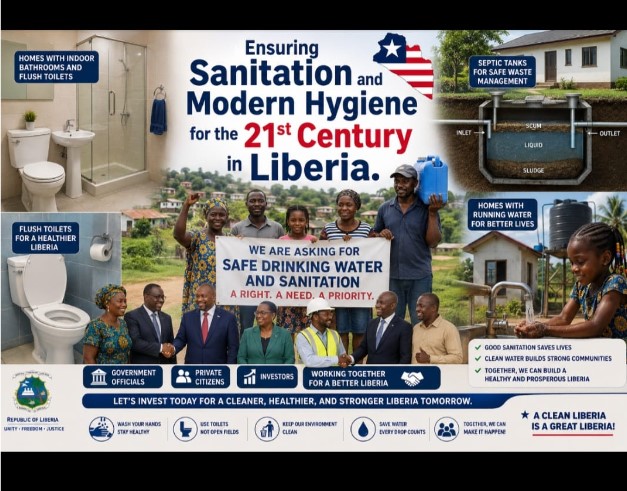
For Liberia, a nation still recovering from decades of conflict and socio-economic challenges, the introduction of in-house baths and flush toilets is a critical step towards joining the civilized, sanitized world.
The task is monumental, but with the concerted efforts of the government, various municipal corporations, and the unyielding support of Liberians both at home and abroad, it is an aim worth pursuing, not just for the betterment of individuals but for the enrichment of the entire nation.
A Call for Change
The often filthy conditions marked by improper waste disposal, unclean water sources, and public toilets lacking basic amenities have long plagued Liberia.
It is disheartening to witness how many families still resort to open defecation or the use of communal latrines that offer little in the way of privacy or hygiene.
Such practices not only jeopardize public health but also perpetuate cycles of poverty, inequality, and underdevelopment.
For Liberia to move forward, we must galvanize public and governmental support for adopting modern sanitation practices, starting with disseminating information about the social, health, and economic benefits of a sanitized environment.
This educational initiative must begin at the grassroots level, targeting communities and households to raise awareness of the urgent health risks associated with inadequate sanitation.
Local government authorities, such as the Monrovia City Corporation, along with the Ministry of Local Government, should lead workshops and campaigns that illustrate the advantages of in-house bathing facilities and flush toilets.
The psychological shift from viewing sanitation as a luxury to recognizing it as an integral aspect of life will become crucial.
Education must include proper hygiene practices that make sanitation a community-wide responsibility, resulting in shared ownership of public health.
The Role of Government Agencies
While educational initiatives form the backbone of this movement, they must be coupled with strong policy frameworks and institutional enforcement.
The Liberia Water and Sewer Corporation is tasked with ensuring that all communities have access to safe drinking water and efficient waste disposal systems.
Policies must be enacted to facilitate the construction and maintenance of necessary infrastructure.
Effective collaboration with engineering and environmental firms, both local and international, can help design and implement modern plumbing systems that serve communities efficiently.
Moreover, the Liberia Environmental Protection Agency plays a pivotal role in enforcing environmental regulations.
Their influence can be felt substantially in promoting waste management and sanitation policies.
Constructing biosolid treatment facilities and promoting the safe disposal of human waste must become national priorities.
Beyond regulatory frameworks, the government, through the Liberia Water and Sewer Corporation, City governments, County governments, District governments, the Liberia Environmental Protection Agency, and other relevant agencies, has a moral obligation to consult with local communities, understand their unique sanitation needs, and tailor solutions that reflect their realities.
The Importance of Public Support
It is essential for every Liberian, those living back in Liberia and those in the diaspora, to feel a sense of collective responsibility toward improving sanitation in Liberia.
This is not merely a job for the government; the success of this endeavor will solely rely on active participation from every citizen.
Every individual has the power to make a difference, whether through advocacy, volunteering, or providing financial support for sanitation-related projects.
When families choose to invest in sanitary facilities for their homes, they demonstrate a commitment to improving their own living conditions, which, in turn, fosters a culture of cleanliness throughout the community and the nation.
The influence of the diaspora cannot be underestimated.
Liberians living abroad often have access to resources and knowledge that can greatly benefit those who remain in Liberia.
Funding campaigns that encourage in-house bathing facilities, flush toilets, and proper waste disposal methods could be adopted.
Engagement through platforms such as social media can invigorate support and raise awareness, transforming these discussions into action-packed rallies that call for tangible results.
Economic Implications of Sanitation
Sanitation goes beyond health and hygiene; it has profound economic ramifications.
A clean, sanitized environment attracts investors who are keen to establish businesses in regions where basic utilities are reliable.
Investing in sanitary practices can create a ripple effect, leading to job creation, boosting local economies, and improving public health.
Particularly in Liberia, where economic recovery is crucial, a focus on sanitation can be an essential development strategy.
When investors see that a region is committed to public health and sanitation, they are more likely to establish roots there.
Furthermore, as the population’s health improves, so does its capacity to work and contribute to the economy.
Improved sanitation directly correlates with reduced healthcare costs, increased productivity, and, ultimately, enhanced standards of living.
A National Responsibility
As I discuss the necessity for in-house baths and flush toilets in Liberia, every well-meaning Liberian must recognize that this challenge requires an all-hands-on-deck approach.
National security, economic development, and public health are interwoven, and citizens must acknowledge that no aspect of their responsibility is too small when it comes to building a safer, cleaner Liberia.
Involve students, educators, health professionals, and community leaders in promoting sanitation awareness campaigns.
We must inspire people to adopt sustainable habits, cultivate a sense of pride in maintaining clean environments, and provide communities with the resources they need to succeed.
Comprehensive sanitation programs, supported by political will and community involvement, will guarantee long-lasting change.
It is time for Liberia to shed its past and emerge as a beacon of sanitation and hygiene, promising a healthy future for its people.
Sanitation is not merely a matter of convenience; it is a vital necessity for national development.
In-house baths and flush toilets have the potential to elevate Liberia to a global standard of public health and sanitation by ensuring that all citizens have access to safe and hygienic living conditions.
In doing so, we will not only improve public health and attract investment but also foster community solidarity and civic responsibility.
The government’s proactive measures, combined with individual citizens’ contributions, can make this goal a reality.
Together, as a nation, united within and outside its borders, citizens can dismantle the barriers to sanitation and step confidently into a cleaner, more civilized future.
Sanitation must be recognized as being as essential to national security as any defense force; it is fundamental to the very essence of what it means to be a civilized society in the 21st century.
Let every Liberian embrace this challenge and take bold steps towards building a healthier, more prosperous Liberia for generations to come.