
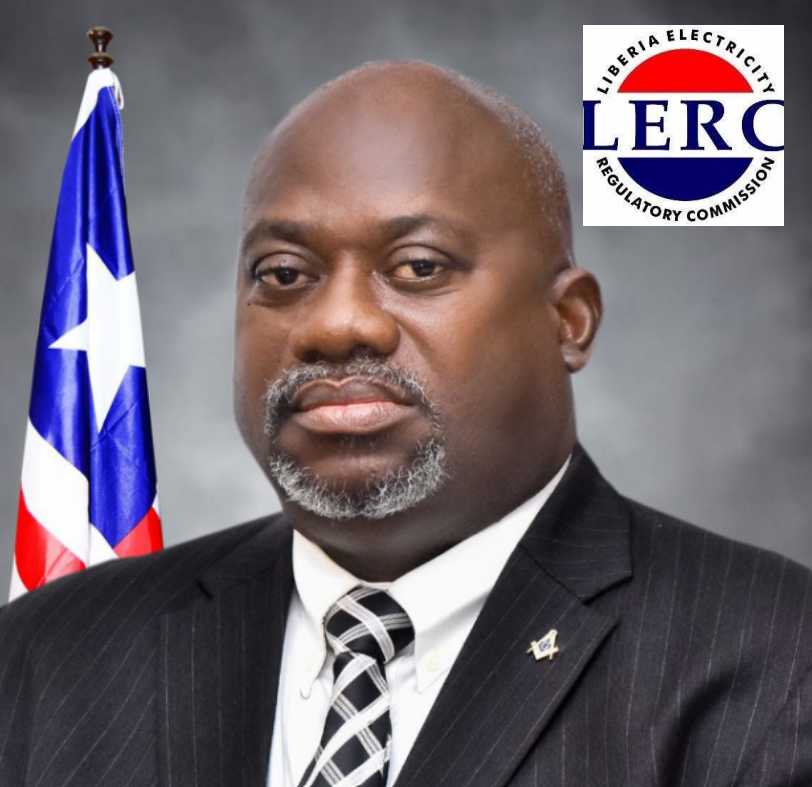
PHOTO: LERC Board Chairman, Claude J. Katta
“This Tariff decision is the result of rigorous technical analyses of LEC’s costs and other parameters, thereby ensuring that only prudent costs are passed on to customers as the end-user tariff,” said Claude J. Katta, Chairman of the Board of Commissioner of the Liberia Electricity Regulatory Commission (LERC) when the decision was announced for the tariff application for the Liberia Electricity Corporation (LEC).
He said the new tariff structure, which comes into force on January 1, 2026, fulfills the LERC’s responsibility under the 2015 Electricity Law to set tariffs ”that enable an efficient service provider to recover its costs, make a reasonable return, and provide incentives for continuous technical and economic improvements in the system”.
According to the LERC’s Board Chairman, the tariff this was approved after a thorough review of LEC’s application, rates and charges payable by the five categories of customers within LEC’s network.
BELOW ARE THE NEWLY APPROVED ELECTRICITY TARIFF STRUCTURE:
- Social customers: which include those whose monthly energy consumption is either less than or equal to Twenty-Five Kilowatt Hour (25kWh) shall pay Thirteen (13) US cents per Kilowatt-hour. This represents a 13.3% reduction from the current price of Fifteen (15) US cents per Kilowatt-hour. LEC’s customers in this category do not pay fixed charges. This customer category is where the poorest households are as their consumption of electricity is minimum.
- Prepaid Residential customers: is set at twenty-two (22) US cents per Kilowatt-hour. This tariff represents an 8.3% reduction from the current price of twenty-four (24) US cents per Kilowatt-hour. This category of customers will pay a monthly fixed charge of Two (2.00) US dollars compared to the current fixed charge of US$2.48 (a 19.4% reduction) to cover a portion of LEC’s fixed costs.
- Postpaid Residential customers: is set at US 22 cents per Kilowatt-hour. This tariff represents an 8.3% percent reduction from the current price of 24 US cents per Kilowatt-hour. This category of customers will pay a monthly fixed charge of US$3.79 compared to the current fixed charge of US$4.47 (a 15.2% reduction) to cover a portion of LEC’s fixed costs.
- Prepaid Non-residential customers: is set at US 22 cents per Kilowatt-hour. This tariff in this category remains the same. However, this category of customers will pay a monthly fixed charge of US$8.48 compared to the current fixed charge of US$10.00 (a 15.2% reduction) to cover a portion of LEC’s fixed costs.
- Postpaid Commercial customers: is set at US 22 cents per Kilowatt-hour and it also remains the same. However, this category of customers will pay a monthly fixed charge of $10.17 compared to the current fixed charge of US$12.00 (a 15.2% reduction) to cover a portion of LEC’s fixed costs.
- Medium Voltage customers: is set at US 20 cents per Kilowatt-hour. This tariff category consists of customers who are supplied at the 22kV and 33kV voltage levels. The new tariff represents a 5.3% increment from the current price of 19 US cents per Kilowatt-hour. This category of customers will pay a monthly fixed charge of US$42.40 compared to the current fixed charge of US$50.00 (a 15.2% reduction) to cover a portion of LEC’s fixed costs.
- Single Phase Connection: is set as US$70 per connection to recover a portion of the cost of connection. The new single phase connection charge represents 218% increment from the current rate of US$22 per connection. Customers shall not pay connection fee in locations where there is evidence that expansion of the grid including the full cost of connection are financed by donors, the Government of Liberia, or a third party.
- Three Phase Connection: is set at US$340 per connection to recover a portion of the cost of connection. The new three-phase connection fee is 0.5% reduction from the current fee of US$350 per connection.
LERC Board Chairman Katta explained that “the End-User-Tariffs include 3.5% on the annual revenue requirement of LEC as a regulatory levy covering a portion of the Commission’s budget.”
He said this is in line with Section 13.4 of the 2015 Electricity Law of Liberia, which stipulates that “Payments shall be made to the Commission in accordance with the procedure prescribed in the Electricity Licensing Regulations. LERC “
FULL TEXT OF THE LERC BOARD OF COMMISSIONERS CHAIRMAN, HON. CLAUDE J. KATTA’S SPEECH BELOW”
SPEECH DELIVERED BY THE CHAIRMAN OF THE
BOARD OF COMMISSIONERS OF THE LIBERIA ELECTRICITY
REGULATORY COMMISSION (LERC) HON. CLAUDE J. KATTA ON
THE ANNOUNCEMENT OF A DECISION ON THE
TARIFF APPLICATION FOR THE
LIBERIA ELECTRICITY CORPORATION (LEC)
DECEMBER 12, 2025
Honorable Minister of Mines and Energy;
Honorable Mohammed M. Sherif, Managing Director of the Liberia Electricity
Corporation;
The media; Distinguished ladies and gentlemen.
The 2015 Electricity Law of Liberia mandates the Liberia Electricity Regulatory Commission (LERC) to, amongst other things, set electricity tariffs for companies operating within the Electricity Supply Market of Liberia. To carry out this legislated mandate of tariff setting, the Commission developed two regulatory instruments, namely: The Electricity Tariff Regulations and the Multi Year Tariff Methodology which form the principal framework for the determination and approval of electricity tariffs in our country.
The process leading to this multi-year tariff determination began on September 13, 2024, when the Commission formally requested the Liberia Electricity Corporation (LEC) to submit its tariff application in accordance with the 2015 Electricity Law of Liberia (2015 ELL). LEC submitted its initial application on October 21, 2024, proposing tariffs for customers in its licensed service areas in Montserrado, Margibi, Bomi and Grand Cape Mount counties for the period 2025–2027.
However, on December 16, 2024, LEC withdrew that submission and requested an extension, citing the appointment (in late November 2024) of an interim management team that was unfamiliar with the submission. The Commission granted a two-month extension, setting a new deadline of February 15, 2025, for LEC’s reapplication. With the prevailing tariffs set to expire on December 31, 2024, the Commission approved the existing rates as provisional tariffs until the new tariffs presented in this document take effect.
Amid continued leadership transition and associated operational challenges, LEC was unable to meet the February deadline. The Commission granted LEC an extension and maintained close engagement with them beyond the February deadline. Consequently, LEC submitted a new tariff application on March 10, 2025, and between that date and May 09, 2025, the Commission worked closely with LEC to gather all the information needed to begin the tariff review process.
However, on July 4, 2025, LEC’s newly appointed management team requested permission to withdraw the March submission and to resubmit the tariff application by September 30, 2025. LEC informed the Commission that additional time was needed to align their financial projections with their newly developed strategic plan, incorporate planned capital investment and quantify the expected impact of new interventions in their proposal. This request was granted by the Commission.
LEC submitted its final tariff application on September 30, 2025 and LEC’s submission included newly licensed areas, covering parts of Grand Bassa and Rivercess counties. This submission, characterized by multiple information requests, technical working sessions, data verification, and continual refinement ensured the completeness and reliability of the data records. On October 14, 2025, the Commission acknowledged the completeness of LEC’s application and proceeded with the tariff revision process in accordance with the 2015 Electricity Law of Liberia and the Electricity Tariff Regulations. The Commission then published an abridged version of the tariff application on its website and in the newspapers informing the public of the LEC application and inviting comments on it.
As part of the tariff review process for the Commission undertook a series of public hearings to ensure transparency, inclusiveness, and broad stakeholder participation.
These engagements formed a critical component of the Commission’s consultative framework and were designed to gather public views on LEC’s tariff application while complying with regulatory requirements.
Between October and November 2025, the Commission conducted six public hearings across Montserrado, Grand Cape Mount, Margibi, Bomi, Rivercess, and Grand Bassa Counties. The hearings provided a platform for stakeholders to interact directly with the Liberia Electricity Corporation on the proposed tariff adjustments.
Public hearings were held on the following dates and at the corresponding locations:
- October 24, 2025 – Nyella Multi-purpose House, Tubmanburg, Bomi County
- October 25, 2025 – Robertsports Youth Center, Momo Tewah Sports Stadium Compound, Gbasalor Community, Grand Cape Mount County
- October 31, 2025 – Compound Number One Administrative Building, Compound One, Grand Bassa County
- October 31, 2025 – Ellen Johnson Sirleaf Town Hall, Yarpah Town, Rivercess County
Additional public hearings were convened in November as part of the extended review process:
- November 5, 2025 – Kakata City, Margibi County
- November 13, 2025 – Monrovia City Hall, Montserrado County
All hearings were conducted in accordance with the procedures set forth in the 2015 Electricity Law of Liberia, the Electricity Tariff Regulation and the Commission’s Administrative Procedure Regulations. Stakeholders received written invitations, while the public was informed via radio announcements and newspaper publications. An abridged version of LEC’s tariff proposal was published in selected newspapers and on the Commission’s website to facilitate informed participation.
A combined total of 1,057 individuals that included stakeholders attended and participated in these sessions. Participants included local government officials, policymakers, civil society organizations, students, youth groups, LEC customers, and other interest groups and among others. About 103 written submissions were received from stakeholders, including local government officials, engineering firms, businesses, civil society organizations, customers of LEC and members of the public.
During these hearings, LEC presented its tariff proposal to the public. The Commission took due notice of the comments and concerns raised by participants across the six counties. Concerns raised at the public hearings were mainly centered around power, reliability, tariff reduction, grid expansion, improvement in customer service, and the safety of LEC’s installations.
This Tariff decision is the result of rigorous technical analyses of LEC’s costs and other parameters, thereby ensuring that only prudent costs are passed on to customers as the end-user tariff. As far as tariffs are concerned, our responsibility under the 2015 Electricity Law is to set tariffs that enable an efficient service provider to recover its costs, make a reasonable return, and provide incentives for continuous technical and economic improvements in the system.
Also, the Electricity Law further requires that LERC’s budget be derived from a levy or regulatory surcharge on energy bills towards strengthening regulation, as a pass-through expense on the regulated entities.
In deriving the electricity tariffs, fixed charges and connection charges we are announcing today, the Board of Commissioners considered the following:
- That growth projections in electricity consumption are consistent with the base year customer database LEC submitted for 2025, and the new customer projections for both donor-financed and LEC-financed projects for the period of the new tariff regime. Customers are projected to grow from three hundred and fifty-five thousand, eight and hundred three (355,803) to six hundred and nineteen thousand, six hundred and twenty-two (619,622), a 74.15% increase during the tariff period; while energy consumption is expected to grow from three hundred fifty-two thousand, two hundred sixty-eight (352,268) megawattshour to eight hundred eighty-five thousand, seven eighty-nine (885,789) megawatts-hour, a 152.17% projected increase in consumption.
- That the aggregate technical and commercial loss levels by 2028 are realistic for Liberia given the baseline numbers in 2025, state of the network, and the evidence in LEC’s own historical records of reducing losses. Loss reduction directly supports tariff affordability. That is, every percentage-point reduction in total losses lowers the end user tariffs by approximately 1.8 percent, all else constant. Aggregate technical and commercial losses are projected to fall from 41% in 2025 to 28% in 2028, a 33% reduction in aggregate losses.
- The Commission’s merit-order dispatch framework which ensures that electricity generating sources are ranked from lowest cost to highest cost; and generation is dispatched in that order until projected demand is fully met. This reduces the overall cost of energy generation, directly lowering electricity tariffs for customers. Energy production including import is expected to grow from six hundred thirtyfive thousand, sixteen (635,016) megawatts-hour to one million, one forty-five thousand, nine hundred ninety-one (1,145,991) megawatts-hour, an 80.47% projected increase in generation.
- Capital Investments (CAPEX) for the tariff period are prudent and necessary to modernize infrastructure, expand electricity access, improve financial viability and enhance grid reliability while reducing aggregate technical and commercial losses.
Total capital expenditure for the tariff period is projected at US$256 million.
- Imposition of a fixed charge payable by all customers except social tariff customers to protect LEC’s revenue against demand reduction and to recover part of the fixed cost of the network assets.
- Imposition of a connection charge, which is a one-time payment made by new customers to recover a portion of the cost of connection.
After a thorough review of LEC’s application, the Board of Commissioners has approved rates and charges payable by the five categories of customers within LEC’s network effective January 1, 2026, as follows:
- Social customers: which include those whose monthly energy consumption is either less than or equal to Twenty-Five Kilowatt Hour (25kWh) shall pay Thirteen (13) US cents per Kilowatt-hour. This represents a 13.3% reduction from the current price of Fifteen (15) US cents per Kilowatt-hour. LEC’s customers in this category do not pay fixed charges. This customer category is where the poorest households are as their consumption of electricity is minimum.
- Prepaid Residential customers: is set at twenty-two (22) US cents per Kilowatt-hour. This tariff represents an 8.3% reduction from the current price of twenty-four (24) US cents per Kilowatt-hour. This category of customers will pay a monthly fixed charge of Two (2.00) US dollars compared to the current fixed charge of US$2.48 (a 19.4% reduction) to cover a portion of LEC’s fixed costs.
- Postpaid Residential customers: is set at US 22 cents per Kilowatt-hour. This tariff represents an 8.3% percent reduction from the current price of 24 US cents per Kilowatt-hour. This category of customers will pay a monthly fixed charge of US$3.79 compared to the current fixed charge of US$4.47 (a 15.2% reduction) to cover a portion of LEC’s fixed costs.
- Prepaid Non-residential customers: is set at US 22 cents per Kilowatt-hour. This tariff in this category remains the same. However, this category of customers will pay a monthly fixed charge of US$8.48 compared to the current fixed charge of US$10.00 (a 15.2% reduction) to cover a portion of LEC’s fixed costs.
- Postpaid Commercial customers: is set at US 22 cents per Kilowatt-hour and it also remains the same. However, this category of customers will pay a monthly fixed charge of $10.17 compared to the current fixed charge of US$12.00 (a 15.2% reduction) to cover a portion of LEC’s fixed costs.
- Medium Voltage customers: is set at US 20 cents per Kilowatt-hour. This tariff category consists of customers who are supplied at the 22kV and 33kV voltage levels. The new tariff represents a 5.3% increment from the current price of 19 US cents per Kilowatt-hour. This category of customers will pay a monthly fixed charge of US$42.40 compared to the current fixed charge of US$50.00 (a 15.2% reduction) to cover a portion of LEC’s fixed costs.
- Single Phase Connection: is set as US$70 per connection to recover a portion of the cost of connection. The new single phase connection charge represents 218% increment from the current rate of US$22 per connection. Customers shall not pay connection fee in locations where there is evidence that expansion of the grid including the full cost of connection are financed by donors, the Government of Liberia, or a third party.
- Three Phase Connection: is set at US$340 per connection to recover a portion of the cost of connection. The new three-phase connection fee is 0.5% reduction from the current fee of US$350 per connection.
The End-User-Tariffs include 3.5% on the annual revenue requirement of LEC as a regulatory levy covering a portion of the Commission’s budget in accordance with Section 13.4 of the 2015 Electricity Law of Liberia. Payments shall be made to the Commission in accordance with the procedure prescribed in the Electricity Licensing Regulations.
These approved tariffs shall become effective on January 1, 2026, and shall expire on December 31, 2028.
These approved tariffs shall remain in force unless they are reviewed by the Commission in accordance with the minor tariff review principles of the Multi-Year Tariff Methodology of May 2021.
A detailed tariff report which highlights the rationale for this decision shall be released by the Commission on our website and shared with stakeholders on Wednesday, December 19, 2025.
In conclusion, I would like to express our thanks and appreciation to our stakeholders and partners for past and continuing support:
- The Government of Liberia represented by the Minister of Finance and Development Planning and the Minister of Mines and Energy for their policy leadership.
- The Speaker of the House of Representatives and Pro Tempore of the Liberian Senate as well as the chairs and members of the Senate and House Committees on Energy, Natural Resources and the Environment.
- LEC’s management and staff for their cooperation with the Commission during this tariff review process.
- Managing Director of LERC and his team for their commitment, hard work and diligence in executing technical regulatory tasks.
- The Media and citizens who follow up with the Commission during the entire Tariff Application and Approval Processes.
Thank You. May God Bless and save Liberia!