
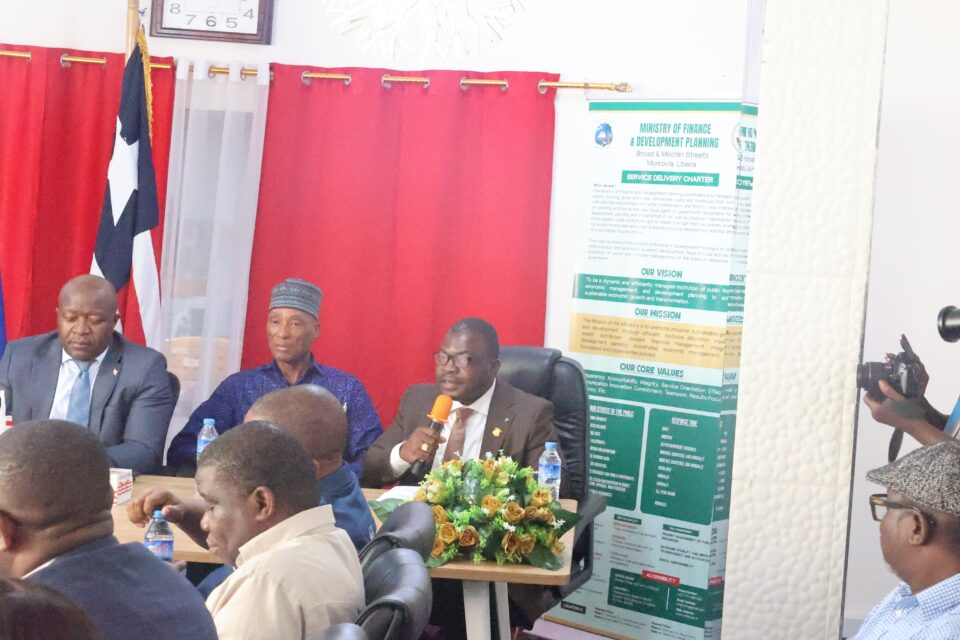
Monrovia, Liberia — The Director General–Designate of the National Fisheries and Aquaculture Authority (NaFAA), Mr. J. Cyrus Saygbe, Sr., has described the newly signed €25 million financing agreement between the Government of Liberia and the European Union as a landmark investment that will strengthen artisanal fisheries, protect Liberia’s waters, and empower fishing communities nationwide.
Speaking at the signing ceremony held Friday at the Ministry of Finance and Development Planning, Mr. Saygbe reflected on a long-standing saying along Liberia’s coast: when the tide is right and the net is strong, even the smallest canoe can return with abundance. He noted, however, that without strong institutions and effective protection at sea, even calm waters cannot secure sustainable livelihoods for fishermen.
“Today, we are strengthening the net, protecting our waters, and empowering Liberia’s fisheries sector to reach its full potential,” the NaFAA Director General–Designate said.
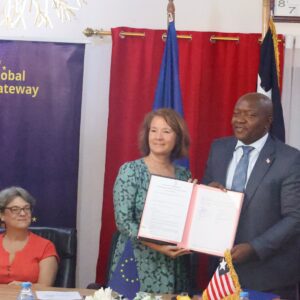
The Minister of Finance and Development Planning Augustine Kpehe Ngafuah and Ambassador Nonna Deprez Head of the European Union Delegation to Liberia signed the agreement.
Mr. Saygbe emphasized that the €25 million financing agreement represents far more than a financial transaction. He described it as a bold statement of trust and partnership, reflecting the European Union’s confidence in NaFAA’s reform agenda, leadership, and institutional direction, as well as the Government of Liberia’s commitment to transforming the fisheries sector into a pillar of inclusive growth, sustainability, and food security under the ARREST Agenda for Inclusive Development.
Additionally, the NaFAA Director General–Designate noted that the support will have a transformative impact on artisanal fishermen and fishmongers across Liberia’s nine coastal counties. He highlighted recent government measures to ease the burden on artisanal fishermen, including a 25 percent reduction in canoe licensing fees, alongside initiatives to strengthen fishmongers’ business development skills and improve market access. These efforts are further supported through NaFAA’s Quarterly Fish Market Day, which brings producers and consumers together and promotes fair trade.
Artisanal fisheries play a critical role in Liberia’s economy, providing employment and livelihoods for thousands of coastal and fishing communities and contributing significantly to national food and nutrition security. Despite its importance, the sector continues to face persistent challenges, including high post-harvest losses, limited market access, weak value addition, inadequate infrastructure, and limited institutional and technical capacity. The project is designed to address these challenges through a comprehensive and inclusive approach, with particular emphasis on women and youth, who are central actors along the fish value chain.
Key objectives of the project include enhancing the productivity and sustainability of artisanal fisheries; reducing post-harvest losses through improved fish handling, processing, and storage; strengthening value addition and market linkages; increasing incomes and employment opportunities for fishing communities; and building the institutional and technical capacity of fisheries stakeholders.
Moreover, Mr. Saygbe also underscored the importance of the financing in addressing the ongoing threat of Illegal, Unreported, and Unregulated (IUU) fishing by migrant vessels. He stated that such activities undermine sustainability, threaten livelihoods, and deprive Liberia of vital revenue. The partnership with the European Union, he said, will reinforce collaboration with the Liberia Coast Guard to enhance coastal patrols, particularly in the South-Eastern and North-Western regions, to safeguard Liberia’s waters for present and future generations.
Institutional strengthening and human capacity development form a core component of the financing. According to Mr. Saygbe, the support will strengthen the Liberia Artisanal Fishermen Association and the Department of Fisheries and Aquaculture Sciences at the University of Liberia. The financing is also expected to support the introduction of short-term certificate and diploma programs at the University of Liberia, Tubman University in Maryland County, and selected community colleges in coastal counties, aimed at building skills, professionalism, and opportunities for fishmongers, processors, and coastal communities.
The Director General–Designate further noted that the financing aligns with NaFAA’s historic decentralization agenda. By July 2026, NaFAA is expected to open its first regional office in Harper, Maryland County, bringing regulatory services, technical support, and economic opportunities closer to fishing communities that form the backbone of the sector.
The initiative also complements preparations for Liberia’s first post-war Fisheries Investment Conference, scheduled for March 30–31, 2026. Mr. Saygbe said the conference will signal to the international community that Liberia’s fisheries sector is organized, transparent, and open for responsible investment.
Describing the EU financing as a major leap forward for the sector, Mr. Saygbe said it will establish frameworks to reduce post-harvest losses, strengthen quality assurance, and improve units of measure for fishmongers nationwide—resulting in better incomes, fairer trade, reduced waste, and improved food security for Liberians.
On behalf of NaFAA, Mr. Saygbe expressed profound appreciation to the European Union for the partnership and the confidence placed in NaFAA’s leadership and the Government of Liberia.
“Together, we are ensuring that when Liberian fishermen cast their nets, they do so in protected waters, supported by strong institutions, skilled communities, and a thriving, sustainable fisheries sector,” he concluded.
Meanwhile, the expected outcomes of the project include increased efficiency and competitiveness of the artisanal fish value chain, improved quality and safety of fish and fishery products, enhanced incomes and more resilient livelihoods for artisanal fishers and processors, and strengthened institutional coordination and governance within the fisheries sector.
The signing of this project represents a significant milestone in Liberia’s efforts to advance sustainable fisheries development and inclusive economic growth. It also reaffirms the importance of artisanal fisheries as a cornerstone of national development and reflects the strong partnership and shared commitment of the Government of Liberia and the European Union to unlocking the sector’s full potential.