
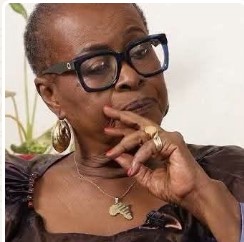
PHOTO: Madam Miatta Fahnbulleh
Written By Patrick M. Yattoh, Jr.
Public debate is the lifeblood of every healthy democracy. Nations progress not because everyone agrees, but because citizens are free to question leaders, challenge policies, and express differing opinions without fear of intimidation or personal attacks.
Liberia’s democratic journey has increasingly demonstrated this reality, even as public discourse often becomes polarized.
Recent remarks by educator and public policy advocate Miatta Fahnbulleh concerning former Presidents Ellen Johnson Sirleaf and George Manneh Weah have generated vigorous national discussion. Her comments have been applauded by some, criticized by others, and widely shared across traditional and social media. Regardless of one’s political affiliation, her observations provide an opportunity to reflect not only on the performance of past administrations but also on the quality of our national conversations.
Among her most widely quoted statements was the assertion that former President Ellen Johnson Sirleaf’s greatest political legacy was helping George Weah become President.
«”Her lasting legacy will be that she unleashed George Weah on us.”»
This statement is unmistakably a political judgment rather than an established historical fact. During Liberia’s 2017 presidential election, disagreements within the ruling Unity Party became highly public, and speculation arose that President Sirleaf was not fully aligned with her party’s presidential candidate, then-Vice President Joseph Boakai. Those political tensions contributed to public debate and internal party divisions.
However, no conclusive public evidence has established that Sirleaf officially endorsed George Weah or directed Liberians to vote for him. While historians and political analysts continue to debate the political dynamics surrounding that election, Weah’s victory ultimately resulted from Liberia’s constitutional electoral process, culminating in a democratic transfer of power that was widely recognized as peaceful.
Fahnbulleh also contrasted Weah’s remarkable sporting achievements with the demands of political leadership. She reportedly remarked:
«”He’s a fantastic football player, but football players should stick to their professions.”»
She further described his presidency as “a disaster” and suggested that he lacked both the interest and preparation necessary for governing, questioning his ability to engage with highly technical government documents such as the national budget.
These remarks reflect one perspective on the Weah administration. Like all political opinions, they should be evaluated through evidence rather than emotion.
Assessing any presidency requires consideration of measurable outcomes rather than isolated quotations or partisan narratives. Such an evaluation should include economic performance, fiscal management, infrastructure development, healthcare, education, public financial accountability, anti-corruption efforts, institutional reforms, foreign relations, human rights, and constitutional governance.
George Weah’s presidency, like those before it, produced a mixed record that continues to be debated. His supporters point to investments in roads and public infrastructure, sports facilities, housing initiatives, and the peaceful transfer of power after the 2023 elections as meaningful accomplishments. His critics argue that his administration struggled with economic management, inflation during parts of his tenure, unemployment, governance challenges, and concerns about corruption and institutional effectiveness. These competing assessments are part of a legitimate democratic conversation.
Democracy does not require unanimity. It requires the freedom to disagree responsibly.
That principle applies equally to those who criticize public officials and to those who respond to criticism. If one believes Fahnbulleh’s assessment is inaccurate, the proper response is to challenge her arguments with verifiable facts, documented evidence, and sound reasoning—not insults, personal attacks, or unfounded allegations.
Equally important is the principle of due process. Public accusations of corruption or misuse of public resources should never substitute for evidence. To date, there has been no publicly established judicial finding that Miatta Fahnbulleh personally engaged in corruption or unlawfully misused public funds. If credible evidence exists against any public official or citizen, it should be presented through Liberia’s constitutional institutions, investigated by competent authorities, and adjudicated according to law. Allegations alone should not be mistaken for proof.
This standard should apply consistently to everyone, regardless of political affiliation, social standing, or public visibility.
Miatta Fahnbulleh has long contributed to Liberia through education, civic engagement, policy advocacy, and public dialogue. Whether one agrees with her political views or not, her role in national discourse has been significant. Democratic societies benefit when experienced citizens participate in public conversations and offer perspectives that invite scrutiny, discussion, and debate.
The same can be said of Dr. H. Boima Fahnbulleh, one of Liberia’s distinguished scholars, diplomats, authors, and public intellectuals. Over several decades, his contributions to higher education, literature, public administration, diplomacy, and cultural preservation have enriched Liberia’s intellectual and national development. His work has helped shape public policy discussions and inspired generations of students and public servants.
Together, the Fahnbulleh family has made enduring contributions to Liberia’s educational, cultural, and civic life. Recognizing those contributions does not require agreement with every opinion they express. Rather, it reflects an appreciation for public service and intellectual engagement.
A mature democracy is built upon institutions rather than personalities. It flourishes when citizens debate ideas vigorously while respecting facts, evidence, and the dignity of those with whom they disagree. Political criticism is both legitimate and necessary, but it carries greater weight when it is supported by verifiable information and presented with fairness.
Liberia has traveled a long road in strengthening democratic governance since the end of its civil conflict. The country’s continued progress depends not only on free elections but also on cultivating a political culture grounded in civility, accountability, constitutionalism, and respect for the rule of law.
As Liberians evaluate the legacies of past and present leaders, the conversation should remain focused on governance, policy, institutional performance, and measurable outcomes—not on personal insults or unsupported accusations. Citizens are entitled to form different conclusions about former Presidents Ellen Johnson Sirleaf, George Weah, Joseph Boakai, or any other public official. What matters is that those conclusions are informed by evidence, historical context, and thoughtful analysis.
Ultimately, democracy is strongest when disagreements illuminate rather than divide, when criticism is accompanied by facts, and when accountability is pursued through law rather than rhetoric. Liberia deserves nothing less.