
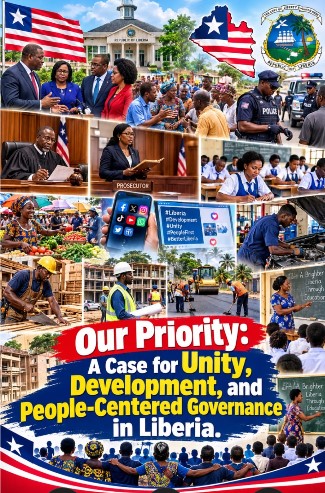
By Austin S. Fallah – A True Son of the Planet Earth Soil: fallahas@yahoo.com
https://www.facebook.com/share/v/18A4ewENRb/
https://www.facebook.com/share/v/1FJxQPZvFC/
“Liberia does not need politics that merely defeat opponents; it needs leadership that defeats poverty, division, corruption, exclusion, and underdevelopment. The true measure of political success is not who scored the greatest political point, but whether the Liberian people are healthier, better educated, more prosperous, more united, and more hopeful about their future.”
President Joseph Nyuma Boakai – Service to the Liberian people
President Boakai’s 2026 Annual Message provides a particularly direct statement for the people-centered governance portion of your theme:
“We are here to serve the Liberian people, not ourselves.” THE LIBERIAN INVESTIGATOR:
He immediately connects service with leadership:
“Service is the measure of leadership.”
Former President George Manneh Weah — National unity and nation-building
In his January 22, 2018 inaugural address, Weah stated: “It will be my task, my duty, and my honor, to lead this nation from division to National Unity, and toward a future of hope and prosperity.” UN Missions.
He also called on Liberians to put political and social differences aside:
“We should all strive to put aside our differences and join hands in the task of nation building.” UN Missions.
And he linked governance directly to ordinary people’s welfare: “The most effective way to directly impact the poor, and to narrow the gap between rich and poor, is to ensure that public resources do not end up in the pockets of Government officials.” UN Missions:
In 2022, Weah again described national unity and reconciliation as central to development:
“In Liberia, National Unity and Reconciliation is the cornerstone to all national development efforts.”
Former President Ellen Johnson Sirleaf — Putting Liberians first:
Former President Sirleaf’s 2012 inaugural address contains an unusually strong quotation for your people-centered governance argument:
“Putting people, especially young people, first and lifting the lives of all Liberians.” She also stated: “Liberia will not reach its potential unless each and every Liberian resolves to reach his own.” Liberian Embassy USA.
Her 2006 inaugural address similarly defined the mandate of government in terms of responsiveness to citizens: “We pledge to live up to your expectations of creating a government that is attentive and responsive to your needs, concerns, and the development and progress of our country.”
Dr. Edward B. Kesselly — Unity and an inclusive Liberia: “Every Liberian, regardless of tribe, group, or status, plays a vital role in advancing the country’s prosperity and unity.” Dr. Kesselly’s political legacy emphasized the proposition that every Liberian, regardless of tribe, group, or status, has a role in advancing Liberia’s prosperity and unity.
Dr. Amos C. Sawyer — Capable government that delivers for citizens: “If we build a capable state, it can administer to the people sufficiently that they will be happy, and the divisions will be minimized once the state is delivering.” -Analyst Liberia.
Dr. Togba-Nah Tipoteh -Development must be people-oriented: “Development is about people and should therefore be people-oriented.” -www.zif-berlin.org
He placed this within a broader framework that included:
“reconciliation, rule of law, good governance, food security, education, health care, sanitation, and employment.”
Dr. Henry Boimah Fahnbulleh- Governance must serve the people:
In a March 2024 interview concerning the new Boakai administration, Dr. Fahnbulleh gave a very direct formulation of people-centered leadership:
“Love the people, serve the people, respect the people, and be committed to their welfare.” Africa Press English.
The report says Fahnbulleh identified these qualities as attributes of good leadership, management, and governance.
Julius Nyerere — People-centered development
“If real development is to take place, the people have to be involved.” — Julius Nyerere.
Liberian application: Development cannot be measured only by government projects or political announcements; citizens must participate in—and benefit from—the nation’s progress.
Socrates — Apology
“The unexamined life is not worth living.” — Socrates, as recorded by Plato in Apology, 38a
Liberian application: A nation, like an individual, must continually examine its institutions, leadership, policies, failures, and aspirations if it is to progress.
African proverb — with an important attribution caveat
“If you want to go fast, go alone. If you want to go far, go together.” — Commonly attributed to an African proverb. The African attribution is disputed, and scholars have traced the modern formulation to earlier non-African sources.
Liberian application: Liberia’s long-term transformation requires cooperation across political parties, ethnic groups, generations, civil society, business, and government.
Martin Luther King Jr. — The Purpose of Education
“Intelligence plus character—that is the goal of true education.” — Martin Luther King Jr., The Purpose of Education.
Liberian application: Political leadership should be based not on market access or political skill, but on integrity, character, competence, and the abilito ty to serve the public faithfully.
Julius Nyerere — Tanzanian statesman: “Unity will not make us rich, but it can make it difficult for Africa and the African peoples to be disregarded and humiliated.”
— Julius Nyerere, Accra, Ghana, March 6, 1997.
Liberian application: Unity alone does not create prosperity, but unity gives a nation greater strength to pursue development and defend its interests.
Socrates — Apology:
“The unexamined life is not worth living.” — Socrates, as recorded by Plato in Apology, 38a.
Liberian application: A nation, like an individual, must continually examine its institutions, 21st-century policies, failures, and aspirations if it is to progress.
Marcus Aurelius —Meditations: “That which is not good for the geese cannot be good for the bee.” — Marcus Aurelius, Meditations, VI.54.
Liberian application: What harms Liberia collectively cannot ultimately benefit any individual Liberian. National interest must come before narrow political advantage.
Plato/Socrates — The Republic:
“Until philosophers are kings, or the kings and princes of this world have the spirit and power of philosophy, and political greatness and wisdom meet in one…” — Plato, Republic, Book VI.
Liberian application: Leadership requires wisdom, judgment, competence, and a commitment to the public interest, not simply political popularity.
Niccolò Machiavelli — Discourses on Livy
“The common good is what makes Cities great.” — Machiavelli, Discourses on Livy.
Liberian application: Political competition should ultimately serve the good, not merely the interests of parties, personalities, or facts.
Liberian politics should not be reduced to criticism, comparison, condescension, and the constant undermining of political opponents.
While democratic societies require debate, scrutiny, and accountability, Liberia’s political discourse too often becomes trapped in personal attacks and arguments over who started a project, or who deserves credit for a particular policy.
Sucha discussions may generate excitemean anti-corruptiononononononrallies, on radio talk shows, and across social media platforms, but they rarely improve the daily lives of ordinary Liberians.
The nation’s most urgent concerns are not political pride or party superiority.
They are about poverty, unemployment, education, health care, roads, electricity, sanitation, clean city streets, clean markets, clean water, food security, and the dignity of citizens who continue to struggle for survival.
Liberia must embrace a new political culture in which national unity, national development, and the welfare of the people become the central focus of public discourse.
Politicians, some of their foot soldiers, and some of their plenty good-for-nothing talking supporters should move beyond destructive comparisons and instead offer practical solutions to improve the country.
The question should not be whether one administration built a road before another administration repaired it, or whether a current leader is continuing a project a predecessor initiated.
The more important question is whether Liberians can travel safely, farmers can transport crops to markets, children can reach schools, and communities can participate in the national economy.
Liberia’s political leaders must recognize that public development is not a personal achievement; it is a public duty.
A more constructive political culture is especially important because Liberia has endured a difficult national history.
The country has experienced political instability, civil conflict, economic hardship, public health crises-Ebola, and institutional weakness.
These experiences have left deep social and economic scars.
Many families remain vulnerable to poverty.
Young people often graduate from high schools or universities without meaningful employment opportunities.
Rural communities continue to face limited access to roads, hospitals, modern schools, electricity, and communication services.
In this context, political leaders have a moral obligation to discuss policies that will address these realities.
A nation confronting such profound challenges cannot afford to waste its political energy on petty quarrels and endless blame.
Criticism itself is not the enemy of democracy. In fact, responsible criticism is essential for good governance.
Citizens have the right to question government decisions, demand transparency, expose corruption, and challenge policies that fail to serve the public interest.
Responsible opposition parties also have a legitimate responsibility to hold the government accountable.
However, criticism becomes harmful when it is driven primarily by hatred, tribalism, personality conflicts, misinformation, or the desire to make the country appear to fail simply because a political opponent is in office.
Constructive criticism differs sharply from destructive opposition.
Constructive criticism identifies a problem, explains why it matters, and proposes a better alternative.
Destructive criticism simply attacks, ridicules, and celebrates failure.
Liberian politicians should therefore understand that national unity does not mean silence or blind support for those in power. Unity means placing Liberia above personal ambition, party loyalty, and short-term political gain.
It means recognizing that political competitors are not enemies of the nation.
They are fellow citizens with different ideas about how the country should be governed.
In a mature democracy, political parties should compete over policies, not insults.
They should debate how to expand agricultural production, improve schools, attract investment, reduce corruption, strengthen the justice system, and create jobs.
The winner of an election should govern for the entire country, while those who lose should continue to serve the country through principled opposition and policy advocacy.
Unfortunately, political foot soldiers and plenty of good-for-nothing talking supporters often make the problem worse.
In many cases, some supporters treat politics as a battlefield where defending a political leader is more important than defending the truth.
They may insult people on social media, spread unverified information, attack critics, and turn every national issue into a partisan conflict.
A broken bridge, the arrest of drug cartels, drug traffickers, a delayed salary, when police enforce the law, when judges apply the law, when prosecutors prosecute violators of the nation’s jurisprudence, a medicine shortage, or a failed school system can quickly become an excuse for political propaganda rather than a reason for national problem-solving.
This behavior weakens public debate and divides citizens who share the same struggles.
Whether one supports the ruling party, an opposition party, or an independent candidate, the reality remains the same: ordinary Liberians need jobs, affordable food, quality education, reliable health care, and safe communities.
The welfare of the Liberian people should be the foundation of political leadership.
A government should be judged not by the strength of its public relations campaign but by measurable improvements in the lives of citizens.
Are more children attending school?
Are schools providing qualified teachers, learning materials, and safe classrooms?
Are health centers equipped with trained personnel, medicines, and emergency services?
Are young people gaining access to skills training, apprenticeships, and employment?
Are farmers receiving support to increase food production?
Are paved roads connecting rural communities to markets and hospitals?
Are public funds being used transparently?
These questions should guide political debate.
One of the most urgent national priorities is liberating the masses from abject poverty.
Poverty is not merely the absence of money. It is the lack of opportunity, security, education, health, and hope.
A low-income family may be unable to afford school fees, transportation, medicine, nutritious food, or decent housing.
A young person without employment may become vulnerable to crime, drug abuse, and exploitation by the drugs cartels, or political manipulation.
A rural farmer without roads, tools, storage facilities, or access to credit may remain trapped in subsistence agriculture, even while willing to work.
Poverty weakens democracy because citizens who are desperate for survival can be easily manipulated by politicians who offer temporary handouts instead of long-term solutions.
Liberia needs development policies that create sustainable pathways out of poverty.
This requires investment in agriculture, small businesses, vocational training, infrastructure, and local industry.
Agriculture should be treated as a major engine of national development, not an afterthought.
Liberia has fertile land, abundant rainfall, and a large population of hardworking farmers.
Yet too many agricultural communities lack access to modern tools, improved seeds, storage facilities, extension services, markets, and financing.
Government policies should support farmers not only with promises but with practical systems that enable them to increase production and earn a stable income.
A country that imports large amounts of food whilehavingg the capacity to grow more of its own must confront weaknesses in its agricultural policy.
At the same time, Liberia must support entrepreneurship and small and medium-sized businesses.
Many young Liberians have ideas, skills, and energy, but they lack capital, mentorship, access to markets, and a stable business environment.
Public policy should be shifted make it easier for citizens to register businesses, access affordable loans, obtain training, and participate in government procurement opportunities.
Rather than using public resources primarily to reward political loyalists, leaders should establish transparent systems that allow qualified Liberians to compete fairly.
Economic opportunity must not depend on political connections.
When citizens can build businesses and earn dignified livelihoods, they become less dependent on politicians and better able to contribute to national development.
Education is another area where Liberia must adopt serious 21-century thinking.
The nation’s future depends heavily on the quality of education provided to its children and youth.
In today’s global economy, young people must be prepared not only to read and write but also to think critically, become innovators, solve problems, use technology, communicate effectively, and adapt to changing labor markets.
Liberia cannot prepare its youth for international competition through outdated curricula, overcrowded classrooms, poorly supported teachers, and limited access to digital tools.
The country must invest in education as a national security issue and an economic development strategy.
A modern education agenda should include early childhood education, teacher training, science and mathematics instruction, technical and vocational education, digital literacy, and stronger partnerships between schools and employers.
while not every student can afford to attend a traditional university, but every young person should have access to a meaningful path toward acquiring education and a productive future.
Technical schools should train electricians, mechanics, plumbers, agricultural technicians, construction workers, information technology specialists, health assistants, and entrepreneurs.
Universities should be supported to produce graduates who can conduct research, manage institutions, develop technologies, be able to intellectual compete internationally, speak diplomatically, and lead public and private organizations with high level of professionalism and a corruption fee mindset
Education should not simply produce certificate holders; it should produce competent, ethical, innovative, and competitive citizens.
The political debate surrounding education should therefore focus on outcomes, not plenty good for-nothing spewing propaganda through their 32.
It is not enough for one politician to claim that their administration built a school, while another insists that the land for the school was acquired years earlier.
The real issue is whether the school is functioning effectively.
Does it have trained teachers?
Do students have textbooks?
Are girls safe from harassment?
Are students learning the skills required for further education and employment?
Is the school accessible to children from poor and rural families?
These are the questions that reflect genuine concern for the people.
Liberia also needs public policies that meet the social and economic demands of the 21-century.
This includes policies on technology, energy, climate resilience, public health, strong national security, sever punishment for drugs cartels and trafficking, urban planning, financial inclusion, environmental protection, and accountable governance.
Digital technology, for example, offers opportunities for education, banking, entrepreneurship, public administration, and communication.
Yet many Liberians remain excluded from the digital economy because of limited internet access, high data costs, lack of electricity, and inadequate digital skills.
A forward-thinking government should treat digital infrastructure as essential infrastructure, just as important as roads and bridges.
Similarly, reliable electricity is necessary for industrial growth, hospitals, schools, businesses, and household welfare.
Without stable power, local businesses face high operating costs, students struggle to study, and health facilities cannot reliably preserve medicines or operate medical equipment.
Political leaders should stop treating energy projects as symbols of partisan victory and begin treating them as urgent national necessities.
Every administration should build on the progress of the one before it. If a project was initiated by a previous government and completed by a current government, the credit belongs ultimately to the Liberian people, whose resources and hopes made the project necessary.
The same principle applies to roads, ports, schools, hospitals, water systems, and public institutions.
Development should not be personalized.
No leader should behave as though a road belongs to a political party, or as though public money is a private gift to citizens.
Elected officials are custodians of public trust.
They manage national resources temporarily, but those resources belong to the people.
When politicians compete for personal credit, they often neglect the more important task of maintaining, expanding, and improving public services.
Liberia needs continuity in governance and development planning.
A new administration should not abandon beneficial projects merely because they were associated with a previous administration.
Doing so wastes public funds and delays national progress.
A people-centered political culture also requires stronger institutions.
Liberia cannot depend solely on the good intentions of individual leaders.
The country needs institutions that function regardless of who is in power.
Anti-corruption bodies, courts, election commission, civil service agency, local governments, and public auditing systems must be strengthened.
Transparency in public spending should be normal, not exceptional.
Citizens should be able to know how national resources are collected, allocated, and used.
When public institutions are accountable, political debates become more factual and less emotional.
Leaders can be evaluated based on evidence rather than rumors and slogans.
Moreover, national unity must include all regions, ethnic groups, religions, genders, and generations.
Liberia’s diversity should be a source of strength, not political division.
Politicians who exploit ethnic or regional identities for electoral advantage may gain temporary support, but they damage the national fabric.
Every Liberian should feel that the government belongs to them, whether they live in Monrovia or in a remote rural community, whether they supported the winning candidate or not.
Inclusive governance means distributing development fairly, appointing qualified people from diverse backgrounds, listening to local communities, and ensuring that no group feels abandoned or marginalized.
The Liberian people deserve more than political noise.
They deserve leaders who can explain how they will reduce poverty, improve education, create jobs, modernize agriculture, provide health care, expand infrastructure, and protect public resources.
They deserve political parties that publish clear policy platforms and are willing to be judged by results.
They deserve foot soldiers who promote peace and facts rather than insults and division.
Most importantly, they deserve a political system that recognizes their humanity and responds to their daily struggles.
Liberian politics should be about national unity, national development, and the welfare of the people, not endless criticism, comparisons, condescension, and undermining.
Accountability must remain a vital part of democracy, but it should be constructive, evidence-based, and directed toward better solutions.
The country’s leaders must stop asking who deserves credit and start asking whether the people are benefiting.
Liberia’s future will not be secured by political quarrels over the past.
It will be secured by bold policies, responsible leadership, educated youth, productive citizens, strong institutions, and a shared commitment to move the nation forward.
The time has come for Liberian politicians to replace petty political competition with purposeful national service.